


Blue Whale Unit Study
Studying ocean life, mammals, or endangered species? Use this information to put together a blue whale unit study to complement them all. You might want to use these free animal report printables to get started.
Imagine a creature that can grow over 100 feet long, weigh up to 150 tons or over 300,000 pounds.
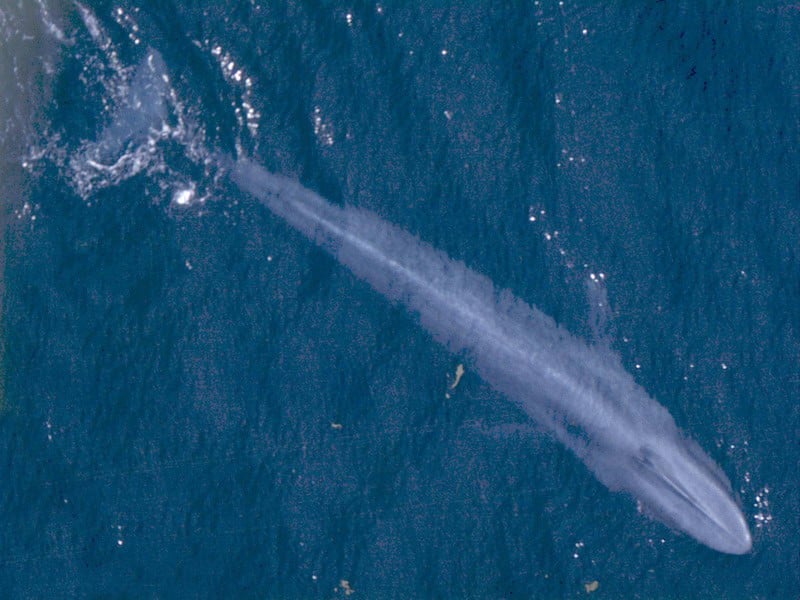
Blue Whale

Volkswagen Beetle
Blue whales have a heart the size of a Volkswagen Beetle. Sounds like something of myths and legends, doesn’t it? Or maybe something prehistoric?
This creature actually exists on Earth right now. The blue whale (Balaenoptera musculus) is the largest animal on Earth. Actually, blue whales are the largest animal to have ever lived. These huge creatures are distributed throughout the world’s oceans. However, even with this large expanse of habitat, the blue whale population is very low and they are considered an endangered species.
Let’s learn more about the blue whale and why their endangered status is a concern.
Blue Whale Facts
How big are blue whales?
Blue whales found in the northern areas of the Atlantic Ocean and Pacific Ocean can weigh up to 100,000 pounds. However, Blue whales found around Antarctica weigh more. Whales located in this very cold climate can weigh up to 330,000 pounds.
A blue whale’s heart can be up to 5 feet tall and weigh up to 400 pounds.
Where are blue whales found?
As stated before, blue whales are found throughout the world’s oceans; they are even found in the Antarctic. In the summer months, they migrate toward the poles to feed and then migrate toward the equator to breed. Blue whales tend to stay in deeper water and avoid coastal areas.
What do blue whales eat?
You might think that the largest animal in the world would be a fierce predator feeding on whatever gets in its way. The truth is blue whales actually have a pretty basic diet of some of the smallest animals in the ocean.
Krill are mainstay of the blue whale diet. These small crustaceans are on average only about 2 inches long. Blue whales filter krill out of large gulps of water at the rate of 8000 tons per day of krill. That’s about 40 million krill!
Blue whales have a unique way of feeding. Instead of teeth, they have baleen plates in their mouths. Baleen is made of keratin, the same material found in human hair and nails. These plates act like a filter, allowing blue whales to trap krill while expelling water.
Baleen looks like a comb hanging from a blue whale’s upper jaw. It is made of hundreds of overlapping plates that form a sort of sieve or strainer.

Baleen. Photo in the public domain courtesy of NOAA.
When a blue whale opens its mouth and takes in a mouthful filled with krill, it closes its mouth and pushes the water out through the baleen. The krill get trapped inside the baleen, allowing the blue whale to swallow its food while filtering out the water.

Think of how spaghetti that is cooked in water is dumped into a strainer, so the water is filtered out and the spaghetti is left for us to eat. The strainer is our baleen to catch the spaghetti!
What is the blue whale’s life cycle?
Since blue whales are mammals, they give birth to live young one at a time every 2 to 3 years. Newborn blue whales are huge in their own right. They can be up to 25 feet long and weigh up to 3 tons. During the first 8-12 months of life, a baby blue whale will eat nothing but mother’s milk and gain 200 pounds a day.
When a baby blue whale can hunt krill on its own, it is weaned and can then make the migration with the adults usually traveling in groups of 2 or 3. Blue whales can live on average 80-90 years.
Do blue whales make noise?
Blue whales are among the loudest animals on the planet. A jet engine reaches levels of 140 decibels. The blue whale crushes that with an impressive 188 decibels! Blue whale sounds can be heard up to 1000 miles away.
However, the blue whale noises are at such a low frequency, human cannot hear them. When scientists using recording equipment, they can pick up the sounds. Click HERE to listen to blue whale sounds.
Related Post: Ocean Animals Unit Study or download our free shark printable pack.
Blue Whale Populations
Blue whales are considered endangered animals. Even though their habitat spans all the Earth’s oceans, there are an estimated 5-10,000 blue whales in the Southern Hemisphere, and only around 3-4,000 in the Northern Hemisphere. However, we had a hard time finding current statistics. The NOAA site does not list a number, and we were unable to find an exact number. The International Whaling Commission discusses the data on whales and how difficult it is to obtain on this page. Think about it, whales are constantly on the move and they stay in deep water.
In 1900, a demand for whale oil and whale baleen drove the whaling industry to hunt and kill blue whales by the thousands. Prior to 1900, there was estimated to be 350,000 blue whales. Up to 99% of all Blue Whales were killed by whaling before the International Whaling Commission banned commercial whaling for blue whales in 1966.
Since then, recovery for the blue whale has been slow. New threats to the blue whale have emerged, such as water pollution, habitat destruction, over fishing of krill, and collisions with boats.
Impact Of Blue Whales On The Environment
Nature is a delicate balance with each species in an ecosystem having a very special role. If one species is removed or its populations thrown out of balance (either an profound increase or decrease), all other organisms will be affected. Most of the time, these effects are not good.
Blue whales are at the top of the oceans’ food chain. They eat huge amounts of krill each day. If the blue whales disappear, this could cause an increase in the number of krill in the ocean. This overpopulation would mean more competition for the same food supply. This could lead to a drop in the populations of other species.
Whale poop is even important to the oceans’ food chain. Phytoplankton need the nutrients in whale poop to thrive. Phytoplankton are an important food source for lots of marine life, such as krill. Phytoplankton, also, plays an important role in removing carbon from our atmosphere – up to 400,000 tons per year.
Blue Whale Unit Study Links
How Does Ocean Noise Affect Whales Info & Activity – from NOAA
How Big Is A Blue Whale Outdoor Science Activity
Awesome video of blue whales underwater
Other Endangered Species
Join me for a 5 day series of endangered species you should know about.

I hold a master’s degree in child development and early education and am working on a post-baccalaureate in biology. I spent 15 years working for a biotechnology company developing IT systems in DNA testing laboratories across the US. I taught K4 in a private school, homeschooled my children, and have taught on the mission field in southern Asia. For 4 years, I served on our state’s FIRST Lego League tournament Board and served as the Judging Director. I own thehomeschoolscientist and also write a regular science column for Homeschooling Today Magazine. You’ll also find my writings on the CTCMath blog. Through this site, I have authored over 50 math and science resources.