


Alexander Calder Art Activity


Alexander Calder was an artist who used metal wire to create sculptures and mobiles. Calder referred to his wire sculptures as “3D line drawings.”
Let’s look at how science and art blend through the creations of Alexander Calder. We have created a free downloadable lesson that includes his biography, his works, how kinetic energy is related to his mobiles, and several hands-on science and art activities for students of all ages.
Born in 1898 in Pennsylvania, Alexander Calder came from a family of artists. His father and grandfather were both sculptors, and his mother was a painter.
During his childhood, he spent time creating and working with his hands. Wherever the Calder family lived, Alexander had his own workshop to explore his ideas and create.
When Calder attended college, he had plans to become an engineer and attended the Stevens Institute of Technology to study mechanical engineering. After graduation, he realized his true calling was art.
He then enrolled at the Art Students League in New York City, where he worked on his drawing and painting skills.
After college, he worked as an illustrator for the National Police Gazette. The job took him to the circus, where he traveled with the circus and illustrated circus scenes for the magazine for two weeks.
His fascination with the circus continued after his trip for the National Police Gazette ended. Calder moved to Paris. While there, he created a miniature circus from wire, leather, cloth, and other materials. Calder displayed the circus for people in Paris and New York. The wire circus was a huge success!
This piece is called Cirque Calder. Cirque is French for circus. The circus is now on display at the Whitney Museum of Art in New York City. You can view pieces from the circus on the museum’s website.
Below is a video of Alexander Calder performing his “Circus”. The video is courtesy the Whitney Museum of American Art.
Next, Calder created wire sculptures of his friends.
Here are some of his wire sculptures on Calder.org:
His most famous works include the “Mobiles” and “Stabiles.” The term “Mobiles” refers to Calder’s kinetic sculptures that move with the slightest breeze. His “Stabiles” are stationary sculptures that were often in abstract shapes.
Calder’s mobiles were inspired by the laws of physics and used balance and counterbalance. By studying how different shapes and weights interacted with each other, Calder created mobiles that seemed to defy gravity. His first mobiles were motorized, but then he moved away from using motors and designed his mobiles to be powered by air currents.

Snow Flurry by Alexander Calder. It was gifted to the The Museum of Modern Art in New York; by Alexander Calder.CC BY 2.0Snow Flurry. (2023, November 2). In Wikipedia.https://en.wikipedia.org/wiki/Snow_Flurry_(design). Ángel Raúl Ravelo Rodríguez from Caracas, Venezuela – rafaga de nieve

Red Mobile, 1956, Painted sheet metal and metal rods, a signature work by Calder – Montreal Museum of Fine Arts. Alexander Calder. (2024, June 2). In Wikipedia. https://en.wikipedia.org/wiki/Alexander_Calder
In addition to his mobiles, Calder also created large-scale outdoor sculptures called stabiles. These very large pieces were often painted in bright colors and could be found in public spaces worldwide. Calder used basic shapes and bold colors.

Dragon II II, by Alexander Calder, 1969. Shirakawa Park, Nagoya. Credit: Depositphotos, editorial use only
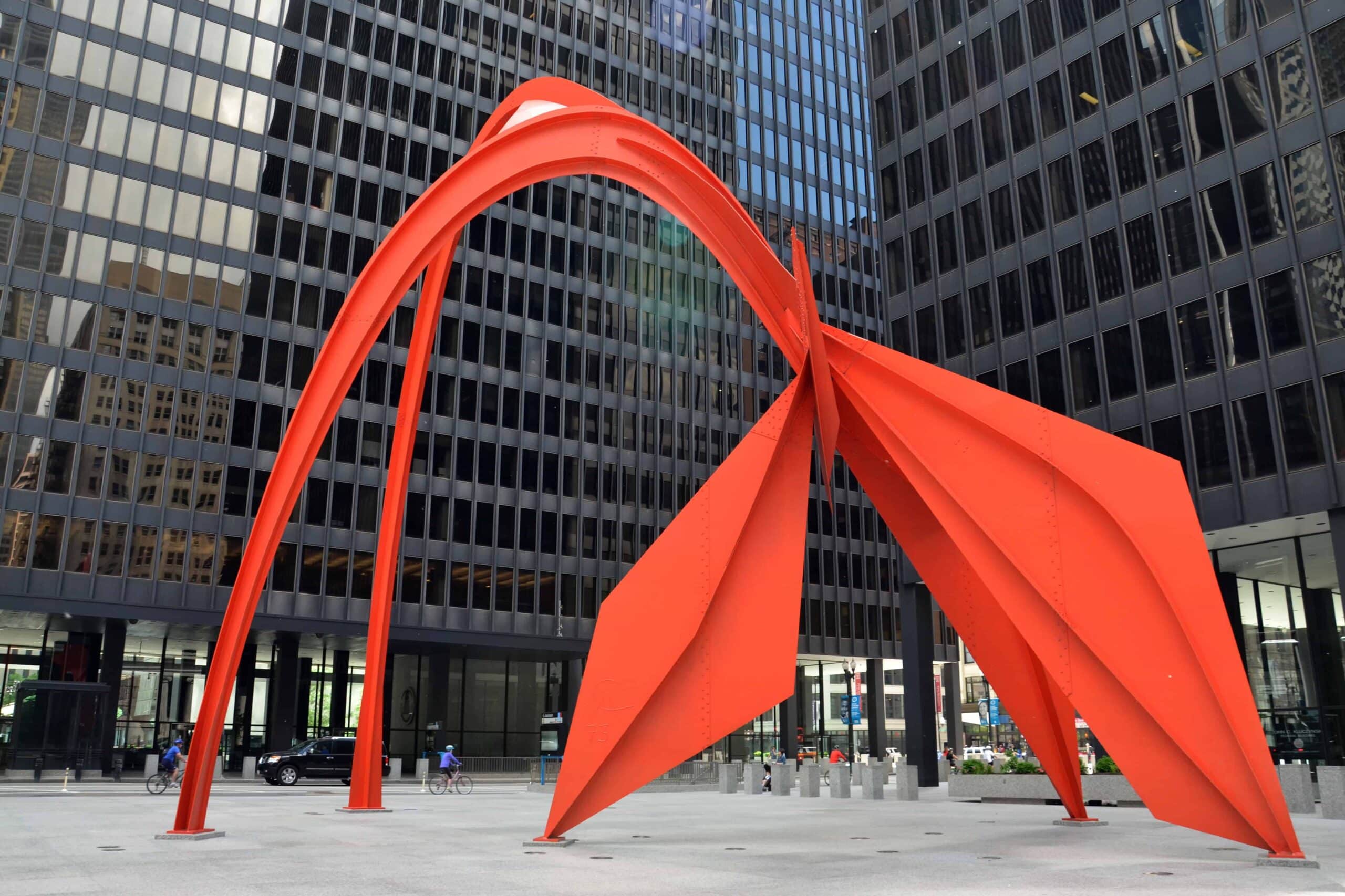
Flamingo by Alexander Calder Federal Plaza, Chicago. Photo credit: smontgom65 via Depositphotos. For editorial use only.
View Alexander Calder’s Work at the Whitney Museum of Art
Teach your children more about mobiles, kinetic energy, and the art of Alexander Calder by requesting our free lesson and activities.
To receive the free printable pack, input your email below. You will be added to our email community and will be the first to know about new resources.
Mobiles and Kinetic Energy
Kinetic energy is the energy that something has because it’s moving. When something is moving, it can do things and change what’s around it. In a mobile, kinetic energy is very important because it helps make the artwork look alive and full of movement.
Kinetic energy is present in a mobile sculpture through its constant motion and changing positions. As the mobile reacts to things like air currents or people touching it, the parts sway, spin, and turn, moving kinetic energy from one part of the sculpture to another.
The amount of kinetic energy an object has depends on its speed and mass. The faster and heavier an object, the more kinetic energy it has.
Here are some examples of kinetic energy in everyday life:
A ball rolling across the floor has kinetic energy. The energy comes from its motion. Think of a heavy bowling ball rolling down the bowling alley.
Now, what would happen if you rolled a tennis ball down the same bowling alley?
Which do you think has more kinetic energy?
Which ball would be able to knock over more bowling pins?

Another example of kinetic energy is a pendulum, like the one on a grandfather clock or a playground swing. When you pull the pendulum back and let it go, it starts to swing back and forth. As it swings, it has kinetic energy because it is in motion. The higher the pendulum swings, the more potential energy it has, which then converts to kinetic energy as it moves back and forth.
If you have ever been on a swing, you discovered that the faster you pumped your legs back and forth, the faster and higher you went, which means you had more kinetic energy!

Make a salt pendulum by following the simple directions on this post.


Create Art Like Alexander Calder
In this STEAM activity, you will design and create a wire sculpture.
After reviewing Alexander Calder’s works using the links provided in our free printable lesson, think of a design you can create using wire and other materials you have on hand. Make an illustration of your sculpture.
Then, gather materials such as floral wire, floral foam or Styrofoam, paper, posterboard, and other materials you have on hand. Other ideas for materials to use: yarn, pom poms, scraps of wallpaper, string, twist-ties, scraps of wrapping paper, fabric scraps.
Below are sculptures our group created. Use your imagination and have fun!


Create a Wire Sculpture
What you’ll need:
- Something to use as a base, such as floral foam or Styrofoam
- Sticks of floral wire
- Scraps of construction paper, wall paper, scrapbooking paper, gift wrap – whatver you have on hand
- Optional other craft items: poster board, pom-poms, scraps of fabric or ribbon, chenille sticks.
- Scissors
- Wire cutters for the floral wire
Directions:
- Sketch what you want to create. You can skip this step and just start creating!
- Start building your creation by placing the floral wire into the base.
- To make longer pieces of wire, twist pieces together
- Use scraps of colored paper or scrapbooking paper to add color to your creation.
- Try different ways to attach the decorations to the wire. You can use tape, wrap wire around the deocrations, or push the wire through the paper.
- Keep adding to your stabile unil you’re done!
Below we have shared some of the photos from our group project.


Other Resources

I hold a master’s degree in child development and early education and am working on a post-baccalaureate in biology. I spent 15 years working for a biotechnology company developing IT systems in DNA testing laboratories across the US. I taught K4 in a private school, homeschooled my children, and have taught on the mission field in southern Asia. For 4 years, I served on our state’s FIRST Lego League tournament Board and served as the Judging Director. I own thehomeschoolscientist and also write a regular science column for Homeschooling Today Magazine. You’ll also find my writings on the CTCMath blog. Through this site, I have authored over 50 math and science resources.