


Bakken Books Space Bound Series Review
My home is full of space lovers. My husband grew up near Cape Canaveral, where his dad worked at Kennedy Space Center. I help write a space-themed curriculum for a NASA Astro Camp, and I also teach Astro Camp for kids K-2 every summer. My 9-year-old, homeschooled daughter is a sponge for space facts and has had “astronaut” towards the top of her career list since she was 5. We watch launches, and we go outside when the ISS flies by. We all love a good sci-fi story. We’re basically just a house full of “space nerds.”
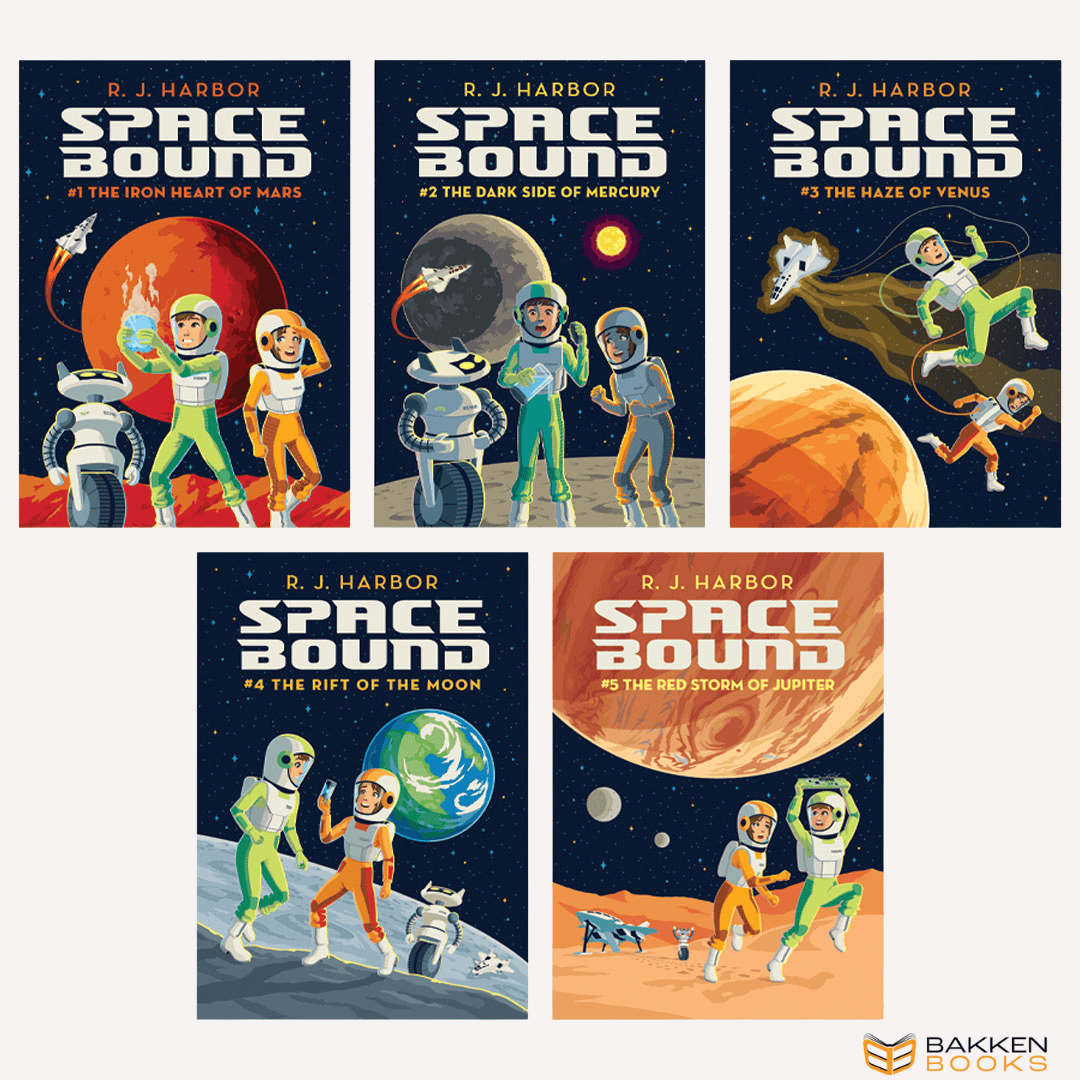
Given our family’s deep love of space, I was thrilled to receive the opportunity to review Bakken Books Space Bound Series Review, books 1-5 of the by R. J. Harbor. For the review, my daughter and I read the first book together and the rest of the series separately, discussing them after we finished each book. As I share about the series, I’ll provide some of my insights as a homeschooling parent/educator, combined with hers as a space-loving kiddo right in the target audience range! I did receive compensation for this review and the information shared are our my and my daughter’s opinions, unedited by Bakken Books.
I was also eager to do the review because I have been impressed in the past by Bakken Books, the small, independent publishing company behind the Space Bound series. I previously explored this publisher’s mission while reviewing The Math Inspectors Series (which, by the way, is an excellent educational fiction series for upper middle-grade readers!)
Bakken Books is unique because they are dedicated to creating educational, wholesome, enjoyable content for kids. I especially appreciate that much of their content focuses on children in the middle (8-12) reader level.
I’ve observed that there seems to be a big gap when it comes to wholesome, educational content that kids in this particular age range will enjoy. As a homeschooling parent, I am grateful for Bakken Books standing in this gap and putting out fun and educational material that can be used in conjunction with schoolwork…or just for pure enjoyment! I am always happy to explore their curated content and tell others about their mission. In this review, I’ll explore:
- The Basics about the Space Bound Series: Plot, Structure, Themes, Characters, and Reading Level
- More About Each Book
- Educational Value and Applications in a Homeschool Setting
- Thoughts from a 9-Year-Old: My Daughter’s Commentary
Space Bound by R. J. Harbor: Basic Plot, Structure and Themes, Characters, and Reading Level
Basic Series and Plot
Basic Series and Plot
To start, let’s discuss the basic plot and intended audience of the Space Bound series by R.J. Harbor. The books follow a brother and sister duo, Monty and Ivory, who discover a sentient spaceship named Nova. Together with their loveable bot, Echo, they board Nova and begin their mission to explore our solar system.
On their first mission, they go to Mars and discover that Marty’s presumed-dead hero, astronaut Ryker Jackson, has lived there for years. Jackson asks the two children to use Nova to take more missions into space to collect nine items for a super fuel he is creating.
Each of the 5 books (discussed individually below) tackles one of the children’s missions to space to retrieve one of those items. The books constantly tie in educational insights, not just for space-related facts, but for other STEM learning such as robotics and physics. One book even contains a little bit of history!
Structure and Themes
The premise of visiting a different planet in our solar system to collect a special item provides an overarching structure for each book in the series. Because of this, children reading it will know what to expect to some degree. I think this is a great structural strategy for a middle reader series. As kids become comfortable with the format of each book, they grow more confident in their ability to devour each new book in the series independently.
However, each book offers diverse themes that fit within the middle-grade age range, too. Each story tackles sibling relationships and other themes of childhood and growing up, such as how to deal with a bully or how to face your fears. The continuous exploration of the roles of robots and AI, in relationship to humans, was also really interesting (and an important topic for kids today.)
The chapters are short and easy to read, and each book is a little over 100 pages. My 9-year-old got really into this series and read about one book per day!
Main Characters
The four main characters in this story are Monty, Ivory, Nova, and Echo. Monty is 12, and Ivory turns 10 in the first book, which puts them towards the top of the suggested age range for this series. This is a good thing, as research indicates that children prefer to read about characters who are just a little bit older than themselves.
Monty is the leader and narrator of the story. He loves science and robotics. He built Echo, and he built Bot Bot in Book 3.
Monty is serious, thoughtful, and protective of his bots and sister. Ivory, by contrast, is carefree, messy, very girly, and sometimes gets on Monty’s nerves. She was my daughter’s favorite character! Though the two don’t always get along, it is evident that they love one another and would do anything to protect each other.
Monty and Ivory challenge each other to grow throughout the series. For example, Monty encourages Ivory to work on her temper, and Ivory challenges Monty to face his fears. They are also often portrayed playing outside together and enjoying learning new things. These are wholesome elements that are nice to see in contemporary, mid-grade fiction.
The ship, Nova, possesses sophisticated AI and is also a character in the story. She and Echo, Monty’s quirky bot, have a sweet, interesting friendship tinged in romance. It reminded my daughter and me a little of the relationship between Wall-E and Eve from Pixar’s Wall-E. Their connection is what helps Nova function correctly. The two robots are also a main source of humor throughout the series. They made both my daughter and I laugh aloud several times.
Other noteworthy characters include:
- Bot Bot, Ivory’s girly bot that Monty builds for her
- Ryker Jackson, Monty’s hero remains slightly mysterious
- Mac, a bully in book #4
- Monty and Ivory’s mom is a background character who is perceived in a positive way
Reading Level and Target Audience
This series is suggested for ages 7-12. After reading these books and watching my daughter read them, I’d most likely suggest the series for kids between 8 and 10.
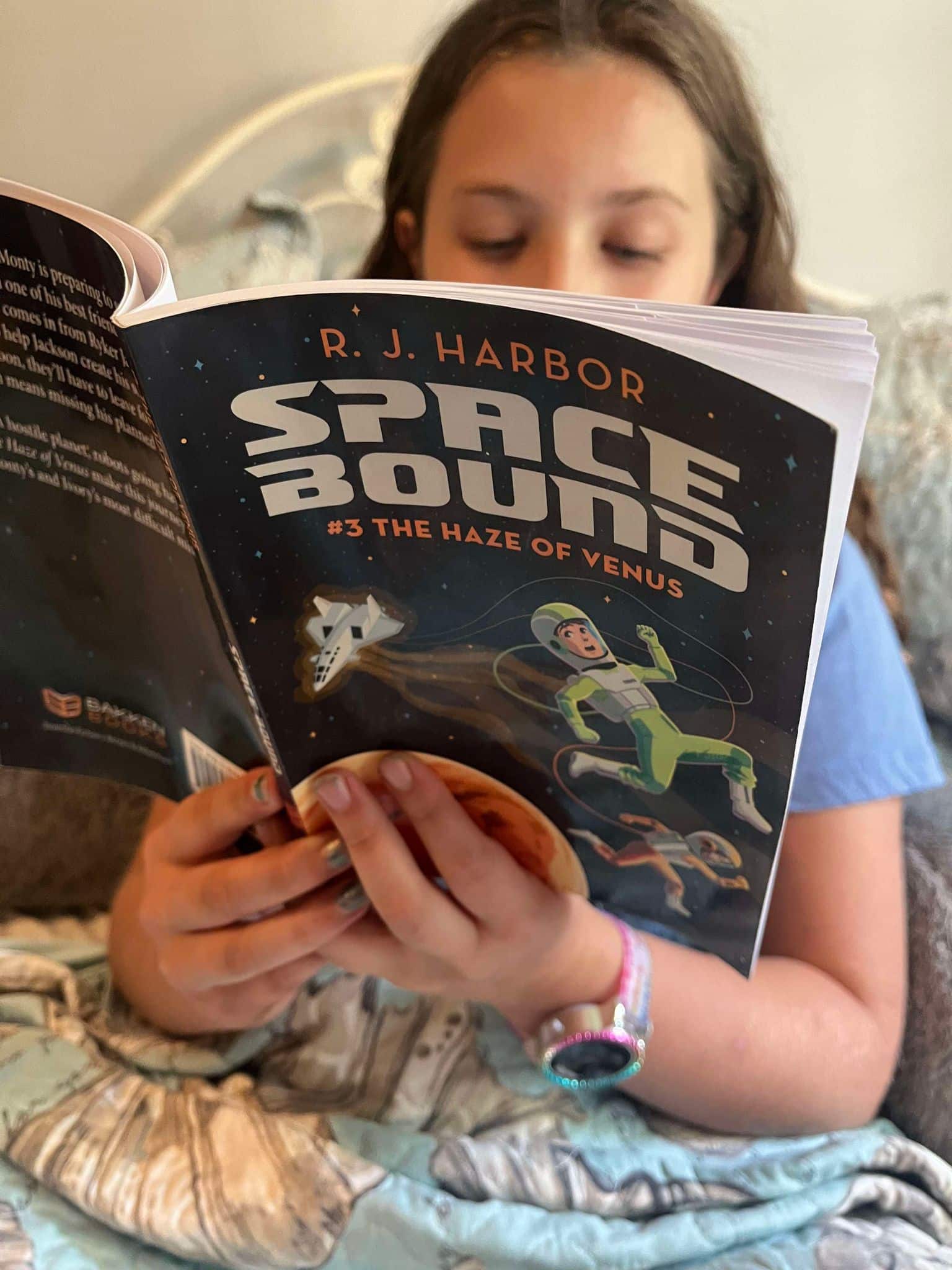
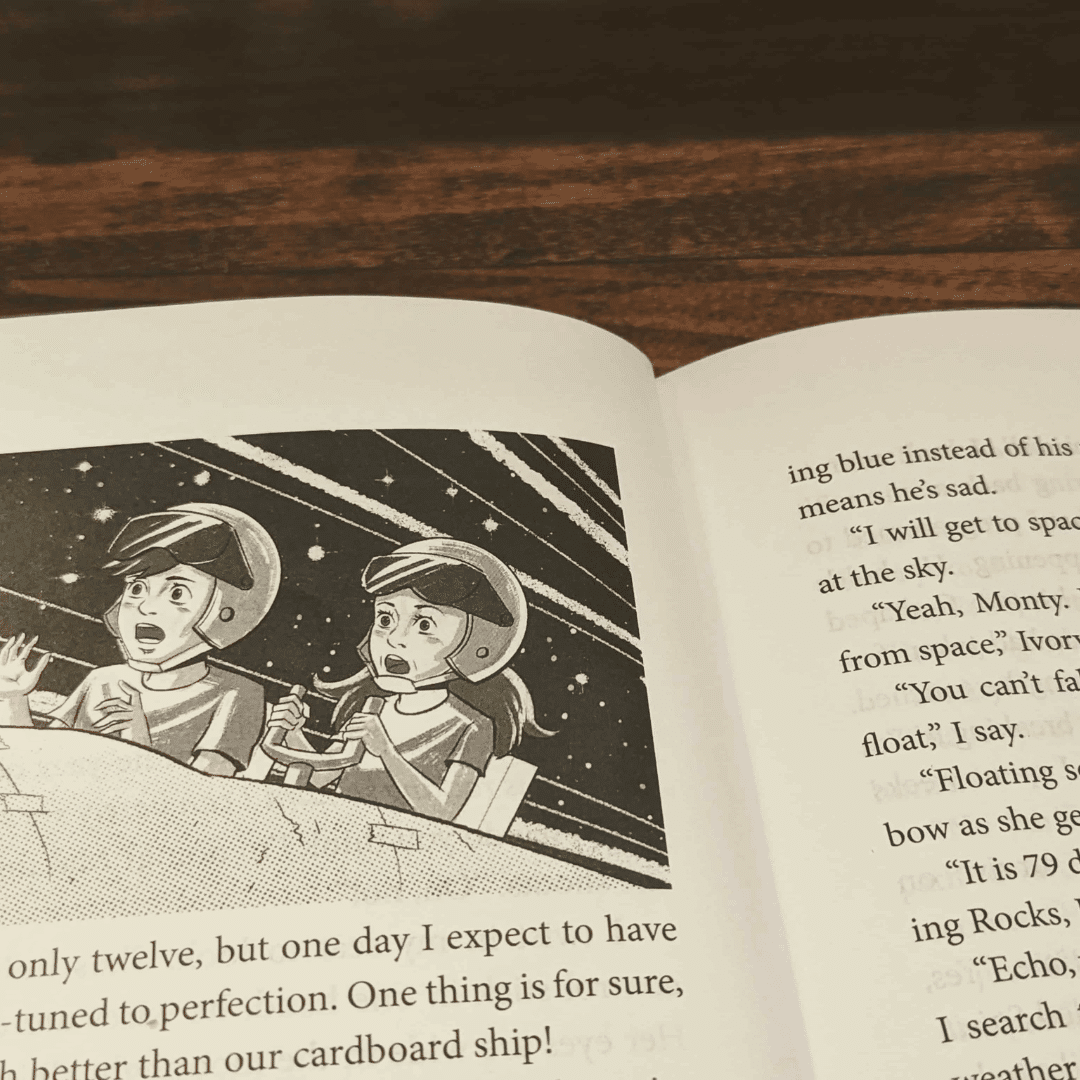
As I mentioned earlier, the books are quick reads. They use short chapters and sentences alongside simple language. The books also include frequent, high-quality illustrations, which my daughter still enjoys seeing at age 9.
However, the characters and themes are more complex and engaging for older children than a series like The Magic Treehouse (which has a similar structure and premise but is geared toward slightly younger readers.) In fact, if your kids like or liked The Magic Treehouse series, these books are the perfect step up from those! The fact that the series features a brother and sister makes it equally accessible to boys and girls.
Individual Book Summaries
If you’re curious about more specific details on each book in the series, I’ve summarized them below, alongside some of the educational content found in each one. Based on the last book’s ending and the fact that there are more planets in our solar system to explore, I would expect more books to follow the first five.
Book Summaries:
Book 1: The Iron Heart of Mars
In the first book, Monty, Ivory, and Echo find a spaceship named Nova, and before they know it, they’re whisked off to Mars. On Mars, they meet Monty’s astronaut hero, Ryker Jackson, journey to Olympus Mons, and discover their space adventures are just beginning.
Some educational snippets include the highest mountain in our solar system, the purpose of rovers on Mars, and the connection between olfactory senses and taste processes.

Book 2: The Dark Side of Mercury
In the second book, the trio travels to Mercury to collect Terlin for Ryker Jackson’s super fuel. This story emphasizes problem-solving and teamwork as they face challenges like a broken navigation system.
The book introduces the value of human creativity in problem-solving and contrasts it with AI technology. Readers will also learn more about Mercury’s extreme temperatures and graphite surface.
Book 3: The Haze of Venus
In this adventure, Monty, Ivory, and Echo travel to Venus to obtain Solar Neon. The book focuses on the importance of robots in space and explores how bots can perform tasks that are too dangerous for humans.
The sibling dynamic in this story deepens as Monty designs a robot (Bot Bot) as a gift for Ivory. Educational content includes coding, robotics, circuits, and learning more about Venus’ hot, gaseous surface.
Book 4: The Rift of the Moon
This book introduces the concept of space-time connection as Monty, Ivory, and Echo accidentally discover a wormhole on the Moon that sends them to different times whenever they try to return to Earth. They also deal with Monty’s school bully, Mac, who hitches a ride on Nova.
The book presents Moon facts, time travel, and various historical periods on Earth alongside themes of emotional growth as Monty learns to treat his bully with kindness.
Book 5: The Red Storm of Jupiter
Monty, Ivory, Echo, Nova, and Bot Bot set out to Jupiter, the solar system’s gas giant, to recover some liquid metallic hydrogen. On the way, Monty faces his fear that he may not be very brave without his bots. When the ship encounters a mysterious space vessel, Monty must use his critical thinking skills and robotics know-how to save his sister and bots.
The final book ends on a cliffhanger, leaving several questions unanswered and suggesting that the Space Bound series may have more books.
Educational Value & Using The Space Bound Series in Your Homeschool
The series introduces kids to advanced concepts such as planetary geology, space-time connections, magnetism, robotics, coding, and more. However, it doesn’t seem too complicated because everything is introduced in terms of story and characters. Furthermore, the characters in the story present science and discovery as fun, which offers a good role model for young learners.

Parents will appreciate the balance between entertainment and education in this series. The books are structured with short chapters often ending on cliffhangers, which helps middle-grade readers to be successful and feel motivated. The series also provides an excellent foundation for discussing more complex topics, both scientific and emotional, with young readers. The presentation of positive sibling and family dynamics is another strong point!
Note: One thing to watch out for, and discuss with your children, is the difference between science fiction and scientific fact. These stories incorporate a mixture of both. The books offer a great way for children to learn more about space and science, but they also incorporate elements of fantasy and a suspension of disbelief. For example, Monty and Ivory discover things like a mysterious goo that smooths out everything it touches and encounter a cloud of sulfuric acid that reacts to magnetism and therefore “dances” to the Beatles’ classic, “Come Together.” These elements make the stories more interesting to children, but they should also provide an opportunity to research and find out which elements in space have been discovered, and which are purely fictional.

Homeschooling parents can use the books in the Space Bound series to encourage research on space-related topics and introduce literary concepts like the use of fictional elements to move the plot forward. Depending on how you homeschool, it could be used in conjunction with a study on each planet or just incorporated for independent study and fun. This series offers plenty of opportunities for discussions about science, critical thinking, and positive character development. I think most homeschool families I know would be very happy to add the Space Bound series to their shelves.
Thoughts from a 9-Year-Old Reader:
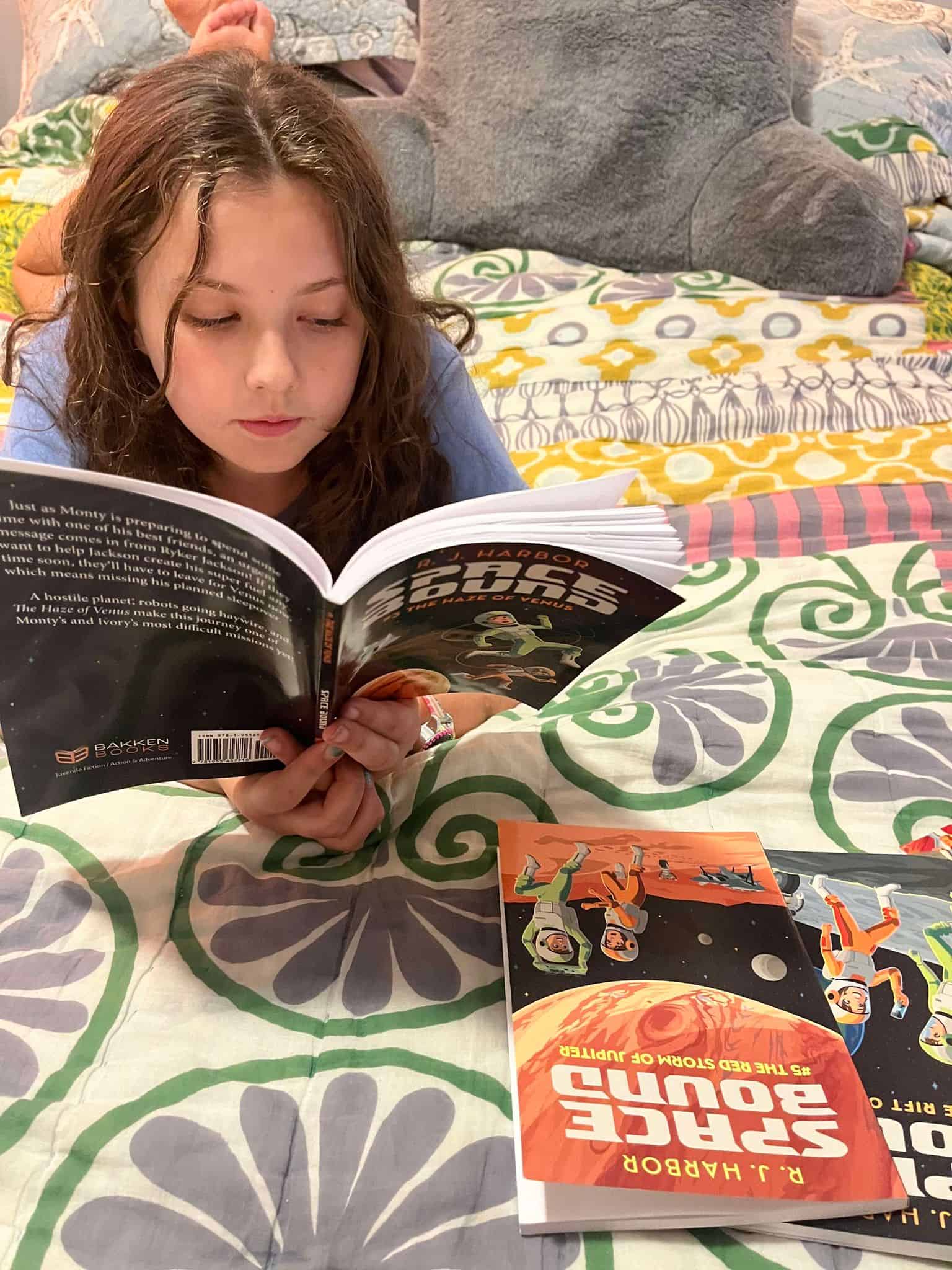
Lastly, but surely not least, I wanted to include some of my daughter’s thoughts on the series. As I said, she read about one book a day, staying about a book behind me at a time. Of course, that’s with me letting her read as much as she wants (homeschool win for all).
She has been a longtime lover of The Magic Treehouse books and still reads them occasionally though she finds them slightly too easy now. Between that and her love of space, this series was a hit. She especially enjoyed the bots, as well as Ivory’s character, whom she related to. Here is a short Q & A I did with her about the series:
Which book in the Space Bound series was your favorite, and why?
- The Rift of the Moon was my favorite because they go back in time. In Greece, everyone thought they were aliens or kings, and it was really funny.
Who are your favorite characters and why?
- Ivory and Echo. Ivory is close to my age, and I understood her personality. She’s really girly and likes a lot of the same things as me. In The Haze of Venus, she mentions that her favorite game is Uno, which is my favorite game too. She also likes pom-poms, glitter, and slime, and so do I! I like Echo because he is smart and funny without meaning to be. He’s good with lasers, and he likes bubble wrap.
What new space or science facts did you learn from reading these books?
- I learned that Jupiter is made out of gas and isn’t solid and that there is something called helium-3 on the moon. I also learned that Venus has a yellow haze made of sulfuric acids, which is similar to what we find in car batteries. I also learned that when you’re building something electric, the wires help the energy flow (circuits).
What did you think about Echo, Nova, and Bot Bot? Would you want to have them in space with you?
- I think Echo and Nova are so cute together. I like that Bot Bot is sparkly and cheery. Yes, I would want them in space! First, Nova is a really fancy spaceship, so you couldn’t really go anywhere without her. Secondly, they know all kinds of interesting things about space.
If Monty and Ivory could visit one more planet in the next book, which one should it be, and why?
- I’d like to see them go to Saturn to get a gallon full of Saturn’s ring rocks.
If you could build your own robot to help you with anything, like Monty does in the books, what would your robot be like?
- She would be really smart and know pretty much everything about space, and she could climb on walls so if she ever needed to get us (me and my brother and dog) out of a crater, she could!
Final Thoughts
The Space Bound series by R. J. Harbor has been an entertaining journey for my daughter and me! Meeting these characters and exploring space through these fast-paced adventures was fun. As a homeschool parent and space enthusiast, I appreciated the integration of science education into a fun and engaging series for middle grade readers. I also appreciated the themes related to emotional growth and positive family dynamics, as this is the type of wholesome content I have come to connect with Bakken Books.

My daughter loved the premise and the characters, especially the funny bots. She already knew a lot about space, but she learned more throughout the series! It has also led to more space-related questions in our home/homeschool, which we then had to look up and discuss!
If your middle-reader child loves science and space, or enjoys a good adventure series, I would recommend the Space Bound Series from Bakken Books. The mix of science fact and fiction invites curiosity and learning, while the short chapters and cliffhangers keep kids eager to turn the page. This series is an especially perfect choice for young readers who enjoyed The Magic Treehouse and are ready for the next step up!
We will definitely be keeping our eyes out for more books in the Space Bound saga and recommending it to other families in the meantime!
Where to Purchase and Keep Up with Bakken Books
Purchase the Bakken Book Space Bound Series on their site by clicking here.
Check out the Math Inspectors Series, Science Inspectors Series, The Campground Series, and more! Read our review of the Math Inspectors Series here.
Stay up to date with Bakken Books by following them on social media; they have an active publishing pipeline! Follow them on Facebook and Instagram.
Space Bound Giveaway
Bakken Books has generously donated two sets of the Space Bound Series for a giveaway. Please use the widget below to enter. Must be 18 years or older and a U.S. citizen with a U.S. shipping address.

Katie is a Christian, wife, writer, and homeschooling mother of two. She and her husband are both homeschool graduates who now homeschool their children. Katie is passionate about literature, the arts, STEM, and education. Katie has a MA in English and literature, and she works with her local STEM organization and Classical Conversations community to help create hands-on learning opportunities for children. She teaches NASA Astro Camp every summer, and she loves to read and paint whenever she can. She believes that the arts and sciences have much more in common than many people realize!