


Comparing Increases In Heart Rate Experiment
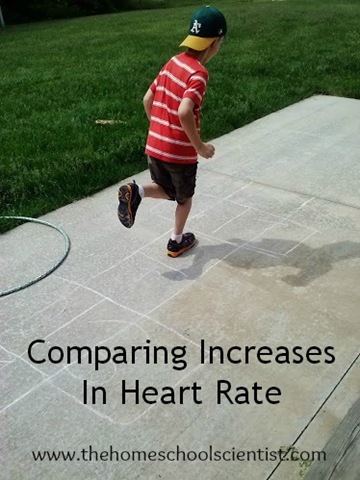
Consider the backyard your children’s workout facility. It is a great place for kids to exercise without knowing it. Playing tag, jumping rope, climbing monkey bars, and even hopscotch are all good forms of exercise.
The kids and I were discussing how play can be exercise, and they wondered which one gets the heart rate up the most. That afternoon, we were jumping rope, playing hopscotch, and having a hula hoop contest. We decided to do a heart rate experiment with these three activities to see which one got the heart rate higher. You can do it too with your favorite backyard activities.
Experiment Supplies
For this experiment, you will need to identify 3 activities that you can do for a 20 second duration. Next, you will need your supplies.
-
a timer
-
a pencil
-
paper to record results
Experiment Procedure
Look at the 3 activities you have chosen. Hypothesize the order from lowest to highest hear rates that you think each of the activities will produce. Record this order. Write down why you chose the order that you did.
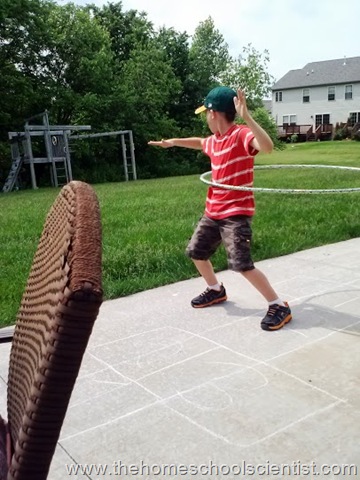
Next, determine who is going to be the first test subject. Have this person sit quietly for 3-5 minutes. Measure and record the test subject’s pulse. (Use the pulse points on the wrist or neck and count the beats for 20 seconds and then multiply by 3.) This is the resting heart rate.
While one person runs a timer, the text subject performs one of the predetermined activities for 20 seconds. Immediately after the 20 seconds of activity, measure and record the test subject’s pulse. Let this person rest for 5 minutes or until their heart rate is back to their resting rate.
Do this for all 3 activities. Try this on multiple people.
Experiment Results
Look at your data. Does it match your original hypothesis? Which activities increase the heart rate the most? The least? Explain any differences.
Are you surprised by your results?
We were surprised by our results. Each of our backyard activities were good at getting the heart rate up. That was no surprise. The surprise was that each of our test subjects ranked hopscotch last in increase of heart rate before the experiment, yet in each test the hopscotch gave the highest increase in heart rate.
Try this experiment in your backyard.
