


How to Make a Pumping Heart Model and Explanation


In this activity, we’ll study the circulatory system and learn how to make a pumping heart model. It’s super-easy to make and uses materials you probably already have.
Our heart is an organ that is important to keeping our bodies alive. It pumps blood throughout the body, delivering oxygen and nutrients to our cells. It also removes waste products.
One of the waste products is carbon dioxide. Our cells use oxygen for energy, and after using oxygen for energy, they release carbon dioxide. This carbon dioxide is carried back to the heart. It’s called deoxygenated blood. The prefix de- before the word oxygenated means “without” or “remove.” So, deoxygenated blood means blood without oxygen.
The deoxygenated blood carrying carbon dioxide returns to the right side of the heart and is then pumped to the lungs. In the lungs, carbon dioxide is exchanged for oxygen during respiration.
Another of the waste products is lactic acid, which is made by our muscles when we do very intense exercising, like running. The lactic acid is taken to the liver. The liver then turns it into glucose, or it’s removed from our bodies via our waste. The heart, arteries, veins, capillaries, and blood are part of our circulatory system.

Your heart is a muscular organ that is about the size of your fist. It is located slightly to the left of the center of your chest.
It is made up of four chambers: two upper chambers called atria (singular: atrium) and two lower chambers called ventricles.
The heart works like a pump with a rhythm. It has two main phases: diastole and systole. During diastole, the heart relaxes and fills up with blood. Then, during systole, the heart contracts and pumps blood to the lungs and the rest of the body.
The right side of the heart receives deoxygenated blood (blood without oxygen) from the body, while the left side receives oxygenated blood (blood rich in oxygen) from the lungs.

Here’s how blood moves through the heart, into the lungs, back to the heart, and out to the body. Follow along using the diagram of the heart.
- Deoxygenated blood returns to the heart through the superior and inferior vena cavae into the right atrium.
- The right atrium contracts, pushing blood into the right ventricle.
- The right ventricle contracts and sends blood to the lungs via the pulmonary arteries. You can see on the diagram the left pulmonary arteries and the right pulmonary arteries.
- In the lungs, carbon dioxide is exchanged for oxygen.
- The oxygen-rich blood returns to the left atrium through the pulmonary veins.
- The left atrium contracts, pushing blood into the left ventricle.
- Finally, the left ventricle contracts and pumps oxygen-rich blood out to the body through the aorta.

Make a Pumping Heart Model – Supplies and Instructions
Gather the materials and prepare the “blood” by filling the jar or bottle 3/4 full with water. Add a few drops of red food coloring to represent blood.

Create the Heart Chamber: Cut the neck off the balloon with scissors. Stretch the balloon over the opening of the jar and secure it with tape to create a heart chamber.

Make the Blood Vessels: Use scissors to make two small holes in the balloon where the straws will go.

Seal One Straw: Use Play-Doh to close off one of the straws, simulating how the heart controls blood flow.
Bend the Second Straw: Bend the second straw downward towards the bowl. This straw will act as the exit for the “blood.”

Pump the Heart: Gently press the center of the balloon and watch as the colored water (representing blood) pumps through the straws.
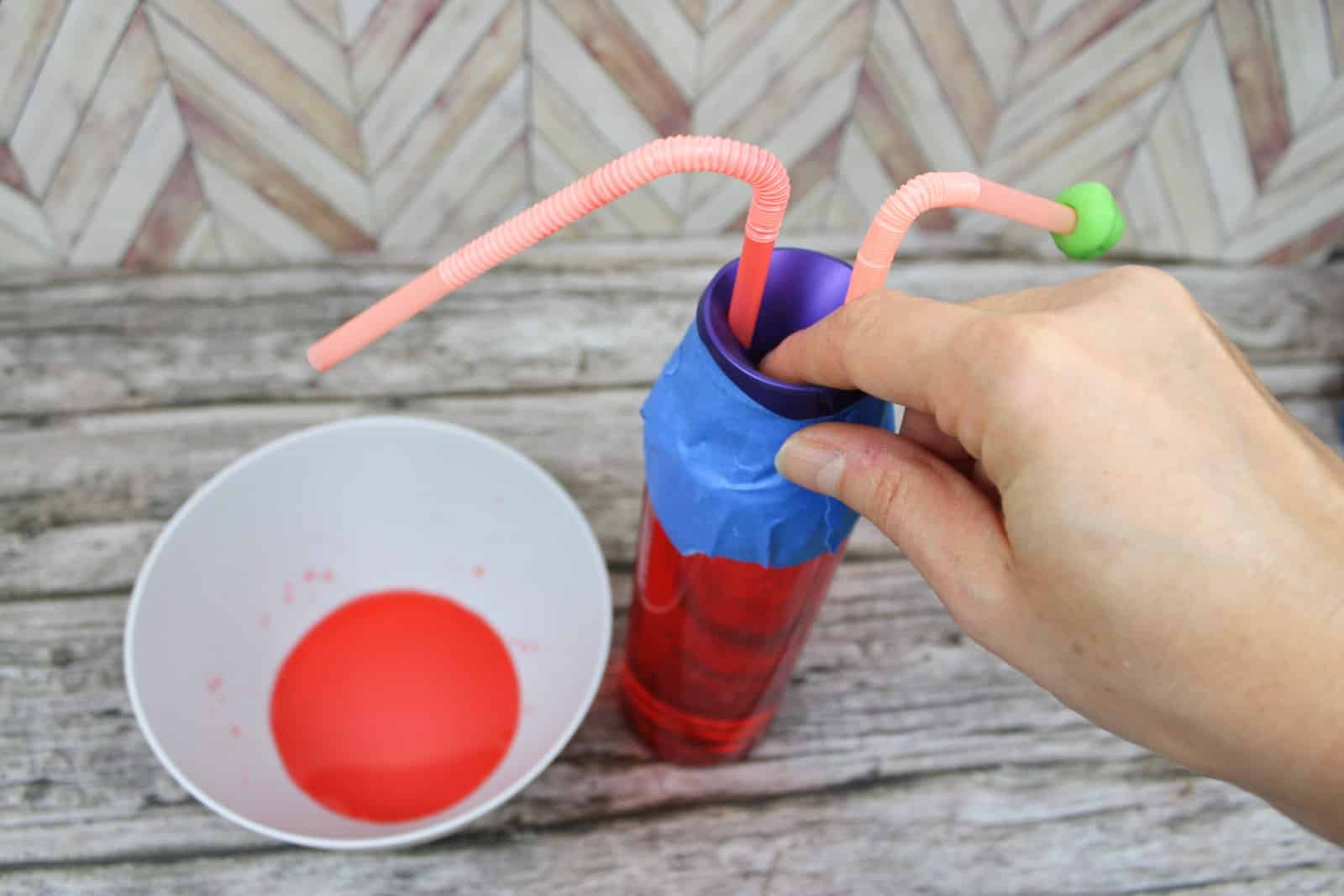

The jar (or glass) Represents the heart chamber, where blood is held. The balloon acts as the heart muscle (specifically the myocardium). When you press the balloon, it contracts. This represents the heart pumping.
The two straws represent blood vessels. One straw acts as an artery that carries blood away from the heart. The other straw mimics the vein that carries blood back into the heart.
We used the play dough to seal one of the straws because the heart controls blood flow into the heart and keeps the blood from flowing backward once it is in the heart. So, the playdough shows how the heart prevents blood from backflowing out of the heart once it enters it.
So, the red water is the blood that fills the heart’s chambers. At this point the balloon is relaxed like the heart is during the diastole phase of the cycle.
When you press on the balloon, the balloon (the heart muscle) contracts and pushes the red water out of the jar and through the straw, bent toward the bowl.
This represents the systole phase when the heart pumps blood out of the heart and into the arteries. The oxygenated blood is pumped out from the left ventricle into the aorta and distributed to the rest of the body.
After you stop pressing the balloon, it relaxes and returns to its original shape. This is similar to the heart entering the diastole phase again, filling with blood for the next cycle.
When the balloon returns to its original shape, it creates a slight vacuum, which helps draw more colored water back into the jar, preparing the heart for the next contraction.
- Review and discussion questions:
- What happened when you pressed on the balloon?
- Why do you think it is important for the heart to pump blood throughout the body?
- How does the play dough help in simulating the heart’s function?
- What other parts of the body work alongside the heart to keep your body healthy?
- What happened when you stopped pressing the balloon?
Download the Free Circulatory System Printable Pack
Heart Resources to Use with This Activity
Every Part Does its Part from the American Heart Association – This is a PDF
This is part two to the AHA activity listed above – Happy Arteries, Happy Heart – This is a PDF

I hold a master’s degree in child development and early education and am working on a post-baccalaureate in biology. I spent 15 years working for a biotechnology company developing IT systems in DNA testing laboratories across the US. I taught K4 in a private school, homeschooled my children, and have taught on the mission field in southern Asia. For 4 years, I served on our state’s FIRST Lego League tournament Board and served as the Judging Director. I own thehomeschoolscientist and also write a regular science column for Homeschooling Today Magazine. You’ll also find my writings on the CTCMath blog. Through this site, I have authored over 50 math and science resources.