


Oak Tree Life Cycle Lesson and Worksheets


One of my kids’ favorite end of summer and fall nature activities is collecting fallen acorns. As the kids are having fun, I find it’s a great time to teach about the oak tree life cycle.
Did you know that he oak is the National Tree of the United States (declared in 2004). It stands for strength, endurance, and patriotism. In ancient Rome Oak leaf crowns, called corona civica, were awarded to heroes who saved lives.
Oak Tree Life Cycle Lesson
Just like all living things, oak trees have a life cycle. In past lessons, we have looked at the general life cycle of plants. Today, let’s look specifically at oak trees.
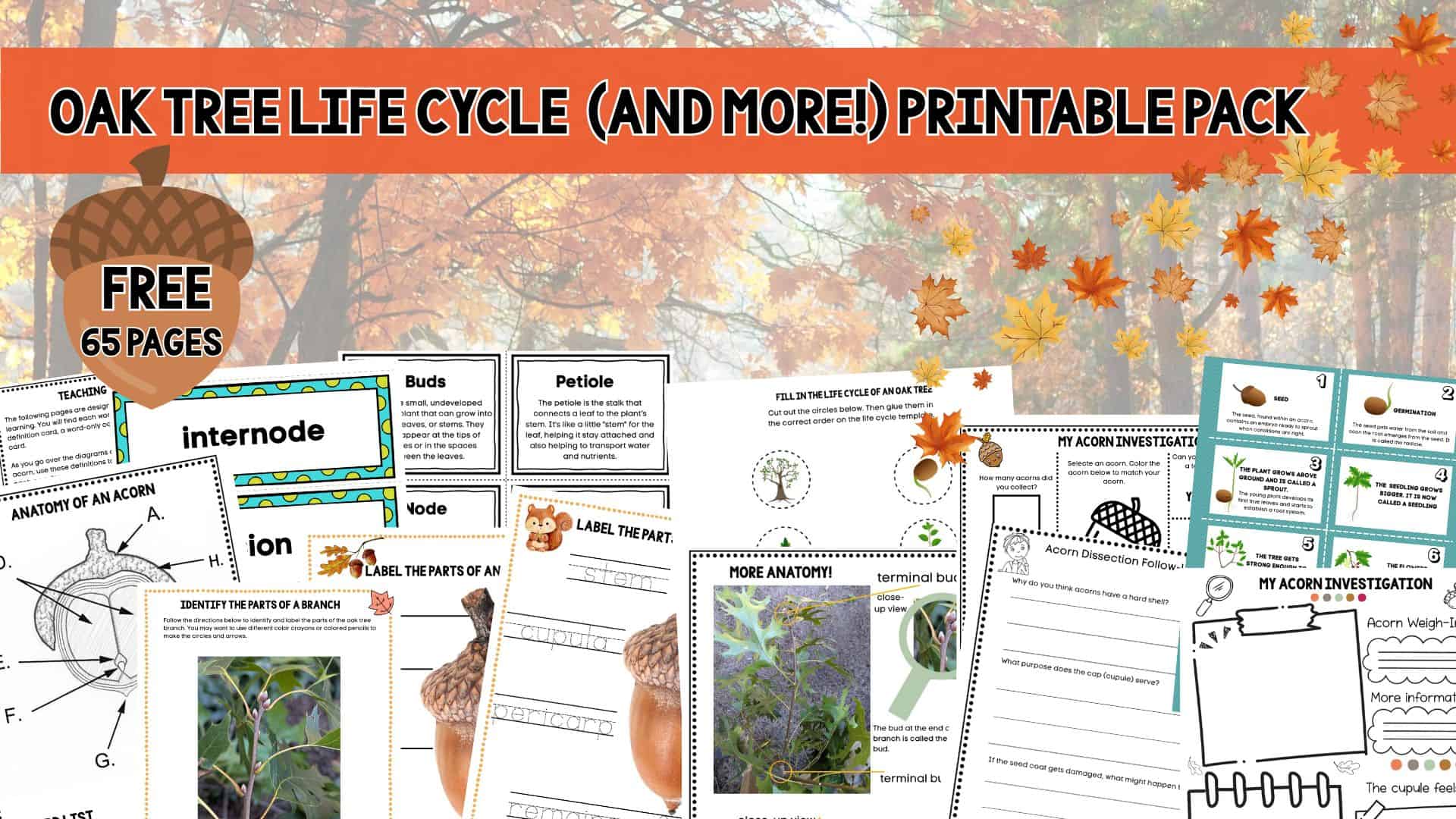
We have a 60+ page free oak tree life cycle worksheet pack you can request below. These worksheets cover the parts of an oak tree, including the parts of a leaf, parts of a branch, parts of an acorn, deciduous trees, and more.

The Oak Tree Life Cycle – What is a Deciduous Tree?
To better understand the oak tree life cycle, we first discussed deciduous trees. Deciduous trees are special types of trees that lose their leaves in the fall. This means that during autumn, you’ll see their leaves change color and eventually fall off. In the spring and summer, these trees are full of green leaves!
Here are some key points about deciduous trees:
New Growth: In spring, the tree grows new leaves again, getting ready for the warm weather.
Leaf Changes: In the fall, the leaves can turn beautiful colors like orange, yellow, and red before they drop off.
Winter Rest: When the leaves fall, the tree goes into a kind of sleep during winter. It saves energy until spring comes.
The Key Players in the Oak Tree Life Cycle
An oak tree’s branches, leaves, roots, and acorns (seeds) all play an important role in the life cycle of an oak tree. Let’s take a closer look. When you download our Life Cycle of an Oak Tree worksheets, you will have a full study about oak trees, the parts of an oak tree, and their life cycle.
Oak Tree Branches
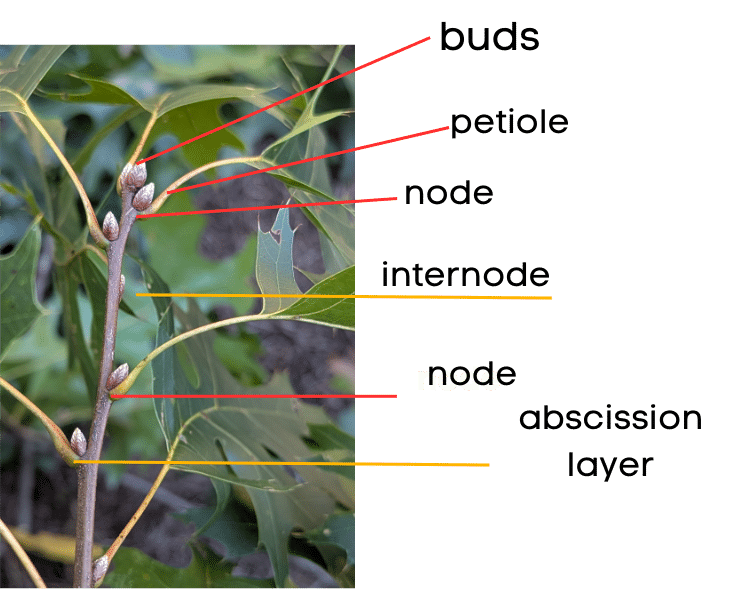
A node is the spot on a stem or branch where a leaf, bud, or flower grows.
The internode is the space between two nodes.
The apex is the very tip of the leaf.
Veins move water, food, and nutrients around the leaf, kind of like straws or pipes.
The midrib is big vein running right down the middle of the leaf. It’s like the backbone that helps hold the leaf up.
The sinuses are the spaces or curves between the lobes of the leaf. Imagine the “valleys” between the bumps.
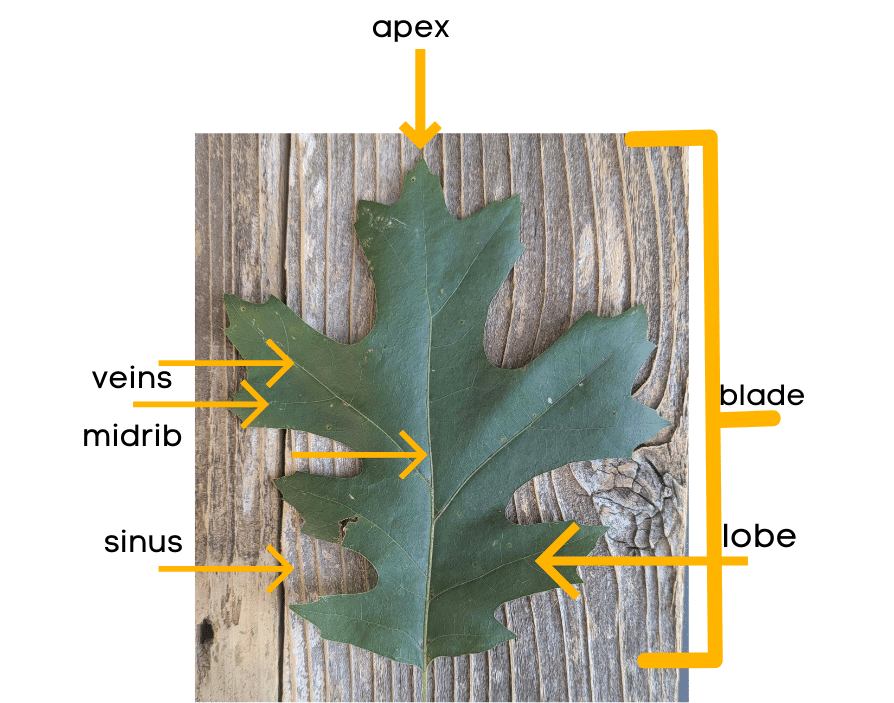
The petiole of a leaf is the little stalk that connects the leaf blade to the stem or branch of the plant. The blade is the big, flat part of the oak leaf that you can see and touch. The lobes are the rounded or pointy bumps that stick out around the edge of some leaves.
The Life Cycle of an Oak Tree
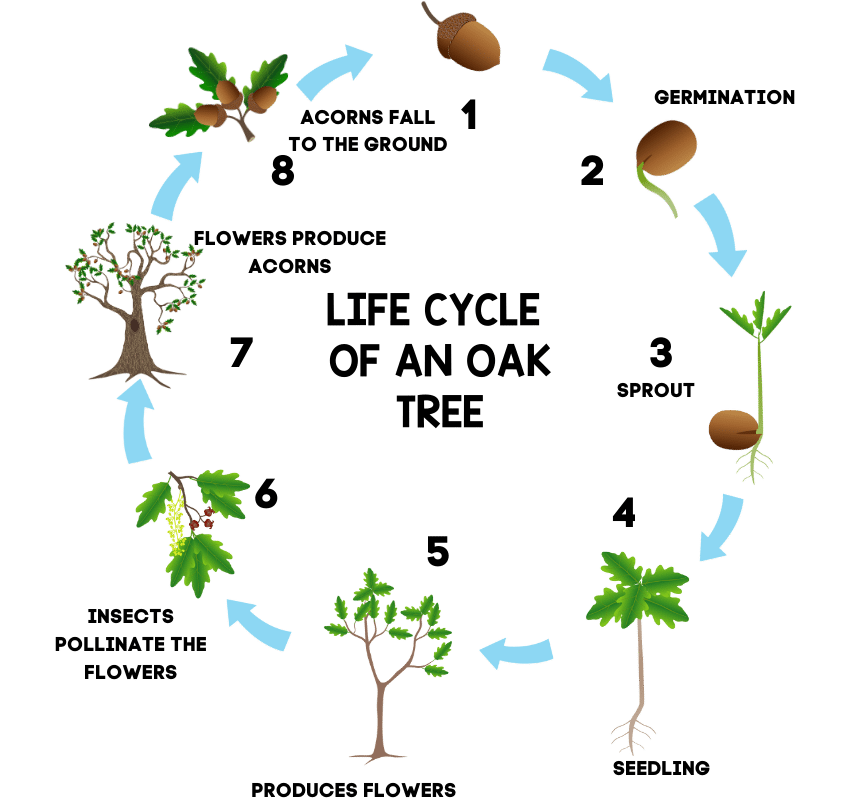
Below is a visual explanation of the life cycle of an oak tree. We’ll take a closer look at the stages. Don’t forget to request our 60+ page printable that covers all of this information and is packed with activities to enjoy with your children. See the request form below.
Seeds or Acorns
Sometimes it’s hard for kids (and adults) to imagine that the mighty oak that towers over head started out as a tiny acorn. But, it did. Just like other plants, trees get their starts as seeds. The seed of the oak tree is the acorn and that’s where the oak tree life cycle begins.

Like all seeds, the acorn is grown by a mature plant and contains all the material necessary for a new plant to form. Inside the acorn, you will find a tiny embryonic tree along with tissue loaded with protein, carbohydrates and fat. It is the nutrient dense tissue that makes a great meal for other animals. This is why you see squirrels burying acorns in the fall. They are storing up food for the winter. Sometimes these buried acorns don’t get found again and will grow into trees!
If your children are fascinated by the wildlife that depends on oak trees, they’ll enjoy this Squirrels and Their Habitats Unit Study, where they can explore squirrel behavior, habitats, and the important role these busy mammals play in forest ecosystems.
Germination
When the acorn falls from a tree, it gets covered in fallen leaves. Next, the tree embryo inside the acorn uses the energy from the nutrients within the acorn, water from the environment, and warmth from the sun to break through the acorn and send a taproot down into the soil. This is called germination. This root gives the young tree an anchor the young tree in place and to obtains water and nutrients from the soil.

Some acorns germinate in the fall, while others wait for spring. Fall sprouting is normal for the white oak acorns. They start to root into the ground as soon as they fall from the tree. Then, in the spring they send up their leaf shoot. The red oak acorns wait until spring to sprout, because they need the winter cold to prepare the seed.
Sprout
After germination, an oak tree sprout emerges from the acorn and shoots above the soil. The sprout uses more of the nutrients from the acorn to grow until its leaves grow and the tree can start producing it’s own food through photosynthesis.
Sapling
As the sprout grows, it develops stems and more leaves. The leaves use energy from the sun and the water and nutrients collected by the roots to make food for the tree. Young oak trees that are growing larger, but not yet producing acorns, are called saplings. The length of time a tree is a sapling varies depending upon the species, but the average oak tree species is 20-30 years old before it begins producing acorns.
Mature Tree

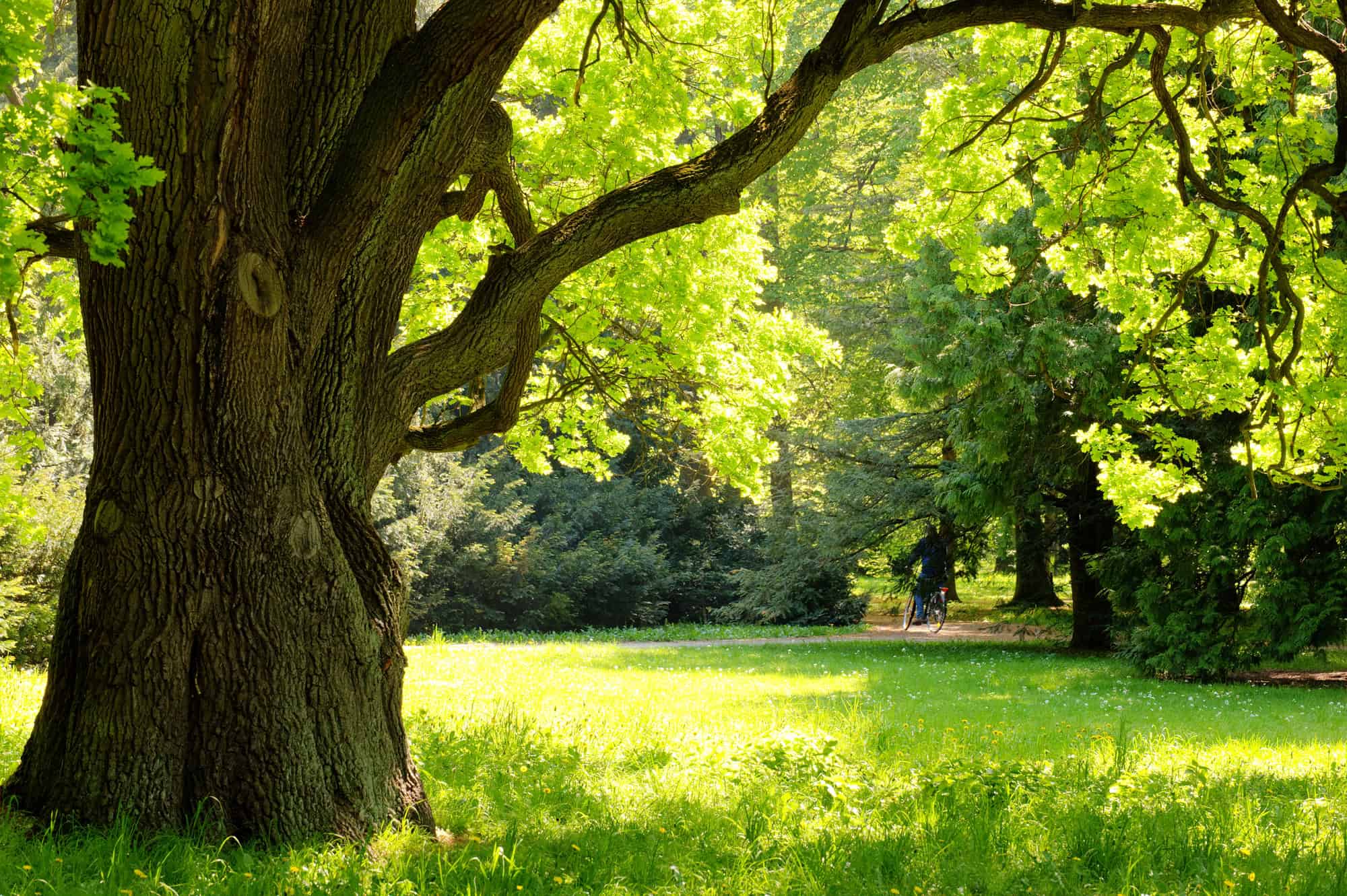
When an oak tree starts producing acorns, we say it is a mature tree. Depending upon the species, oak trees can live from 80 to over 1000 years. When an oak tree does die, it starts to decompose and becomes a tree stump.
Tree Stump
Tree stumps themselves are lifeless, but are actually teeming with life within. Bacteria, fungi, and insects are hard at work inside the tree stump in the process of decomposition. Decomposition breaks down the tree so that it’s nutrients can be added back to the soil so that other trees can grow.
Books to Use When Studying the Oak Tree Life Cycle


Oak Tree Life Cycle Worksheets and Printable Lesson
Now that you have learned about the oak tree life cycle, dowload our free 60+ page resource. This a FREE download for our email subscribers!
Fill out the form below and I will send you the oak tree life cycle printables. This printable covers:
- Deciduous trees
- Parts of an oak tree
- Parts of a leaf
- Parts of a branch
- Parts of an acorn
- Vocabulary cards
- Word wall cards
- Hands-on observation activities – includes 2 versions of worksheets for lower and upper elementary students.
- 65+ pages in all.
(If you are already a subscriber, filling out the form just lets me know you want me to send you the printables. You won’t be subscribing twice.)
Need a PowerPoint Presentation to Use Alongside the Free Printable?
We also have a 40-slide PowerPoint presentation and 5 additional activities you can use alongside this resource. This enriches the learning experience for all students, is helpful in a co-op or classroom setting, and allows students to go through the material independently.
The presentation includes beautiful photos and covers information beyond what is in the packet. Plus, we’ve included fun review questions that can be used just-for-fun or as an informal quiz. There are also 5 additional activities in a PDF you’ll receive along with the PowerPoint slides. You cannot edit the information on the slide, but you can rearrange the order, if needed. Check out the preview video on the product page.
Information about the slide presentation and extra activities is below the email box.
Get the free printable lesson here:
More Oak Tree Lesson Resources
Delightful Deciduous Trees Unit Study

I hold a master’s degree in child development and early education and am working on a post-baccalaureate in biology. I spent 15 years working for a biotechnology company developing IT systems in DNA testing laboratories across the US. I taught K4 in a private school, homeschooled my children, and have taught on the mission field in southern Asia. For 4 years, I served on our state’s FIRST Lego League tournament Board and served as the Judging Director. I own thehomeschoolscientist and also write a regular science column for Homeschooling Today Magazine. You’ll also find my writings on the CTCMath blog. Through this site, I have authored over 50 math and science resources.