


Pipe Cleaner Constellations

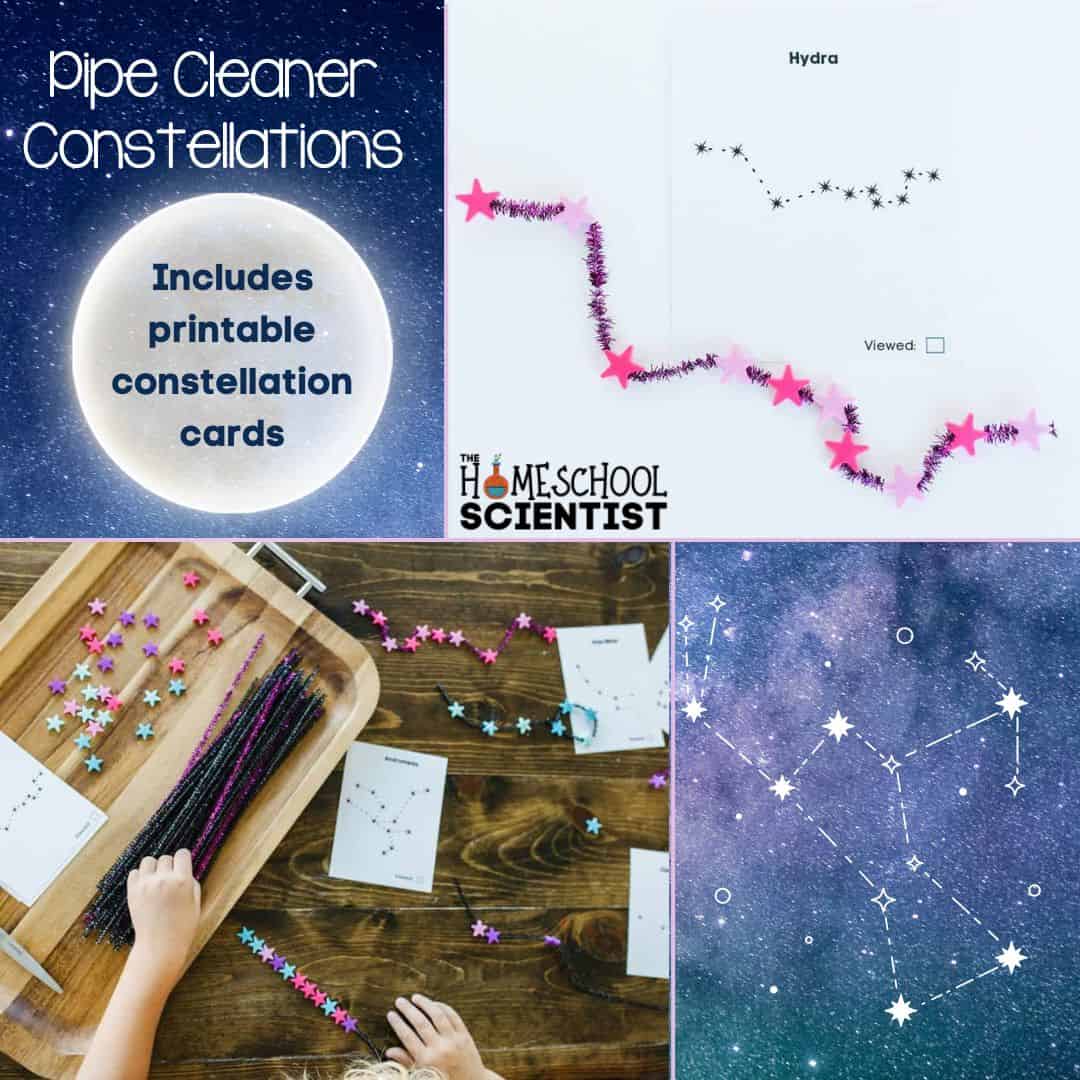
This pipe cleaner constellation activity is an engaging and concrete way of helping young children understand constellations.
As adults, it is easier for us to look at a constellation diagram in a book and then look up in the night sky and translate it to the stars that are light years away and light years apart from each other.
But for young children, trying to make that connection can be a bit confusing. Hands-on activities like these pipe cleaner constellations are an effective learning tool. I liken it to teaching children division and multiplication using manipulatives, like beans or candies, where they can represent the concepts with actual items.
Plus, making pipe cleaner constellations is just.plain.fun. We used purple and black sparkly pipe cleaners, chenille sticks, and purple and pink star-shaped beads.
Our Favorite Constellation Resources
Below are three resources we used for years. You can either purchase an astronomy (red-light) flashlight or place red tissue paper over a regular flashlight.


Pipe Cleaner Constellations
Materials
- 1+ packs Pipe cleaners or chenille sticks. (Glitter chenille sticks make this extra-colorful!) The exact number of packs will vary depending on how many are in the pack and how many children are doing the activity. I’d go with at least one pack per child.
- 1 container Beads with a hole in them. You can use round pony beads or star-shaped beads.
- Scissors that will cut the wire of the chenille sticks
- Constellation cards from the printable pack
Instructions
- Select a constellation from one of the cards.For younger children, start with an easy constellation.

- Shape the chenille stick to match the constellation. You will most likely have to cut and attach pieces. This step will help your child achieve the overall shape. Some of the constellation outlines get interesting! Your child will discover that they have to twist pieces together.
- There is no right or wrong way to get the constellations put together. This project is an excellent opportunity for children to try their ideas, undo them, and try again! STEM is like this—testing ideas and coming up with solutions when ideas don’t work well.
- Do not attach anything until the beads are threaded onto the pipe cleaners.
- Fold over loose ends with a bead to prevent the bead from sliding off.
- Use thread or string to hang the constellations from the ceiling or an overhead light fixture. (We hung ours from the light over our kitchen table.) Some friends used theirs as ornaments on their Christmas tree!


We have a free constellations printable that you can request below that includes 16 constellation cards and another painting activity. (If you download our printable pack, you might want to pick up some glow-in-the-dark paint when purchasing the craft supplies for this activity.)
In addition to the pipe cleaner constellations, you may want to add these activities and resources:
- Try our Make a Night Sky activity.
- If you have older children, learn about astronomical units and how to calculate them.
- Don’t forget to enjoy a family star gazing night. Here are 12 apps to help your family locate the visible constellations given the time of year and your geographical location.
- Have you printed our 55+ page resource – Get to Know the Planets?
- How Does the Sun Create Energy?
- Moon lessons and printables

I hold a master’s degree in child development and early education and am working on a post-baccalaureate in biology. I spent 15 years working for a biotechnology company developing IT systems in DNA testing laboratories across the US. I taught K4 in a private school, homeschooled my children, and have taught on the mission field in southern Asia. For 4 years, I served on our state’s FIRST Lego League tournament Board and served as the Judging Director. I own thehomeschoolscientist and also write a regular science column for Homeschooling Today Magazine. You’ll also find my writings on the CTCMath blog. Through this site, I have authored over 50 math and science resources.