


Astronomical Unit Definition & Science Activity


To simplify measuring distances in the solar system, scientists use astronomical units. What is the astronomical unit definition?
One astronomical unit is equal to approximately 93 million miles. This is the average distance between the Earth and Sun.

Let’s use our Jupiter example to find out how astronomical units work. We said Jupiter is 438,654,262 miles from the Sun. One AU equals 93 million miles. Let’s divide 438,654,262 by 93,000,000.
Therefore, we can say Jupiter is 5.2 astronomical units away from the Sun. That is much easier to write, say and understand than 438,654,262 miles
Understanding the Astronomical Unit Definition by Making a Model of the Solar System
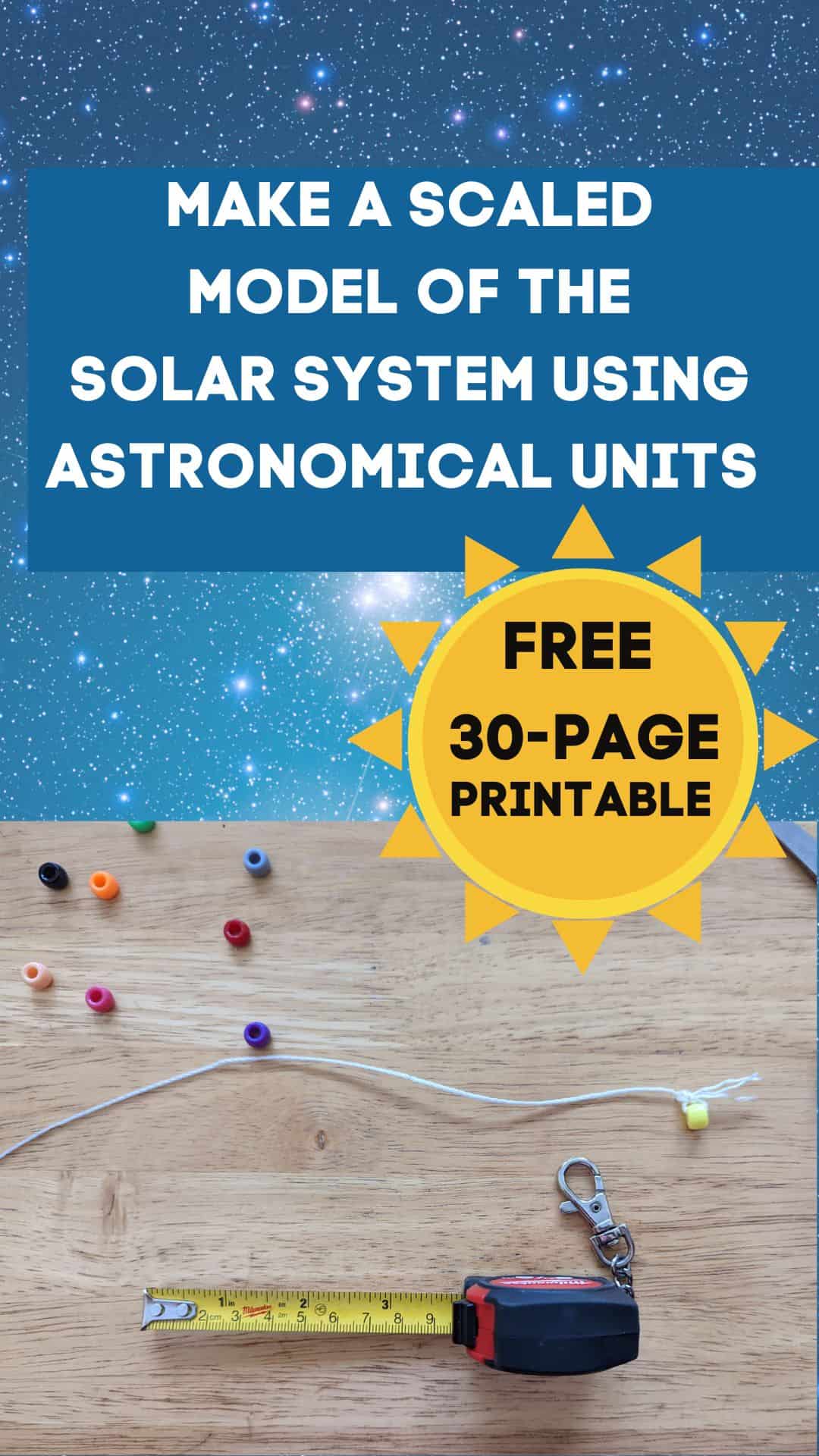
Now that we have an understanding of the astronomical unit definition, we are going to make a scaled model of the solar system. The model we’ll be making is obviously much smaller than our actual solar system, but the distances between the planets (we’ll use beads for planets), will be a scaled down example of the real distances.
For this activity, you’ll need 9 beads and 120 inches of string. Select a bead to represent the Sun and each planet. You’ll want the worksheet included in the free solar energy printable pack (see below). Using the AU worksheet, write the color down on the chart under the column that reads “Representing Color.”
For this activity, 1 astronomical unit is going to equal 10 cm. This will become more clear as we move through the activity.
For those using inches, you can then convert the centimeters to inches by using an online converter or by multiplying the cm measurement by 2.54 because there are 2.54 centimeters in an inch.
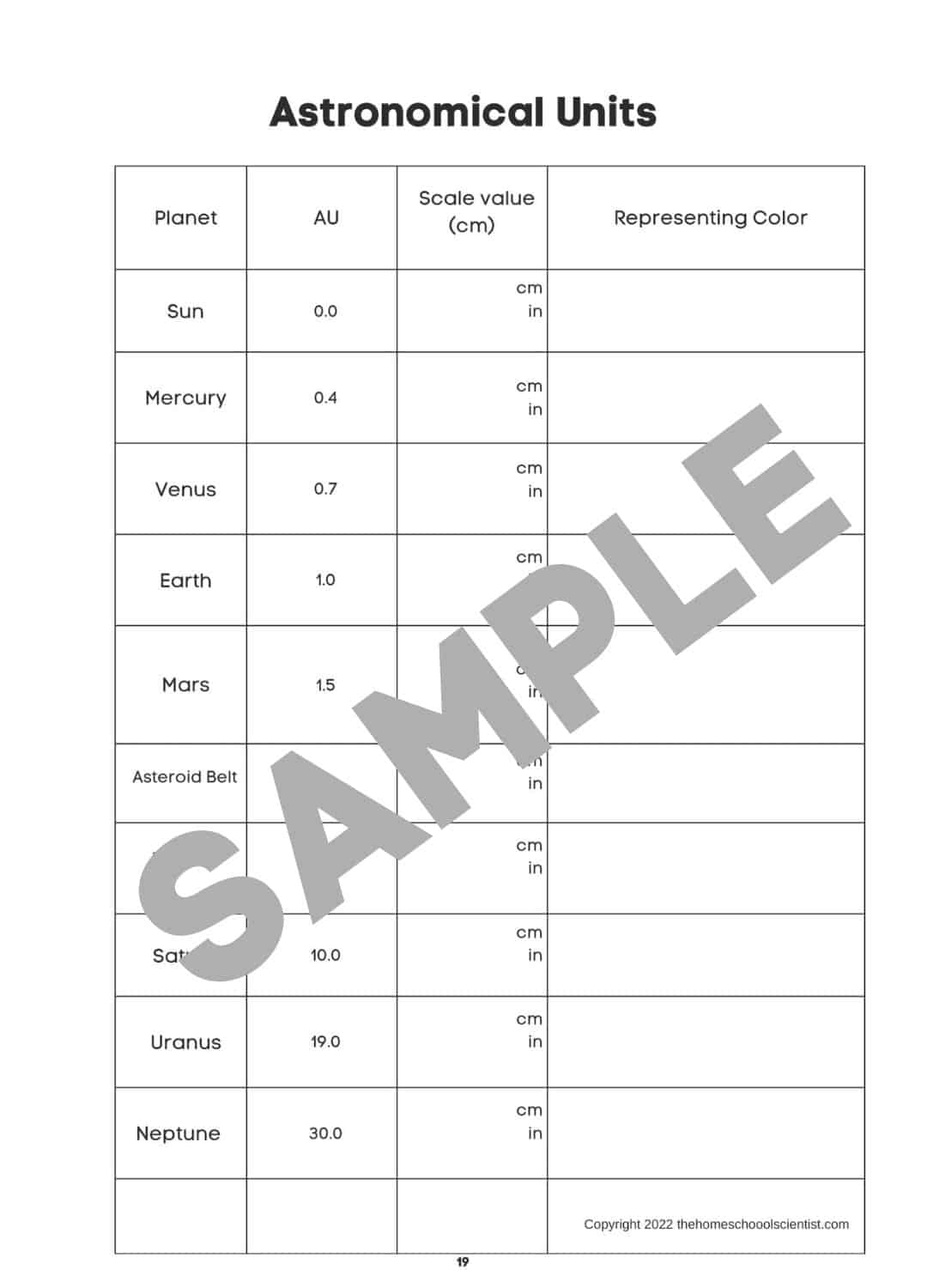
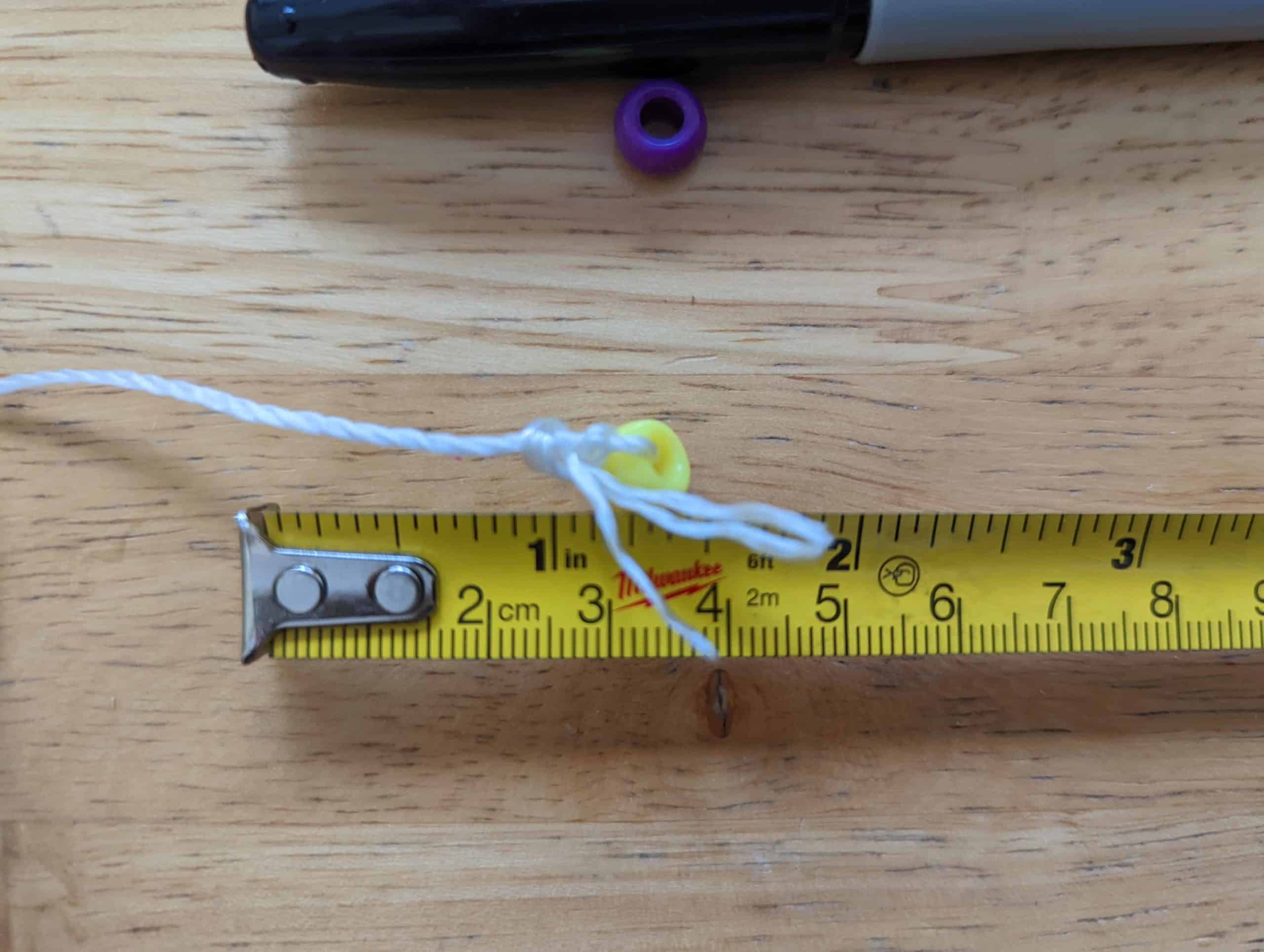
Tie the “Sun” onto one end of the string. Next, we need to determine how far the bead representing Mercury should be placed on the string.
To do this, multiply .4 (as it appears in the chart under the AU column for Mercury) by 10 (cm). Mercury is actually .4 astronomical units away from the sun. For our activity, we are using 10 cm for 1 AU. So, . 4 x 10cm = 4cm. Tie the “Mercury” bead onto the string, 4 cm away from the “Sun” bead. (Again, you may want to use inches rather than centimeters.) To convert to inches divide 4 by 2.54.
Next, multiple .7 (the AU factor for Venus) by 10cm (= 7cm). Measure 7 cm from the “Sun” bead and tie the “Venus” bead onto the string.
Continue multiplying each AU unit in the table by 10 (cm), to get the distance the planet bead should be placed from the Sun.

When complete, you will have a scale model of the solar system.

How Does The Sun Create Energy? Download the FREE Lesson Printable!
This astronomical unit definition activity is just one lesson found inside our solar energy unit. Inside this free lesson unit, you’ll find the calculation sheet and the printed instructions for this activity.
Subscribe to The Homeschool Scientist email list in the form below and I will send it to your inbox asap. If you already subscribe, fill out the form just to let me know you want this printable and I will send it to you. You will not be subscribing twice.
[wp_eStore_ssf id=96 template=4 button_text=”Subscribe and Send Me the Free Resource”]
Related Resources:
How Does the Sun Produce Energy – Covers the Sun and how we use solar energy
The heat from the Sun creates convection currents that cause winds to blow and generate ocean currents. Heat energy from the sun is key in the Earth’s water cycle.
NASA posters, lithographs, and more

I hold a master’s degree in child development and early education and am working on a post-baccalaureate in biology. I spent 15 years working for a biotechnology company developing IT systems in DNA testing laboratories across the US. I taught K4 in a private school, homeschooled my children, and have taught on the mission field in southern Asia. For 4 years, I served on our state’s FIRST Lego League tournament Board and served as the Judging Director. I own thehomeschoolscientist and also write a regular science column for Homeschooling Today Magazine. You’ll also find my writings on the CTCMath blog. Through this site, I have authored over 50 math and science resources.