


Fall Chemistry Activity – Grow Crystals

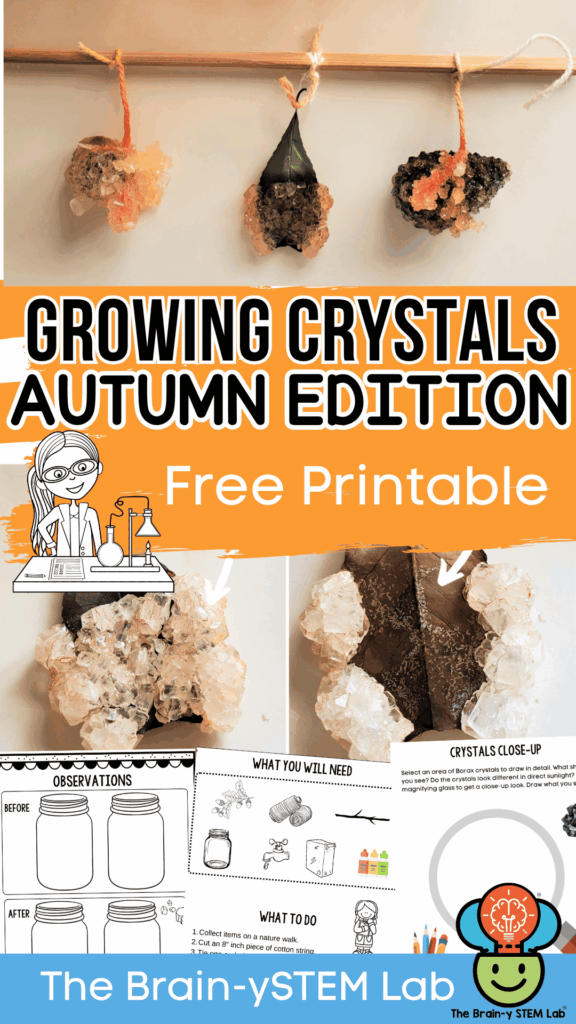
This is a fun Fall chemistry activity you can combine with a Fall nature walk. While out enjoying the cooler Fall temperatures and changing landscape, look for items on which to grow crystals.
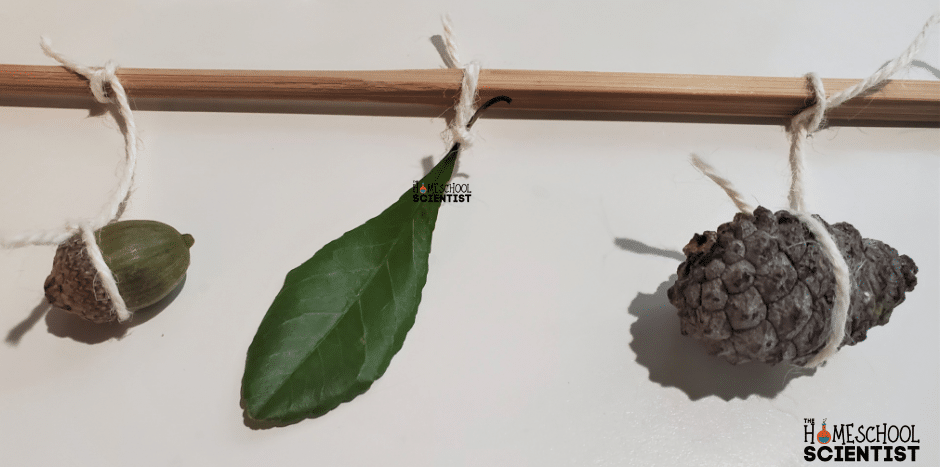
We used a leaf, an acorn, and a small pinecone for our project. If you plan on using larger pinecones or leaves, you’ll want to ensure you have a large enough glass jar and enough Borax solution.
What is Borax?
Borax, or sodium borate, is a natural mineral with many useful properties. It is a type of solute, which is something dissolved in a liquid. In chemistry, we also call this liquid a solvent. In this activity, the solvent is water.
When Borax dissolves, it breaks down into smaller parts. In this activity, we mix Borax with water to make a special solution to create crystals when the conditions are right.
What is a solution?
A solution is formed when a solute (like Borax) dissolves completely in a solvent (like water). When you add borax to hot water, the heat from the hot water helps break apart the Borax molecules. The hot water molecules are moving quickly and collide with the Borax molecules, pulling them apart and spreading the Borax molecules throughout the water. This is what happens when we say the Borax is dissolving in the hot water.
As the borax dissolves, the individual borax molecules become surrounded by water molecules. This is because water is a polar molecule, which means it has a positive end and a negative end. The positive end of the water molecules is attracted to the negatively charged parts of the borax molecules. At the same time, the negative end of the water molecules is attracted to the positively charged parts. This attraction helps to separate the borax molecules from each other and keeps them evenly distributed in the water.
This Borax and water solution looks clear. The Borax is still there, it’s just mixed with the water.
Solubility
Solubility is the ability of a substance to dissolve in a solvent. Different substances have different solubilities. For example, Borax has high solubility in hot water, which means it can dissolve well when the water is warm. However, as the water cools, the water’s ability to hold Borax decreases, leading to a change in the solution. This activity will help us see that change!

Materials Needed
- collected items (a leaf, acorn, pinecone, stick, etc.)
- chopsticks or a long tree twig
- 8-inch-long piece of butcher string
- Borax
- water
- small glass mason jar
- red and yellow food coloring, to make orange
- Tie one end of the cooking string around the item.
- Tie the other end of the cooking string around the chopstick or tree twig.
- Boil 1/2 cup of water. While waiting for it to boil, add a couple of drops of red and yellow food coloring.
- Slowly pour in 1/4 cup of Borax and stir until all the Borax is dissolved. You should see small crystals forming on the surface of the water.
- When all the Borax is dissolved in the water, set the solution aside, and let it cool for 5 minutes.
- Transfer the Borax water solution into the mason jar.
- Stick the fall item into the water/Borax solution.
- Leave alone for 24 hours.
We left our jars alone overnight. When we woke up in the morning, we pulled the acorn, leaf, and pinecone out of the liquid, and look what we found!
As we examined our results further, we noticed crystals grew all over the acorn and pinecone. We also noticed that the crystal growth on the pinecone and acorn had areas where the crystals took off, and many crystals grew.

What is Happening?
Crystals are formed when a substance goes from being dissolved in water to becoming solid again. Here’s how it works with Borax:
Water molecules move slower, in cold water. So, when the hot water in our solution begins to cool, the molecules in the water begin to slow down. This means the colder water molecules have less energy and do not move around as much. So, they can no longer keep the borax molecules separated and evenly distributed in the solution. When the water is hot, it has enough energy to hold the Borax in solution, but as it cools, that energy decreases.
Because there is less energy in the water molecules, the water and Borax molecules cannot bump into each other with as much energy. So, the Borax molecules start to clump together again, forming crystals.
This process is called crystallization, which happens when something solid that has dissolved in a solution comes out of the solution and forms a solid again.
Eventually, if the water cools enough, the Borax will no longer be able to stay dissolved. The Borax will then settle at the bottom of the jar we used in this activity.
What Makes Crystals Sparkle?
The reason crystals sparkle is because of how light hits their surfaces. Each crystal has flat faces and sharp edges, which reflect light in different ways. That’s why they can look so pretty, like tiny diamonds!
The crystals formed from Borax have smooth surfaces that reflect light beautifully. This is why they sparkle and look like tiny gems! Each crystal has flat faces and sharp edges, reflecting light differently. Each crystal has a unique shape based on how the Borax molecules come together.
Download the Free Lesson Printable

I hold a master’s degree in child development and early education and am working on a post-baccalaureate in biology. I spent 15 years working for a biotechnology company developing IT systems in DNA testing laboratories across the US. I taught K4 in a private school, homeschooled my children, and have taught on the mission field in southern Asia. For 4 years, I served on our state’s FIRST Lego League tournament Board and served as the Judging Director. I own thehomeschoolscientist and also write a regular science column for Homeschooling Today Magazine. You’ll also find my writings on the CTCMath blog. Through this site, I have authored over 50 math and science resources.