


Free Find the Missing Number Worksheets and Activities

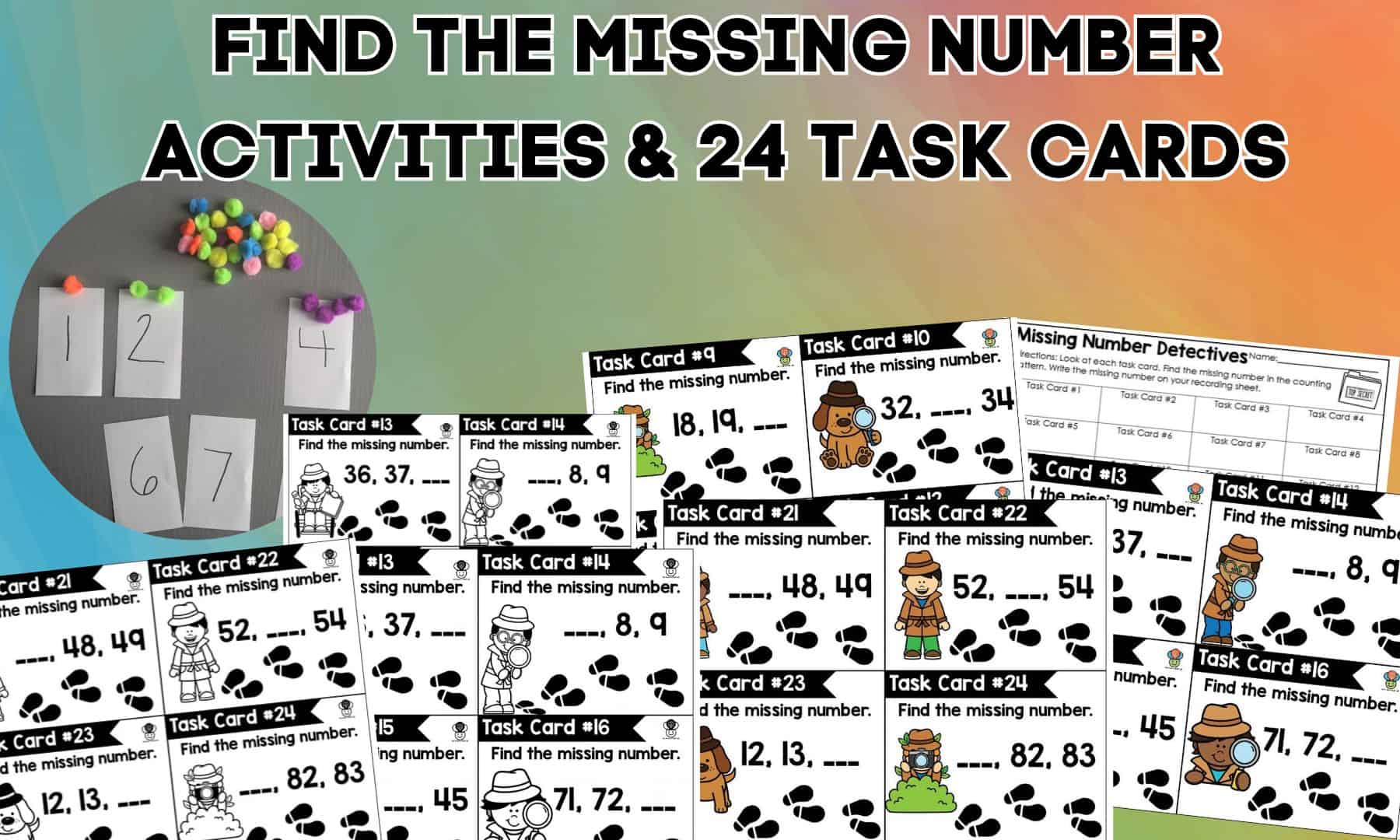
These free find the missing number worksheets and activities give children practice recognizing numbers and figuring out which number comes before, after, or between other numbers in a sequence.
What number comes after 5? What number comes before 10? What number belongs between 12 and 14?
These may seem like simple questions to us, but learning number order is an important part of building a strong math foundation for addition and subtraction.
Why are Finding the Missing Number Worksheets and Activities Important?
When young children first learn to count, they may memorize number words almost like words to a song: one, two, three, four, five . . ..
That’s an important first step! But we do want them to ultimately understand what those numbers mean and how those numbers relate to one another. For example, that 8 is less than 9. Or when we ask them, “Do you want 6 grapes or 8?” They know that 8 is more than 6 by counting 6, 7, 8.
Missing number activities can help our kids practice:
- Number recognition
- Counting forward
- Counting backward
- Number order
- Identifying the next number
- Recognizing patterns
- Building overall number sense
These skills become part of the foundational math skills for our young children who will soon move on to basic addition and subtraction.
For us, building that strong math foundation had its challenges. One of our children was diagnosed with dyscalculia, so I learned pretty quickly that we needed to approach math a little differently.
For us, that meant using lots of math manipulatives, going over concepts multiple times, and finding fun ways to review the same skills without making it feel like we were simply doing the same math lesson over and over again.
Colorful, hands-on resources were a big help. I used a lot of task cards and often made my own flashcards from index cards so we could practice a concept without a traditional worksheet.
And we turned those cards into games whenever we could!
I did set up a math center with favorite manipulatives and fun paper and pencils. Plus, I used colorful and fun-looking resources. It was a place we could go to together to enjoy more hands-on, game-like activities. Sometimes, I would hide the task cards or flashcards around the room or house, and we’d make a “You’re getting hotter. You’re getting colder game out of it.”
I’ve listed a few of the simple games we played.
Hands-On Find the Missing Number Activities
The task cards we have for free here are a helpful resource your child can use as a warm-up. I used resources like task cards with my child who struggled in math because they break up “the routine.” Instead of using worksheets all the time, it was a more tactile way to work with the concepts.
Task cards also gave me a quick way to see how well she was retaining what we had been working on. This was a big concern because with dyscalculia, understanding and retaining number relationships is a problem, but it varies from child to child.
Here are some of the hands-on activities we used with a package of index cards, a marker, and small toys or counters we have used.
First, here are some materials we used:
- Index cards
- Beans, pennies, Legos, pom-poms, craft sticks, toothpicks, recycled bottle caps, acorns, small rocks, linking cubes
- Marker (I always used black to keep it simple and less distracting.)
- Free printable find the missing number task cards (request below)
Make a Number Line
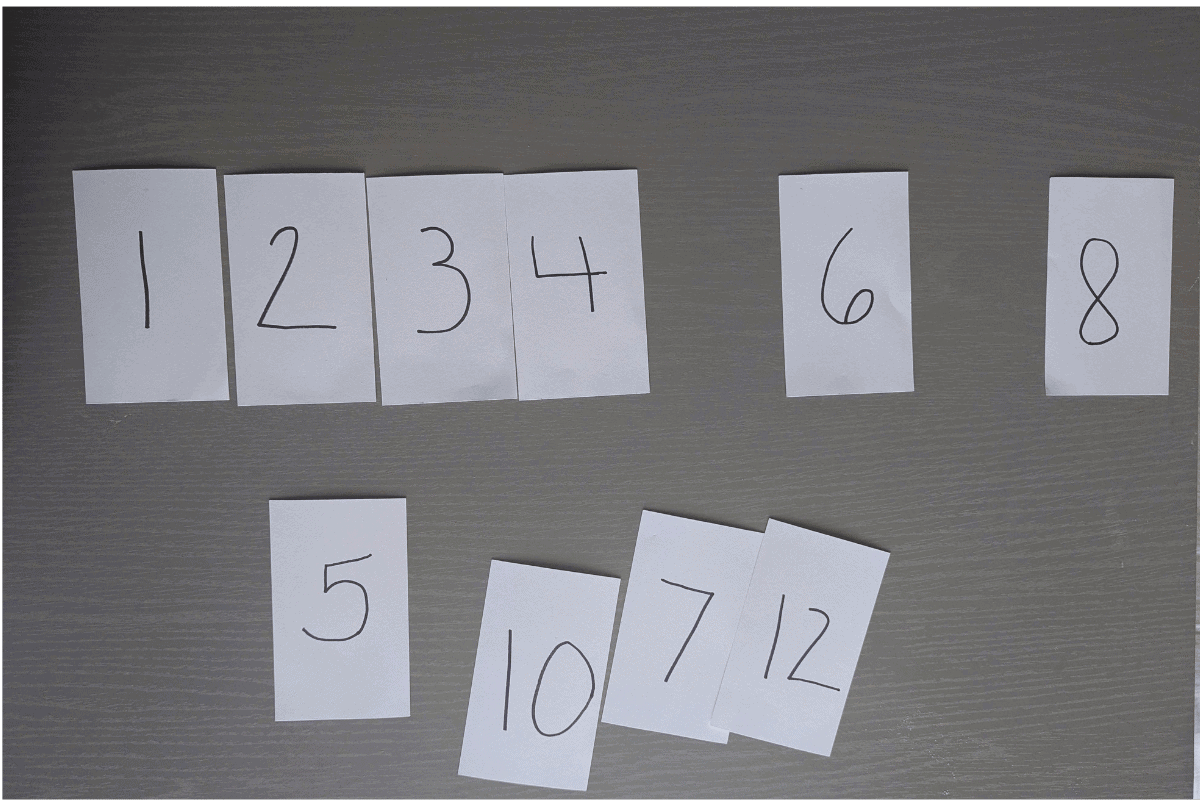
Write numbers on index cards. We started out with 1-12 and then moved up to 13-30. Place the first 7 or 8 in order on the floor: 1 2 3 4 5 6 7. Then remove one: 1 2 _ 4 5 6 7.
Ask your child which number is missing. Once they get the answer correct, put the missing card back in place.
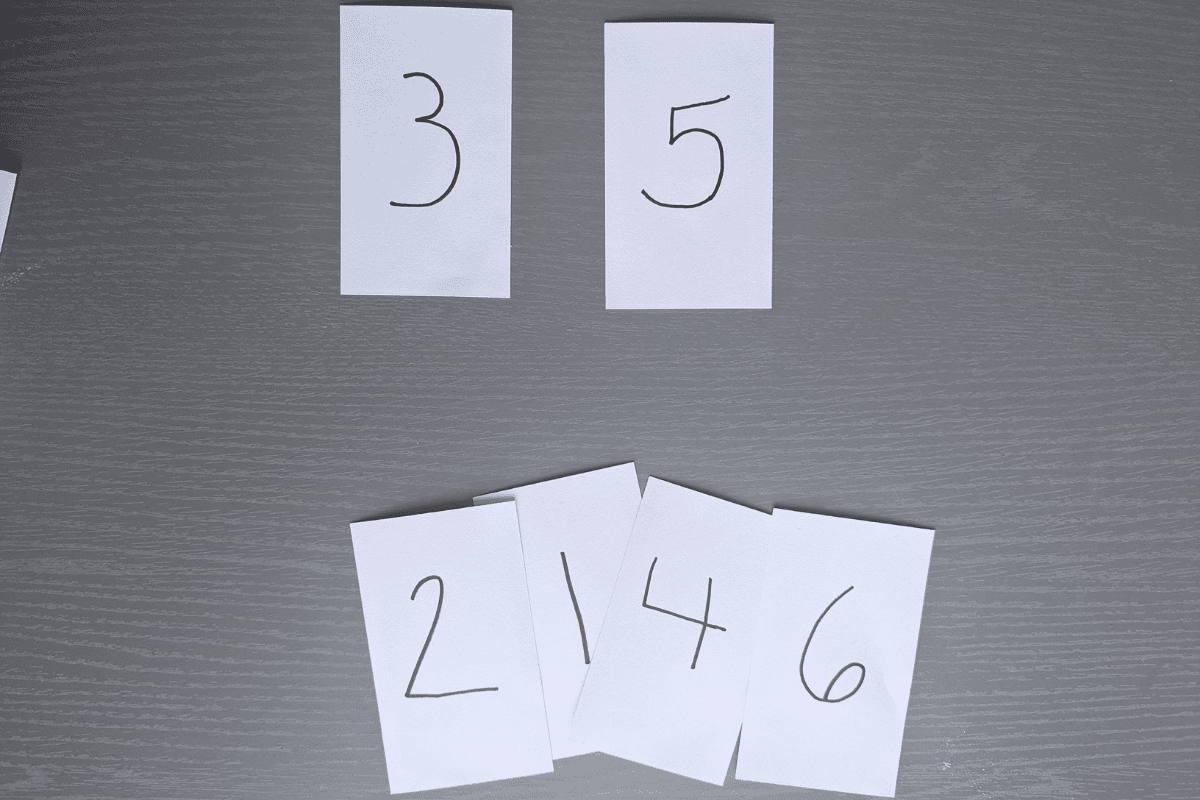
Remove another card and repeat the question. Once you know they have mastered one missing number, remove two cards.
For example: 1 2 3 _ 6 7
Then, remove two out of order.
For example: 1 2 3 __ 5 6 7 _ 8
Use Math Manipulatives
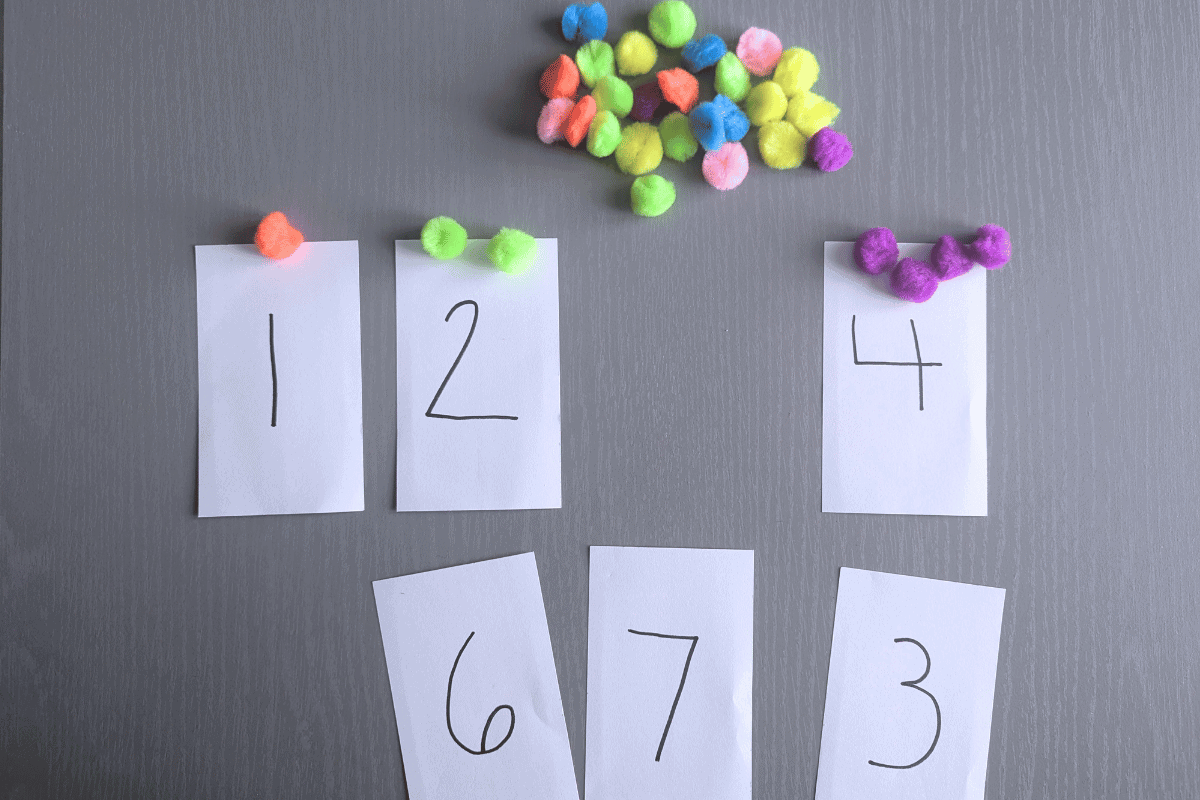
Gather some small objects that will help connect the written number to an actual quantity. I use pom-poms and bulk bottle caps a lot for STEM camps, so that is what we have used; you can certainly use other free items like dried beans, pennies, even acorns or small rocks gathered from outside!
- Select a sequence, for example, 5, _, 7, then make groups of five, six, and seven objects. Ask your child to count each group and match it to the correct number card. This reinforces the idea that 6 isn’t just the number that happens to come between 5 and 7. The numeral 6 represents a quantity of six objects.
- Switch things around! Give your child 3 or 4 of the number cards, ask them to put them in order. Then, have them count out the matching number of objects for each card.
- My kids loved it when I would play a hide-and-seek game with either our letter or number cards. Then, I’d give them hints, “You’re getting warmer” or “You’re getting colder.” So, with number sequencing, hide 3 to 5 cards that belong in a sequence. Once your child finds the cards you hid; they have to put them in order. You can also hide the items, then have them put the cards in order and count out the objects. This one took a long time, but I was able to fold laundry at the same time! 🙂 Actually, a game like this is a great break that gets kids up and moving, playing a fun hide-and-seek type game, and is a math lesson.
Use Find the Missing Number Task Cards
Add to the ideas above with our find the missing number task cards that you can request below. Print them out and use them for quick reviews, independent work, or any time your child needs a little extra number practice. As I mentioned earlier, I like to use resources like this as an assessment that doesn’t feel like a test.
There are 24 cards and an answer sheet. If your child is unable to use the answer sheet, have them call out the answers to you.
Get the Free Find the Missing Number Task Cards
Input your email below and receive the free task cards. Our sponsor for our math resources is CTCMath. When you request this resource, you will also be added to the THSS and CTCMath newsletter lists. You may unsubscribe at any time.

I hold a master’s degree in child development and early education and am working on a post-baccalaureate in biology. I spent 15 years working for a biotechnology company developing IT systems in DNA testing laboratories across the US. I taught K4 in a private school, homeschooled my children, and have taught on the mission field in southern Asia. For 4 years, I served on our state’s FIRST Lego League tournament Board and served as the Judging Director. I own thehomeschoolscientist and also write a regular science column for Homeschooling Today Magazine. You’ll also find my writings on the CTCMath blog. Through this site, I have authored over 50 math and science resources.