


Make a DNA Model with Gummy Bears and Candy


In this activity we will make a DNA model with gummy bears and candy. Add this to a DNA extraction activity. Check out our 28+ page lesson on DNA and extracting DNA from a banana.
You might also like to extract DNA from a banana, strawberries or pumpkin. Then, add this DNA card game for a well-rounded, fun, and hands-on DNA study!
Very Basic Background
For a deeper understanding of DNA, the bases, and the base pairs, consider downloading our 28+ page unit authored by Lindsay Zetzsche, founder of Science Geek Games and a genetic counselor by trade. Lindsay includes a DNA extraction activity as well in this printable lesson for upper elementary grades and up.
DNA stands for Deoxyribonucleic Acid. It’s the special code that tells our bodies and every living thing how to grow, work, and look. DNA is like the instruction manual for all living things!
DNA is found inside the cells of all living things. More specifically, it’s stored in the nucleus of the cell, which is like the control center. (In bacteria and some other simple organisms, it floats around in the cell because they don’t have a nucleus.)

DNA is made up of smaller building blocks called nucleotides. Each nucleotide has three parts:
- A sugar molecule
- A phosphate group
- A nitrogen base
A DNA strand looks like a twisted ladder. Like a regular ladder, it has two long sides running alongside each other, with steps—called rungs—connecting them. The sides of the DNA ladder are made of two repeating parts: deoxyribose, which is a sugar, and phosphoric acid. These two components alternate all the way down the length of the strand.
The steps, or rungs, of the ladder are formed by organic bases, which connect to the deoxyribose on the rails.
There are four bases in DNA:
- A = Adenine
- T = Thymine
- C = Cytosine
- G = Guanine
The bases pair up to form the “rungs” of the DNA ladder. They always match in a specific way:
- A pairs with T
- C pairs with G
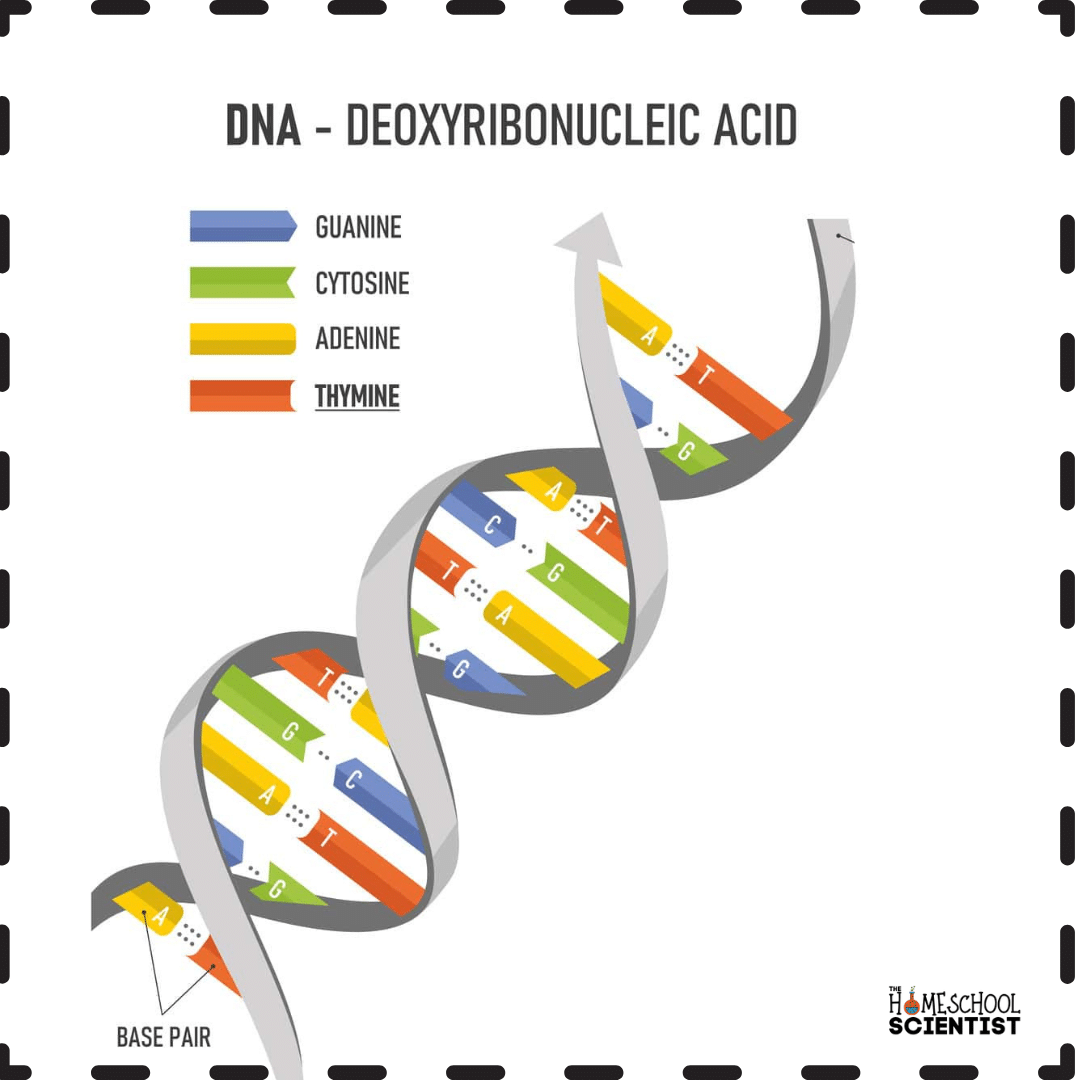
Each rung is made of a pair of these bases, and they always match in a specific way. Adenine (A) always pairs with Thymine (T), and Cytosine (C) always pairs with Guanine (G)—you can remember this with the pairs AT and CG. They also pair as TA and GC
The base pairs link together to form the long spiral-shaped structure of DNA, which looks like a twisted ladder. This shape is called a double helix.
The order of the bases is very important. Changing the order can change the instructions—just like changing the letters in a word can make a new word!

There is much more to learn about chromosomes, genes, and karyotypes. Request the DNA lesson below, authored by Lindsey Zetzsche, a genetic counselor and founder of Science Geek Games. This resource includes activities, informational reading passages, the activity listed below, and the instructions for extracting DNA from a banana.
In this activity, we will create a DNA model that will help you visualize the structure of our DNA.
Make a DNA Model with Gummy Bears and Candy
Materials
- 2 pieces Twizzlers Candy
- 1 bag Gummy bears
- Toothpicks
- DNA printout
Instructions
- Gather the supplies needed to create edible DNA

- Separate four colors from the gummy bear candies. Place them into the bowls.
- Pair two colors together to represent Adenine, Thymine, Cytosine, and Guanine. *Reminder: Adenine and Thymine go together, and Cytosine and Guanine always go together
- Insert a toothpick through the side of the licorice. Add the first pair of nucleotides A & T, and repeat with another toothpick and a second pair of nucleotides C & G.
- Switching the nucleotides from A & T to T & A and C & G to G & C as you go.
- Repeat steps 5 and 6.
- Add a second licorice to complete the double helix.


Download the DNA Lesson Printable Worksheets
We have prepared a 30+ page printable lesson to use when your students make a DNA model with gummy bears and candy. Use this printable with a wide range of grades (upper elementary and up.) You’ll be added to our email community.
Additional Activities & Resources
- Extract DNA from a Strawberry (with another free printable)
- Extract DNA from a pumpkin
- Extract DNA from a banana
- Play Variance, a DNA card game
- Make a cell model with plant and animal cell printables

I hold a master’s degree in child development and early education and am working on a post-baccalaureate in biology. I spent 15 years working for a biotechnology company developing IT systems in DNA testing laboratories across the US. I taught K4 in a private school, homeschooled my children, and have taught on the mission field in southern Asia. For 4 years, I served on our state’s FIRST Lego League tournament Board and served as the Judging Director. I own thehomeschoolscientist and also write a regular science column for Homeschooling Today Magazine. You’ll also find my writings on the CTCMath blog. Through this site, I have authored over 50 math and science resources.