


How to Make a Model of the Skin


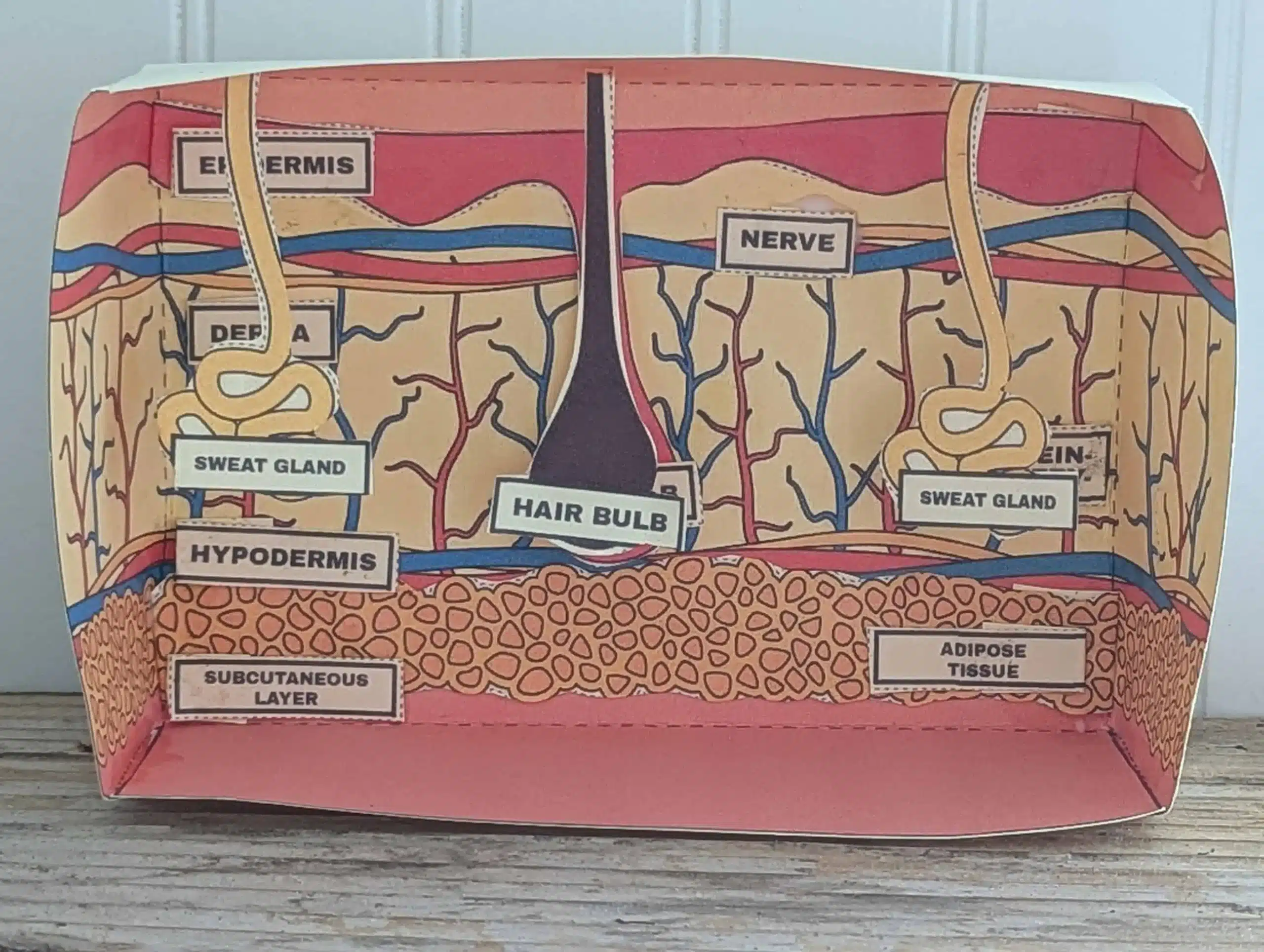
This step-by-step skin model is super-easy and affordable for younger and older students. Making this skin model is also easy to accomplish in a group setting, like a co-op or classroom. You just need the templates (colorized or more ink-friendly) that are in our free worksheet printable, glue, scissors, and crayons or colored pencils (optional).
I recommend that your child make their model of the skin early in your study of the integumentary system. Then, as you move through the information and activities, your child can refer to their model of the skin to reinforce the info about how our skin works and how our body cools down in hot weather.
Our free lesson printable has 40 pages about the integumentary system, along with instructions for building this model of the skin.
How to Make a Model of the Skin
Materials needed to make a model of the skin:
- Project templates (in the free printable)
- Glue
- Paper and/or cardstock. Cardstock works best for the background that will be folded into a shadow box.
- Scissors
- Crayons or colored pencils if using the print-friendly version of the template.
To Make a Model of the Skin:
Print the templates in the free worksheets, cut out all pieces. Glue the three layers of the skin to the backdrop piece, which will be our shadow. Glue all other pieces and word labels in place. Fold and glue the sides to form a shadow box.
Here is a step-by-step guide with photos to show you how to make a model of the skin.
- Print and cut-out the background piece. This will form the shadow box

2. Cut out the remaining pieces and labels.

3. Glue the main layer pieces to the background.

4. Glue the remaining pieces in place and attach the labels.

5. Glue the corners to form a shadow box.

6. Use the pages in the lesson printable to learn the function of each part of your skin.
How Our Skin Keeps Us Cool
When your body gets too hot, such as on a warm day or after exercising, your brain signals your skin to cool you down. That’s when sweat glands get to work!
As you read more about how our body creates sweat to help us stay cool on a hot day, use the diagram on the next page.
Look closely at the hair and hair follicles on your arm. Can you see the tiny sweat pores? You might need a magnifier or take a close-up photo with a cell phone. There’s a lot going on under the surface of your skin to produce the sweat that you see on your skin when you are hot and sweating.

How Our Body Sweats and Cools Down
- Eccrine glands are all over your body and make watery sweat. This sweat comes out through tiny openings in your skin called sweat pores. Look closely at the hair and hair follicles on your arm. Can you see the tiny sweat pores?
- When sweat evaporates, it helps cool you down—kind of like a built-in air conditioner.
- Apocrine glands are found in places like your armpits. These produce a thicker sweat that doesn’t help cool you off as much. These glands become more active as you get closer to your teenage years. These sweat glands can sometimes cause body odor when the sweat mixes with bacteria on your skin.
- You have nerves that send messages from your brain to your sweat glands, telling them when to produce sweat. You also have arteries, which are blood vessels that bring warm blood from inside your body closer to the surface, so the heat can escape.

Your skin has sebaceous glands, too. Can you find these on the model of the skin?
The sebaceous glands make oil to keep your skin soft, but they’re not involved in sweating.
Each follicle has a hair erector muscle attached. When you’re cold, that muscle pulls the hair upright, giving you goosebumps! The next time you get so cold you have goosebumps, you’ll know that tiny muscles attached to your hair follicles are at work!
The layer you see in the diagram labeled adipose tissue, is fat that helps keep your body warm and stores energy.
The next time you feel sweaty, remember—your skin is working hard underneath the surface to keep you cool!
Learn more about the integumentary system and how our body keeps us cool by downloading our free 40+ page free lesson printable.
Related resources:
- Extra Skin Study Resources
- Fingerprint Patterns Video
- Fingerprint Characteristics Video
- Categorizing Fingerprints
- A Simplified Guide To Fingerprint Analysis
- Patterns & Fingerprints
- Skin Lesson from KidsHealth.org
- Skin Science!- Make a Von Frey Device
- Color Me Human: Biology & Genetics Activity
- How Strong is Your Hair?
- Hair Science Fair and Experiment Ideas for All Ages
- Science Experiments With Shampoo & Conditioner

I hold a master’s degree in child development and early education and am working on a post-baccalaureate in biology. I spent 15 years working for a biotechnology company developing IT systems in DNA testing laboratories across the US. I taught K4 in a private school, homeschooled my children, and have taught on the mission field in southern Asia. For 4 years, I served on our state’s FIRST Lego League tournament Board and served as the Judging Director. I own thehomeschoolscientist and also write a regular science column for Homeschooling Today Magazine. You’ll also find my writings on the CTCMath blog. Through this site, I have authored over 50 math and science resources.