


Skittles Experiment with Worksheets


The popular Skittles experiment with worksheets offers lessons in diffusion, and in this version, we are also going to enjoy a lesson on polarity and nonpolarity in chemistry.
If your student isn’t familiar with independent, dependent, and control variables, let’s look at those terms first. (These are also covered in the printable pack. Scroll to the bottom to request your free worksheet pack.)
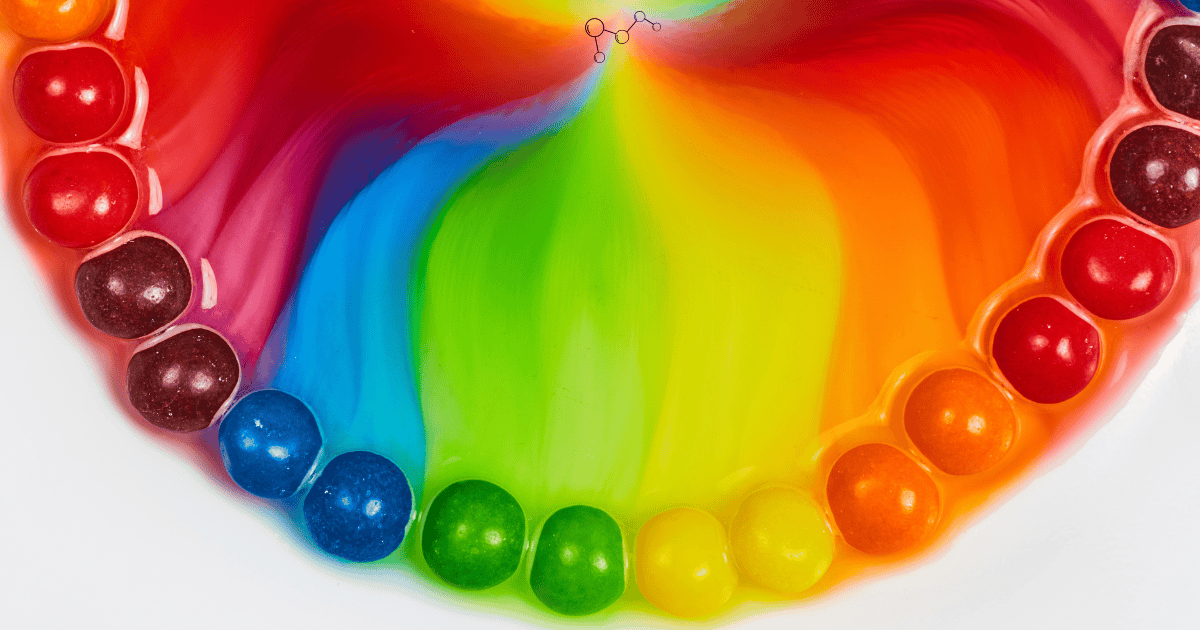
What are the Independent and Dependent Variables in the Skittles Experiment?
What is the independent variable in an experiment? The independent variable is the variable we manipulate or change.
Scientists design experiments using variables to understand the relationship between different factors. Variables include things like temperature, the amount of liquid, and location (e.g., a sunny window vs. inside a dark room). There are three types of variables: independent variables, dependent variables, and control variables.
The independent variable is the factor that we change or manipulate. We deliberately change this variable to see how it affects the dependent variable. In this experiment, one of the independent variables is the liquid we pour into the dish. We will use oil and room-temperature water.
The dependent variable is what we measure. In this experiment, we record how the dye in the candy dissolves and how long it takes for the colors to cover the entire dish.
The control variables help us ensure that any changes we observe in the dependent variable are due to the changes we make in the independent variable. They also help eliminate other explanations for the results, ensuring that the experiment tests only the effect of the independent variable. In this experiment the temperature of the room is the same, so it is one of the control variables.
How Do We Do the Skittles Experiment?
Before starting, we recommend you download and print the worksheets that accompany this Skittle experiment.
First, review the background information on the dependent, independent, and control variables in our version of the Skittles experiment. Then complete the pre-experiment pages.
Next, gather the materials and follow the instructions below.
Materials for the Skittles Experiment
- Four plates
- Several bags of Skittles
- Sugar
- Room Temperature water – we used 1/2 cup per plate. But before starting determine how much water will completely cover the plate, without overflowing the sides. Use this same amount of water and oil for each plate.
- Vegetable oil
- Corn Syrup
- Liquid measuring cup
- Tablespoon
- Set of worksheets
- Pencil
- Colored pencils or crayons
Step-by-Step Procedures for the Skittles Experiment
- Complete the Think About It page in the printable packet.
- Place several plates on a flat surface to easily observe the experiment.
- Make five labels, one for each plate: Warm Water Only, Room Temperature Water Only, Cooking Oil, Warm Water & 2 T Sugar, and Warm Water & 2 Corn Syrup.
- Fill the plates with water or oil in the following fashion. Carefully pour, ensuring that the water or oil covers the bottom of the plate but does not overflow:

- One plate with cooking oil only
- One plate with room temperature water only
- Second plate with room temperature water only
- Third plate with room temperature water only
- Dump the 2 T of sugar in the middle of one of the plates with room-temperature water. Do not stir it.
- On one of the plates, with room temperature water, pour 2 T of corn syrup into the center.
- You should now have:
- One plate with cooking oil only
- One plate with 1/2 cup of room temperature water only
- Second plate with 1/2 cup of room temperature water only with 2 T sugar in the center
- Third plate with 1/2 cup room temperature water only with 2 T corn syrup in the center
- Next, line each plate around the edges with Skittles. You’ll need help to get this done quickly. But do NOT bump the plates as the candies are placed around each dish.
- On each plate, arrange them in a circular pattern around the edge of the plate. You can organize them by color or mix them up for a rainbow effect!
- Observe and record what happens to the Skittles as soon as the water or oil touches them.
- Let the plates sit for 3 minutes, then 6, then 10 minutes. What happens with each plate over time? What does the dye look like after 20 minutes?
While you’re setting up this experiment, take your Skittles science a step further. Try this Skittles Rainbow Density Experiment from A Little Pinch of Perfect to explore how different concentrations of sugar affect density.
What Happened

Room-Temperature Water Only

With Sugar Added to the Dish
With Corn Syrup Added to the Dish
Oil Only
In the dishes with room-temperature water only, the dye and sugar from the Skittles move toward the center, and we see an example of diffusion.
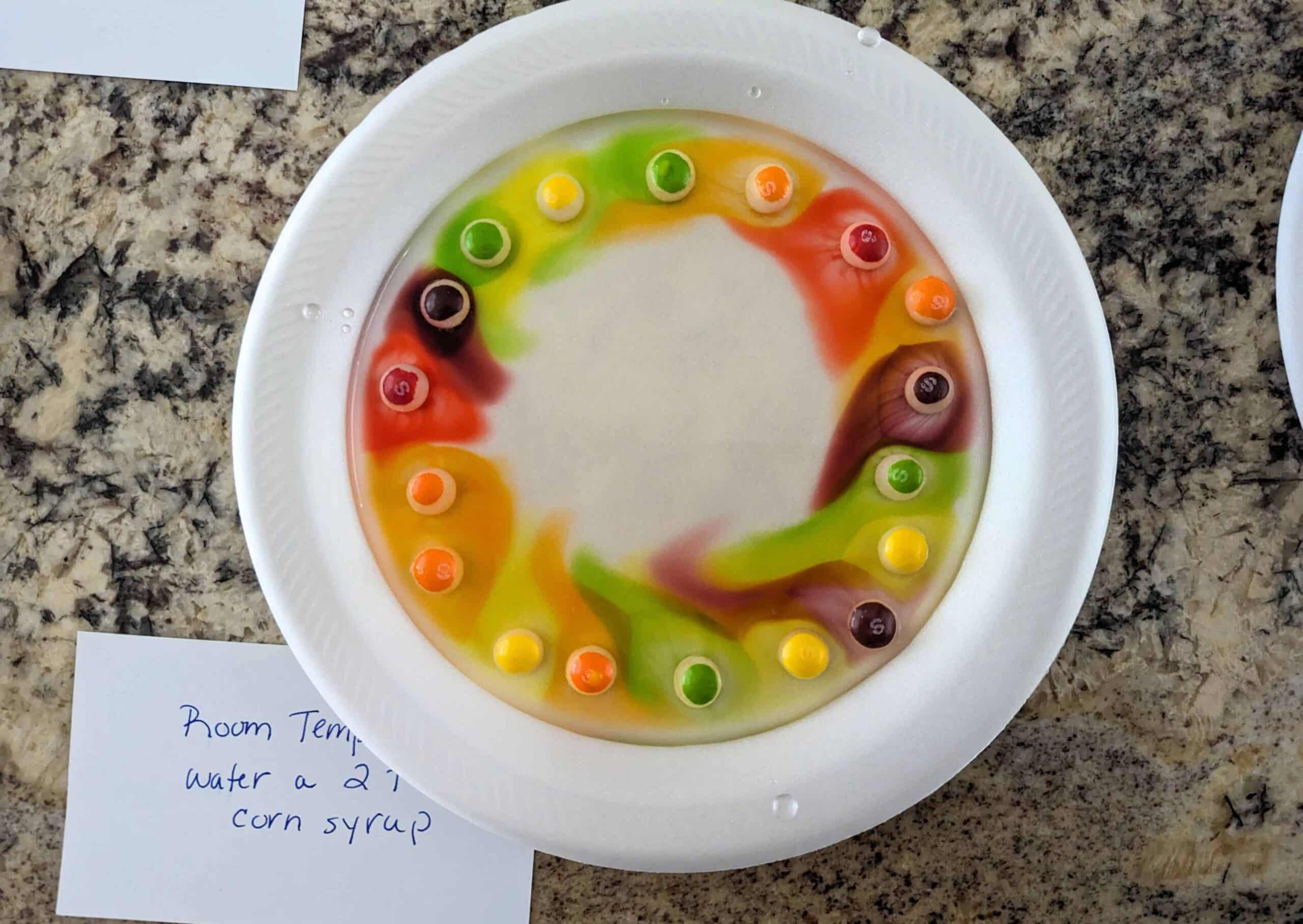
Let’s look at the dishes where we added either sugar or corn syrup in the center. When the dye and sugar from the candies dissolve, and the sugar or corn syrup in the center of the plate starts to dissolve too, there is a higher concentration of sugar around the rim of the dish and in the middle of the dish. However, there is a space between those two areas of lower concentration. So, the dye and sugar along the rim start to move toward the center. Plus, the sugar from the center begins to move outwards. This is why we see the dye start to curve as it moves closer to the center. The high concentration from the center is moving outward.
The concentration of sugar begins to equalize all over the plate, so the dye starts to spread more. What happened to the dye after 20 minutes?
This is a demonstration of diffusion. Diffusion is the movement of particles (atoms, molecules, ions) from an area of higher concentration to an area of lower concentration. In this experiment, the particles are sugar and dye moved from the higher concentration along the edge of the plate to the center of the plate, where there was an area that had a lower concentration of sugar. However, the dye started to curve as it moved closer to the enter because of the higher concentration of sugar right in the center of the dish.
However, once the corn syrup in the center of the plate starts to move, the two high concentrations of different solutes that meet in the middle collide, causing the dyes to spread throughout the dish.
When pouring the corn syrup onto the dish, did you notice how thicker it is than water or other liquids you’re familiar with, like soda or milk? Diffusion may still occur in a thicker liquid; however, because the corn syrup is denser than water, it will cause the dye molecules to disperse at a slower rate.
In the photos below, you can see how the dye started to move, then curved away as the high concentration in the center of the dish moved outward.

Water with sugar added.
Water with corn syrup added.
Polar vs Nonpolar
In chemistry, nonpolar and polar are descriptors that scientists use to differentiate how atoms share their electrons when they’re connected to other atoms. Sometimes, atoms are really good at sharing their electrons equally, so there are no differences between the charges of atoms in those molecules. However, some atoms are bigger and a bit more selfish than other atoms in a molecule, and as such do not share their electrons equally, leading to an imbalance of charge within the molecule.
FYI, you can learn more about polar and nonpolar molecules in our Testing the Properties of Water lesson.
Polar molecules are those cases where the sharing of electrons is not equal between the atoms. Think of this like as if you were playing tug of war with a lion, you’re probably not strong enough to win. A good example of a polar substance is water. Water molecules are made up of one oxygen and two hydrogen atoms. Compared to the negative charge of an oxygen atom, hydrogen atoms are really weak at their game of tug of war, so the oxygen atom always wins.
When you place Skittles in water, the colored coating dissolves because water is polar and can interact with the polar molecules in the Skittles. The polar nature of both the water, sugar, and dyes allows the water to break down the dye coating on the candies and spread the colors out, creating a colorful display in the water.
Now, nonpolar molecules are when the atoms are really good at sharing their electrons equally. Because of their shared charges, there is no imbalance of charge or power. Suppose you had superpowers, and you could replicate yourself and then played tug of war with your copy, you would be perfectly matched. Oil is nonpolar.
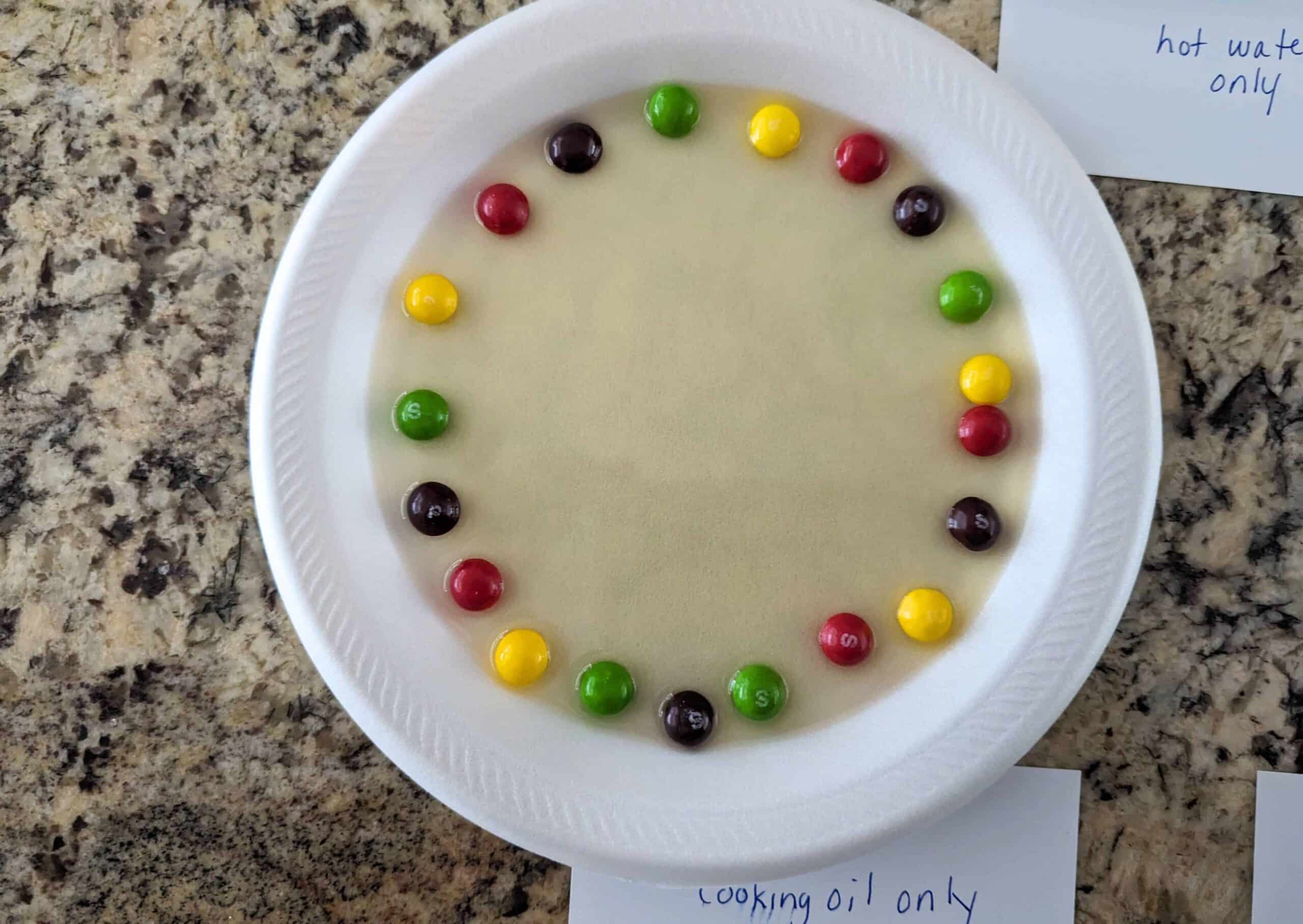
Because of their differences in how they share their electrons, polar and nonpolar molecules don’t like to play with each other. This is why we see that the sugars and dyes of the Skittles don’t dissolve in oil. The unequal charges of the Skittles’ molecules are repelled by the nonpolar molecules of the oil.
Download the Skittle Experiment Worksheet Pack
Other Resources You Might Enjoy

I hold a master’s degree in child development and early education and am working on a post-baccalaureate in biology. I spent 15 years working for a biotechnology company developing IT systems in DNA testing laboratories across the US. I taught K4 in a private school, homeschooled my children, and have taught on the mission field in southern Asia. For 4 years, I served on our state’s FIRST Lego League tournament Board and served as the Judging Director. I own thehomeschoolscientist and also write a regular science column for Homeschooling Today Magazine. You’ll also find my writings on the CTCMath blog. Through this site, I have authored over 50 math and science resources.