


The Richter Scale Activity
Through the centuries many myths, folklore and scientific theories have been created to explain earthquakes. However, the most current and widely accepted theory is the plate tectonics theory. This theory was first discussed in the early 1900’s by a German scientist Alfred L. Wegener.
The Earth’s crust is divided into sections or plates.
Think of these plates as a huge jigsaw puzzle on the Earth. The rock that makes up these plates can handle some moving and stretching, but just like a rubber band that is stretched too far, the rocks can “snap” and split apart. Have you ever felt a rubber band that snapped and broke? There is a lot of energy released and the snapping rubber band can hurt when it hits your skin.
When these plates move along their boundaries by either squeezing, sliding or stretching, and the movement is “stretching” the Earth too far, the Earth moves and shakes causing an earthquake.
The image below shows the plates earth scientists have identified. Find the area in the world in which you live. Which plates are located where you live?
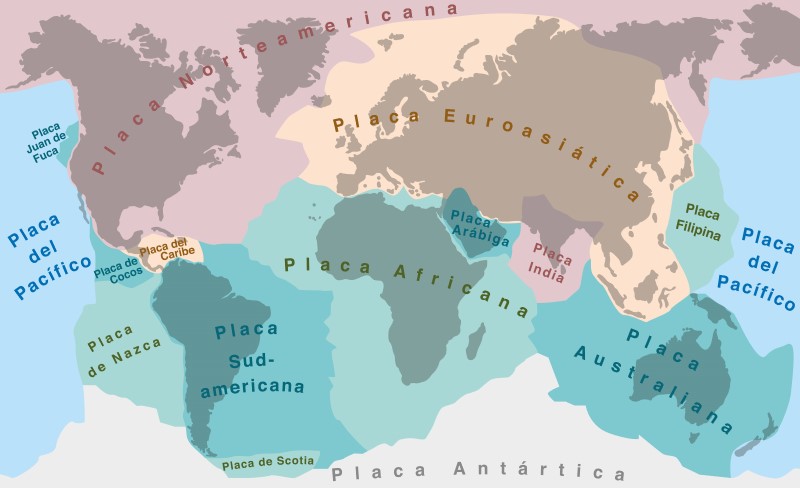
The tectonic plates are in constant motion and each plate moves at a different rate. The African Plate moves about 25 millimeters a year, and the Australian Plate moves 60 millimeters a year. Grab a ruler and measure off those distances. Would you consider that large distance for the Earth’s crust to move?
TRY THIS >> Have your children draw a line that is 20 millimeters and one that is 60 millimeters.
When these plates move against each other, a tremendous amount of energy is stored up. When the force and energy becomes too much, the energy is released in the form of seismic waves. These waves then move outward and move the Earth. When they reach the Earth’s surface, everything on the Earth (in that particular area) shakes.
Earthquakes can last for a few seconds or a few minutes. The movement can be a slight shaking, a slight rolling, or a sudden jolt.
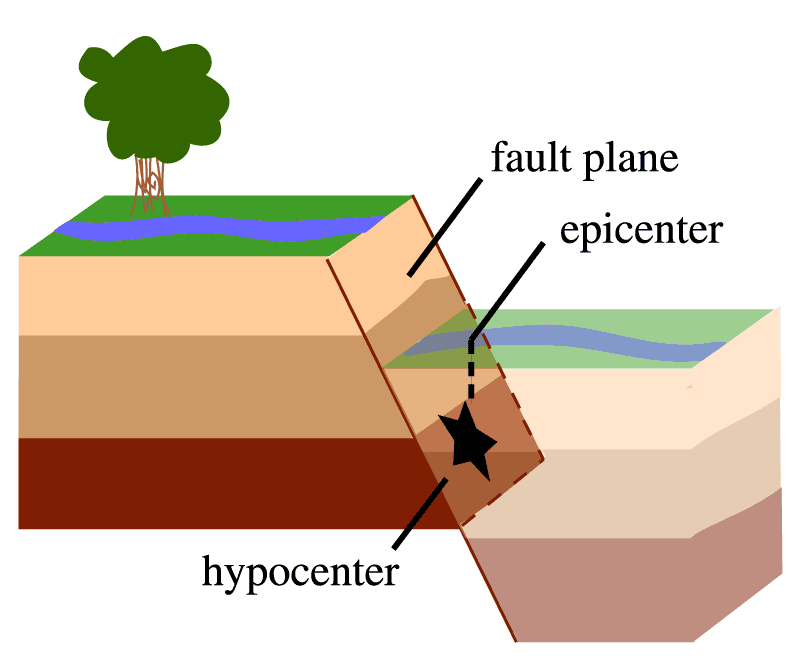
Where the two plates slip or slide by each other is called the fault line. The place where the sliding began is called the hypocenter.
The area on the Earth’s surface that is right above the hypocenter is the epicenter. By the way, the closer a house, building, bridge or road is to the epicenter, the more damage it will experience.
Fun Fact: Moonquakes happen on the Moon! They are not as strong as earthquakes and do not happen as often as earthquakes.
The Richter Scale and the The Modified Mercalli Scale
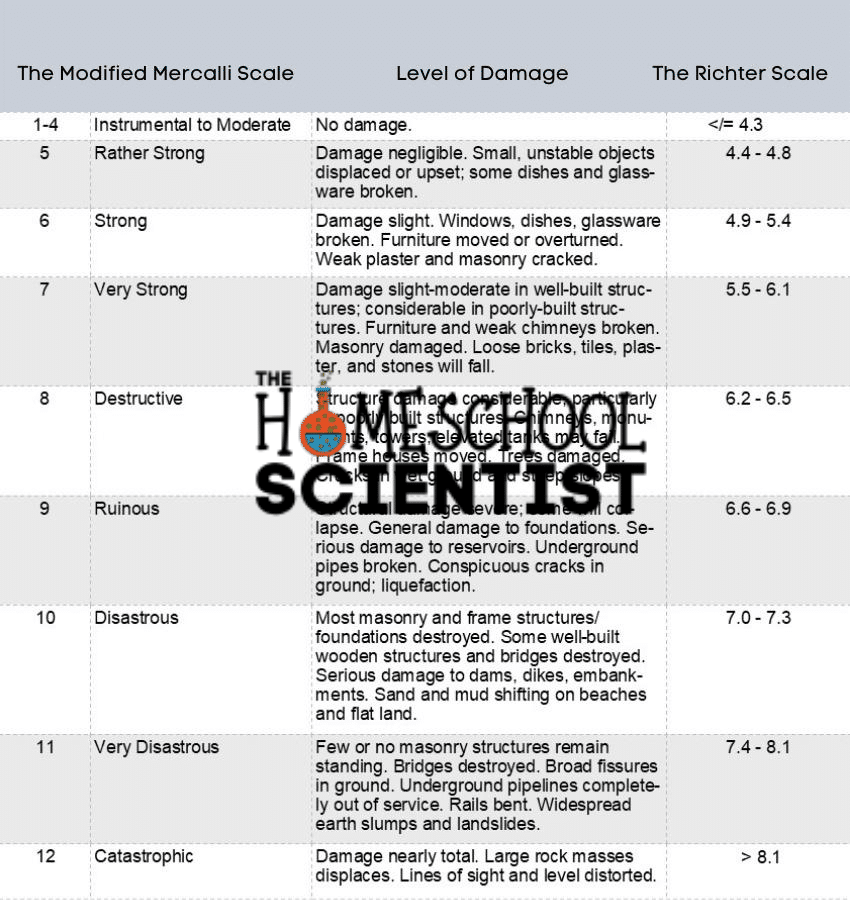
Scientists use two scales, The Modified Mercalli Scale and the Richter Scale, to describe the strength of a an earthquake. When hear about an earthquake on the news, we usually hear the Richter scale measurement.
The Richter Scale was developed by Charles Francis Richter. He was a physicist and seismologist at Cal Tech. The Richter Scale was first used in 1935.

Use the earthquake research form (see below) to research several earthquakes in history. Can you find information on earthquakes of different readings on the Richter scale? Compare the damage reported and the Richter scale measurement.

I hold a master’s degree in child development and early education and am working on a post-baccalaureate in biology. I spent 15 years working for a biotechnology company developing IT systems in DNA testing laboratories across the US. I taught K4 in a private school, homeschooled my children, and have taught on the mission field in southern Asia. For 4 years, I served on our state’s FIRST Lego League tournament Board and served as the Judging Director. I own thehomeschoolscientist and also write a regular science column for Homeschooling Today Magazine. You’ll also find my writings on the CTCMath blog. Through this site, I have authored over 50 math and science resources.