


Valentine’s Chemistry Activity with Free Printable

This Valentine’s chemistry activity contains a recipe that we have tweaked and tested, so enjoy making a batch and sharing a warm and “fizzy” Valentine with family, friends, or someone who needs a little surprise.
To make your gifts even sweeter, pair them with an artsy, handmade I Love You to Pieces Craft; it’s the perfect creative add-on that turns a simple science activity into a heartfelt keepsake.
During the first attempt to make these fizzy baking soda hearts, we noticed some of the hearts broke apart during delivery to some friends.
So, the challenge was on to engineer a recipe that was more durable!
After spending some time thinking about our broken hearts, I realized what we needed was a binder. In chemistry, a binder is a substance that makes things stick together. The simplest example of a binder is glue, so I added some white glue to my heart mixture, and voila! I had a much stronger heart!
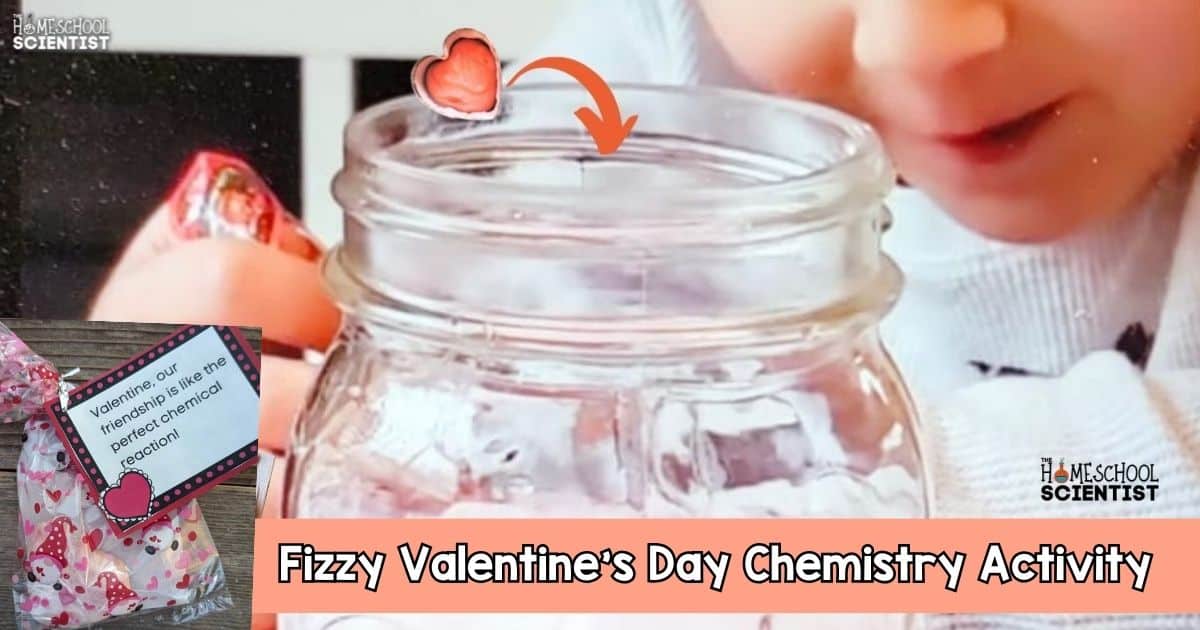

Valentine’s Chemistry Activity
Equipment
- 1 2" heart cookie cutter. You can use a 1" or 3" cookie cutter, you'll need to adjust the vinegar used.
- 1 Small bowl
- 1 mixing spoon
- 1 measuring cup
- 1 set of mixing spoons
- 1 Roll of wax paper
- 1 Plastic or butter knife We'll use the blunt side to smooth out the water-baking soda "dough"
- 1 Baking sheet or foil baking sheet
- 1 Large jar or large mason jar
Materials
- 1/2 Tablespoon White school glue
- 4 Tablespoons Hot water
- 11 Tablespoons Baking soda
- 12 Drops Red food coloring
- 1 2" cookie cutterss
- 1 bottle White vinegar
Instructions
- Add 1/2 Tablespoon of glue to the hot water, and stir until the glue is mixed well.
- Add 11 T of baking soda into the red glue/water mixture.

- Place the heart cookie cutter on a piece of wax paper, and pour a little bit of the mixture from step 4 into the heart. If you have some overflow, use the blunt side of the butter knife to smooth off the excess. Leave the cookie cutter in place for 8 to 10 minutes.

- Carefully remove the heart from the cookie cutter and let dry overnight.

- If you are going to use these as a chemistry activity for your children or class, gather the vinegar and jar. Place the jar inside a baking pan so the mess is contained. If using a 2" heart cookie cutter, start with 1 cup of white vinegar. Pour the vinegar into the jar. Drop in the heart and enjoy!

- If using these as fun Valentine's Day gifts, print the cards and instructions, gather some construction paper and glue.
- Wrap them up and have fun sharing with grandparents, other family members, neighbors, and friends. Make sure to hand these to adults or older students and let them know these are not edible, but are for fun Valentine's chemistry!


Video
Download the Printable
The Science Behind the Valentine’s Chemistry Activity
Explanation of What Happened:
The vinegar (acetic acid) is an acid, and when mixed with baking soda (bicarbonate), which is a base, a chemical reaction occurs, and a gas forms. This gas is carbon dioxide. Carbon dioxide is invisible, but we knew it was there because of the bubbles. Did you know you exhale carbon dioxide?
Variations on the Valentine’s Chemistry Activity & Other Related Activities
While you have out the baking soda and vinegar, enjoy this fizzy love potion STEM activity that can be enjoyed by toddlers and teens alike! Allow plenty of time for this activity, because kids love to explore chemical reactions by testing their ideas, and science is about hypothesizing and testing. It pairs playful experimentation with simple materials and is a great follow-up that encourages curiosity, observation, and creative problem-solving for early learners and older students alike.
Here are some variations to try on our Fizzy Valentines chemistry activity:
Other Fizzy Chemistry Activities
Since you have the baking soda, vinegar, and food coloring out, why not try a few other fizzy chemistry activities?

I hold a master’s degree in child development and early education and am working on a post-baccalaureate in biology. I spent 15 years working for a biotechnology company developing IT systems in DNA testing laboratories across the US. I taught K4 in a private school, homeschooled my children, and have taught on the mission field in southern Asia. For 4 years, I served on our state’s FIRST Lego League tournament Board and served as the Judging Director. I own thehomeschoolscientist and also write a regular science column for Homeschooling Today Magazine. You’ll also find my writings on the CTCMath blog. Through this site, I have authored over 50 math and science resources.