


Chemical Reaction Pumpkin Patch – A Chemistry Activity for Kids

This chemistry activity for kids puts an artistic and colorful twist on the traditional baking soda and vinegar combination. Having a very artsy child, having activities on hand that blend science with art or adding an art history or craft alongside a science or history activity always engages my kids more.
After the chemistry explanation for this activity, I do list some fun craft ideas you can add for your young learners.
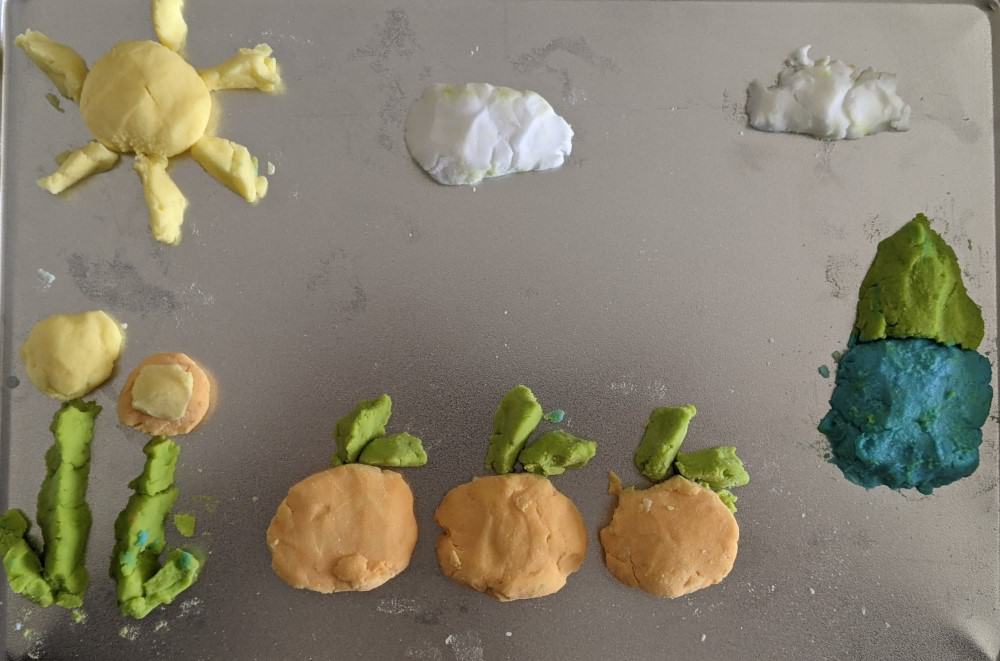
While completing this chemistry activity, your youngest scientists will learn and observe how:
- A liquid and solid mix to change the properties of the solid
- A liquid and solid mix to create a gas
- The primary colors of red, yellow, and blue can be mixed to make new colors (orange, green)
We designed and tested this activity with preschool and elementary ages, but honestly, we all had fun creating our pumpkin patches.
I highly recommend you have your children wear gloves when handling food coloring. Our four-year-old twins love mixing colors, but what a mess food coloring makes.
Tip: We did discover that baking soda and vinegar can remove food coloring from skin. It might take a few applications, though.
Reading Reccommendations
One of my absolute favorite college classes was Children’s Literature for Elementary Grades. From the start of my lesson planning days, I always incorporated several read-alouds into a day.

Whopper Cake is sure to get some giggles, and it presents the idea of mixing substances and creating a chemical reaction. I’ve used this with 4-year-olds before when introducing baking soda and vinegar activities. Oh, how they giggled!
If you are doing this chemistry activity with children from preschool to second grade, consider the read-aloud Whopper Cake.
The other title pictured is Chemistry (Baby’s Big World.) I found the content better suited for K-3rd grade, as it discusses elements, The Periodic Table, molecules, and more. Fore those early elementary ages, it’s a straightforward explanation. It was way too much for our four-year-old twins.
A Few Notes Before Starting
- While we have made our project Fall-themed on this post, you can adapt this for any season. Make a summer flower garden or snowflakes and snowmen for winter.
- Add a few drops of Dawn to the playdough to add some extra fizz.
- Have extra baking soda and vinegar on hand to allow students to explore more and take the activity where their curiosity leads them.
If you want to turn this activity into an experiment with a variable that changes, here are some ideas:
- Mix the food coloring with milk? Will the milk and baking soda mix to form a “dough”? Will the vinegar have the same chemical reaction with the milk-based dough as the water-based “dough”?
- Mix the food coloring with lemon juice. Will the lemon juice and baking soda mix to form a “dough”? Will the vinegar have the same chemical reaction with the lemon juice-based “dough” as the water-based “dough”?
Supplies You Need for This Activity
- 1 ½ to 2 cups of baking soda
- 6 Tablespoons of water (room temperature to cool is fine)
- Food coloring: yellow, red, blue (leave out the green, as we’ll make that by mixing blue and yellow)
- 2 to 3 cups of vinegar
- Five plastic containers for mixing
- Five small bowls or cups
- Spoons
- Child-size droppers (We have two of these sets that come with droppers.)
- Tablespoon measuring spoon
- ¼ cup measuring cup
- ½ cup measuring cup
- Foil or metal baking sheet
- Paper towels
- Gloves (if you’re trying to keep fingers from getting stained by the food coloring)
Questions to Ask Before Starting this Chemistry Activity for Kids
- What do you think will happen when we mix the water and bake soda?
- What do you think will happen when we add vinegar to the water and baking soda?
- In this activity, we will make some “dough” out of baking soda, water, and food coloring. We have three colors—red, yellow, and blue. How can we mix the colors to make orange dough?
- What colors do you mix to get green?
What to Do:
- Measure ½ cup of baking soda into one of the mixing containers
- Next, measure ¼ cup of baking soda into each of the four remaining mixing containers.
- Measure 2T of water into a small bowl or paper cup.
- Mix the 2T of water, 2 drops of red food coloring, and 8 drops of yellow food coloring. Stir well.
- Add the orange water to the ½ cup of baking soda and stir well. The mixture should form a soft dough that sticks together well.
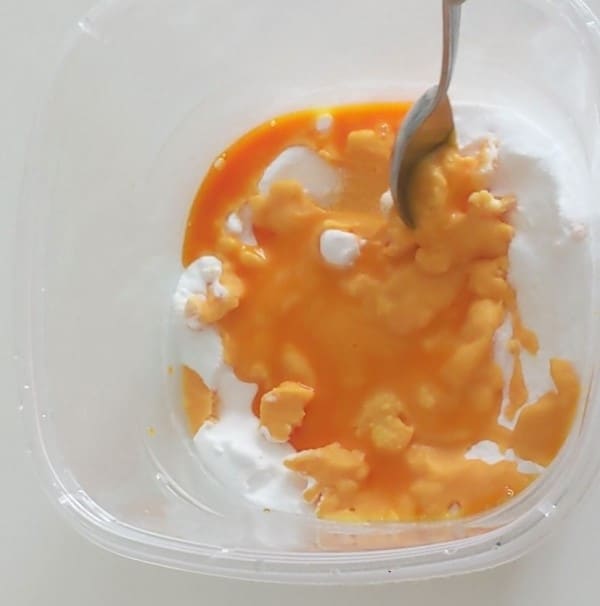
- Measure 1 T water into the remaining four small bowls or paper cups.
- Set aside one of the water cups for dough that will not be colored.
- Add two drops of blue to one of the water containers and stir.
- Add two drops of blue and 8 drops of yellow to another water container and stir.
- Add 3 drops of yellow to the fourth container of water and stir.
Next:
- Pour the plain water into ¼ cup of baking soda and stir to make a dough. You may want to stir with a spoon and then mix by hand.
- Pour the yellow water into ¼ cup of baking soda and stir to make a dough. You may want to stir with a spoon and then mix by hand.
- Pour the blue water into ¼ cup of baking soda and stir to make a dough. You may want to stir with a spoon and then mix by hand.
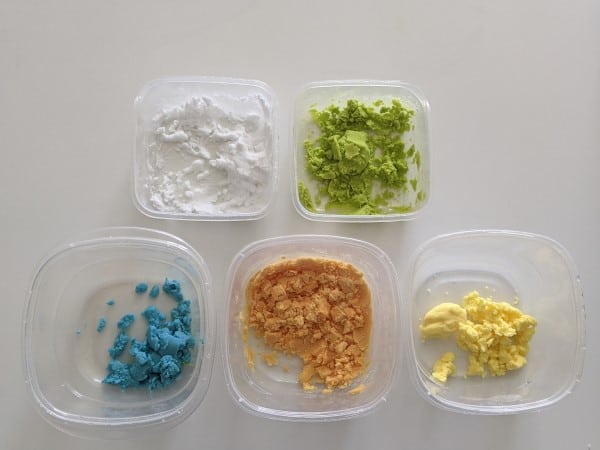
You should now have five baking soda “dough” containers – orange, white, yellow, blue, and green.
Design and create a pumpkin patch scene with the dough on the cookie sheet.
Once the design is complete, use a dropper or paper cup to pour vinegar over the baking soda “dough” and watch the pumpkin patch fizz!
With extra baking soda, vinegar, and food coloring on hand, mix up more “dough” and try different color combinations.
One tablespoon of water for every ¼ cup of baking soda is a good formula.
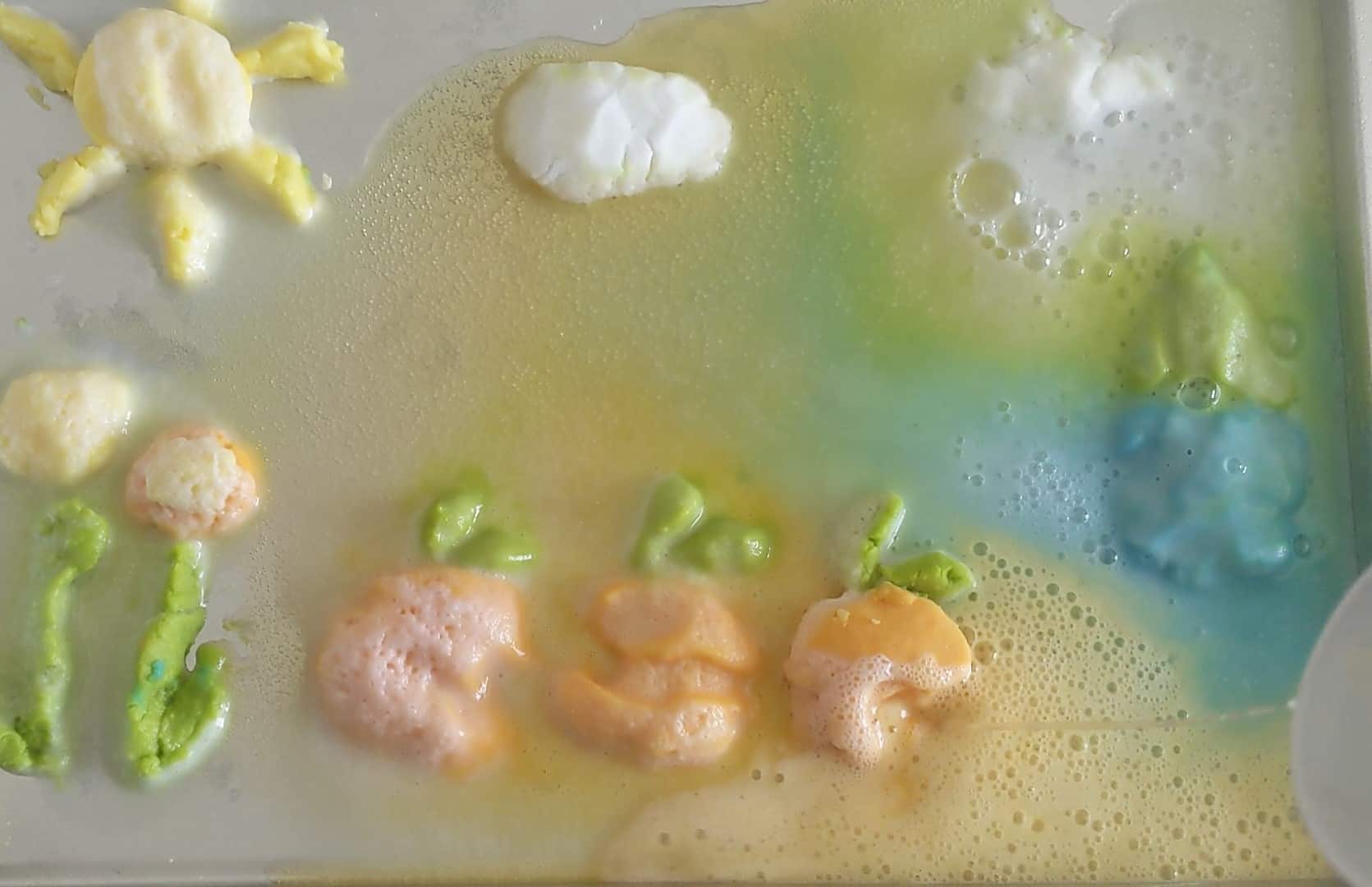
Watch our video of this activity:
Explanation of What Happened in This Chemistry Activity for Kids:
The vinegar is acetic acid. When it is mixed with baking soda, which is sodium bicarbonate, a chemical reaction occurs, and a gas forms. This gas is carbon dioxide. Carbon dioxide is invisible, but we knew it was there because of the bubbles. Did you know you exhale carbon dioxide?
A more in-depth explanation for older students from the University of California, Santa Barbara website.
Time for More Discovery Learning!
This is the time to let your child take the activity further by testing some of their ideas and ask them a few questions to get them started:
“What if we add more vinegar?”
“What if I mix to drops of each color into the water?”
“What if I used orange juice?”
(Within limits 😊) Encourage your child to test their ideas. Discuss what they think will happen, and test it!
Pumpkin Arts and Crafts
For preschool and early elementary students, hands-on art projects:
- 🎨 Deepen understanding. When our young children can use craft materials to create a model of what they studied or learned, it helps them understand more abstract concepts. For example, to a four year old, the idea of a life cycle is something new to them, but crafting a pumpkin with seeds inside helps them understand why a pumpkin has seeds and how it helps the plant.
- 🧠 Build fine motor and observation skills. Cutting, painting, and gluing train focus and hand–eye coordination while also encouraging careful observation — two skills every budding scientist needs.
- 💡 Boost curiosity and creativity. Art invites experimentation — the same kind of creative thinking scientists use when testing ideas. It teaches that “mistakes” are just part of discovering something new.
- 💬 Support language and communication. When children describe what they made or explain how it works, they’re developing the scientific habit of communicating results and reasoning.
- 💖 Make learning memorable. A colorful craft tied to a science topic becomes a visual anchor — kids remember the lesson because they built it.
Add some of these arts and crafts to this chemistry activity for added creativity and curiosity:
Try these Additional Chemistry Activities:

I hold a master’s degree in child development and early education and am working on a post-baccalaureate in biology. I spent 15 years working for a biotechnology company developing IT systems in DNA testing laboratories across the US. I taught K4 in a private school, homeschooled my children, and have taught on the mission field in southern Asia. For 4 years, I served on our state’s FIRST Lego League tournament Board and served as the Judging Director. I own thehomeschoolscientist and also write a regular science column for Homeschooling Today Magazine. You’ll also find my writings on the CTCMath blog. Through this site, I have authored over 50 math and science resources.