


Earth Day Math Activities

Celebrate Earth Day with our Earth Day math activities that utilize geoboards, pattern blocks, and linking cubes.
Before we even started a formal math curriculum in our homeschool, we started with pattern blocks. We used premade worksheets and workbooks, but also did a lot of free design activities.
With our youngest, who was diagnosed with dyscalculia, hands-on manipulatives like pattern blocks, geoboards, and linking cubes helped us add concrete representations to math concepts.
Young learners need to touch, build, move things around, and see how stuff works. That’s why hands-on math tools are so powerful during these early years. Geoboards, pattern blocks, and linking cubes help kids really understand math—because they can explore it in a way that makes sense to them.
While your young mathematician is enjoying these Earth Day math activities, enjoy some cute Earth Day books for kids. The list is perfect for preschool through early elementary. We loved combining reading time with hands-on time. One of our favorites on the linked list is Compost Stew: An A to Z Recipe for the Earth by Mary McKenna Siddals. We do have a composting activity to go with this book (and others on the list).
Geoboards Make Shapes Come to Life
Geoboards are one of those simple tools that can be used in so many different ways. Kids stretch rubber bands across the pegs to create shapes, patterns, or designs. It’s a great way for them to explore geometry and learn about shapes, sides, angles, and symmetry—and at the same time, they’re working on fine motor skills. You can even use geoboards to introduce perimeter or area later on, once your child is ready.
Pattern Blocks Are Great for Building and Thinking
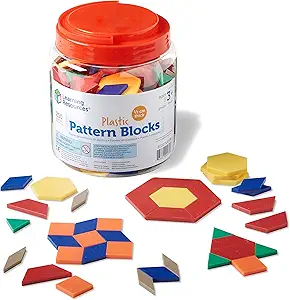
There’s something about pattern blocks that kids just love. They’re colorful, easy to hold, and super inviting. But beyond the fun, these blocks help kids explore important ideas like symmetry, fractions, patterns, and how shapes fit together. When a child figures out that two triangles make a square or that three triangles can become a trapezoid, they’re building a strong foundation in spatial reasoning. And because these blocks are so open-ended, they’re also perfect for creative play that still builds math skills.
Linking Cubes Help Kids Understand Numbers
Linking cubes (you might know them as snap cubes) are a favorite for teaching number sense and early operations. They snap together, so kids can build towers, model math problems, and group them to understand concepts like place value, counting by tens, or even beginning multiplication. We have also used them for comparing numbers, measuring, or sorting.
We have put together these three Earth Day themed hands-on math resources you can easily add to your teaching plan. If you want to use them long-term, laminate them or slide them into a plastic protector. All the supplies you need are linked here:



Download the Earth Day Math Activities
Request the Earth Day math activities using the request boxes below. All of our free math resources are sponsored by CTCMath. With a comprehensive curriculum covering everything from kindergarten through high school, students can grow in their math skills with CTCMath year after year without needing to switch programs. Lessons are tailored to each learner, allowing the platform to adjust to a student’s strengths while gently reinforcing areas that need more practice. The interactive format keeps learning engaging, using clear teaching videos, interactive questions, and instant feedback so students immediately understand what they’re doing right and where they need help. Because the program is self-paced, children can move forward when they’re ready or spend extra time on challenging topics, helping them build true understanding rather than rushing through lessons. It’s no surprise that this award-winning program is trusted by homeschool families around the world who appreciate its consistent results and supportive approach to learning math.
Use these resources alongside your curriculum as warm-ups, skill reinforcement, or just for fun! When you request one of the resources below, your email will be added to The Homeschool Scientist and CTCMath email communities.
You will be added to our email community. Explore additional Earth Day STEM activities here.
If you want more ideas for hands-on math resources, check out our library of free math activities and our post highlighting over 40 math manipulatives.

I hold a master’s degree in child development and early education and am working on a post-baccalaureate in biology. I spent 15 years working for a biotechnology company developing IT systems in DNA testing laboratories across the US. I taught K4 in a private school, homeschooled my children, and have taught on the mission field in southern Asia. For 4 years, I served on our state’s FIRST Lego League tournament Board and served as the Judging Director. I own thehomeschoolscientist and also write a regular science column for Homeschooling Today Magazine. You’ll also find my writings on the CTCMath blog. Through this site, I have authored over 50 math and science resources.