


Earth Day Activity- Composting Experiment and Activity for Kids


We love it when Spring arrives here in the southern U.S. We put chicken manure in our raised beds in February since we typically have an unseasonably warm spell here in NC during February. We add to our composting efforts all winter, and we start discussing what we’ll plant in the upcoming growing season.
We recently added composting activities to our gardening efforts. Standing on the border of our woods, we are surrounded by decades of natural composting. In this composting experiment activity, we’ll look at composting, how to start a composting bin (big or little), and what can and cannot be composted.
You may want to check out our composting cups activity and experiment ideas on this post. I highly recommend doing an earthworm study alongside this composting activity; worms help make a healthier compost pile and garden. Download this earthworm activity for kids that is ready to print and use, covering the parts of an earthworm and its life cycle.
While you’re learning about composting and what happens beneath our feet, take a closer look at the layers that make up soil. These Edible Earth Soil Layers Dirt Cups are a fun way for kids to model soil layers, and they get a tasty treat when the lesson is done!
Where to Use Compost?
Composting can be used with any type of gardens including raised beds and container gardening. Growing Family has a very helpful post on ten easy vegetables to grow in containers and how to do it.
We used our compost in our raised beds. You may also want to have your kids try square foot gardening and using their compost in this fun garden project.
Once a garden gets planted, it does take some attention to make sure the plants are watered and not getting choked by weeds, but there are so many lessons in gardening. Petra at A Mum Reviews shares The Garden Classroom – Benefits of Gardening for Children.

Photo courtesy: A Mum Reviews

Why Compost?
We started our first year of raised bed gardening with much zeal and enthusiasm. We hauled our utility trailer two miles down the road and brought backfill dirt for the boxes.
Plants were placed using a little 10-10-10 fertilizer, our homemade drip system was implemented, and we waited.
Unfortunately, our abundant harvest never arrived. The first year, our yield was abysmal. Despite using some “organic” fertilizer granules and consistent watering, the plants were stunted, and the fruit never grew large enough to ripen.
With the end of the summer season approaching, we concluded that the topsoil we had purchased lacked nutrients—lots of them! Applying fertilizer granules every 3 to 4 weeks was just a band-aid. We needed to build a nutrient-rich base in the boxes to enjoy a better harvest the next growing season.
And thus, our years-long homeschool science project was created—composting!
Composting helps us naturally remediate an existing garden area and can help us start off with a nutrient-rich foundation in a new planting area. So, let’s talk more about what composting is.
What is Composting?
Composting is the process of turning food scraps, lawn clippings, leaves, and other yard waste into healthy soil.
The next time you’re on a hike or nature walk with your children, have them look for signs of decomposition—those dead leaves, twigs, fallen branches and tree trunks are all part of a natural compost pile!

Microorganisms, such as bacteria and fungi, break down dead organic matter, such as leaves, twigs, and tree trunks, and recycle nutrients back into the ecosystem.
These microbes produce enzymes, specialized proteins that speed up chemical reactions and help break down organic matter (leaves, grass clippings, fruit, vegetables) into smaller molecules.
Kitchen scraps like potatoes, corn kernels, and celery stalks contain large molecules of carbohydrates and proteins.
When these microbes also have plenty of oxygen, they break down carbohydrates and proteins, releasing energy, carbon dioxide, and water. This is what we want in a compost bin or pile. It’s why a compost pile will release carbon dioxide and have an elevated temperature. The heat is a result of the breakdown process.

When organic material like food scraps, leaves, and twigs is placed in a pile without much oxygen, like in a landfill, it undergoes anaerobic decomposition. This causes the production of methane and more acidic liquid byproducts.
This is why waste management companies that pick up our trash have separate collection days for yard waste and/or request yard waste be kept out of household trash cans.
Composting food scraps not only produces nutrients that can be put back into our garden soil, but it also helps keep our landfills free from dangerous gases like methane.

Household trash, yard waste, and recycling cans keep items separated.
How to Get Started Composting
Before starting a compost bin or pile, everyone must be clear on what can and cannot be added to a compost pile. Besides the obvious yard waste of grass clippings and leaves, here are things that can be composted:
- Vegetable scraps
- Fruit scraps
- Eggshells
- Coffee filters
- Leaves and grass

What cannot be composted:
- Any meat and fish – These can lead to the growth of salmonella or listeria
- Dairy products
- Cooking oil
- The peels of citrus fruits
- Diseased plants
- Plants sprayed with harmful chemicals
- Any animal feces, pet litter
- Treated wood
- Fertilizer. Remove any fertilizer sticks if you are tossing in the potting soil from a planter.

Compost Bin or Pile?
There are several ways to structure your compost area. Two of the most popular are a compost pile with sides and open on top or with some wire “fencing” around it and a plastic bin. There are several other ways to set up your composting area. We have included a research activity in the accompanying printable for this month about different ways to set up a composting area physically. Before starting your composting area, have your children research the various options.
Compost piles need the following to thrive and stay disease and pest-free. Whatever compost method you choose, make sure these three factors are considered:

Layers of a Compost Pile
- Aeration: Aeration refers to the airflow within the pile. Good airflow allows microorganisms to break down organic materials faster.
- Moisture: Compost needs to be damp, like a wrung-out sponge. Too much water can cause it to smell. If the pile is too dry, the decomposition process slows down.
- Particle Size: Smaller pieces of materials break down faster than larger ones. Chopping or shredding materials helps speed up composting. If I have our chopper out when prepping vegetables or fruit with a meal, I will sometimes run the larger scraps through the food chopper.
It’s best to layer the materials you put in a compost pile so that it has good airflow and a balance of leaves and kitchen scraps.
Bottom Layer: This bottom layer helps set up the pile for airflow. Use twigs and sticks to help facilitate airflow from the bottom to the top.
Green Material Layer: Next, add a layer of green materials, like the vegetable and fruit scraps. The purpose of the green layer is to provide nutrients to the microbes. This nutrient is mostly nitrogen.
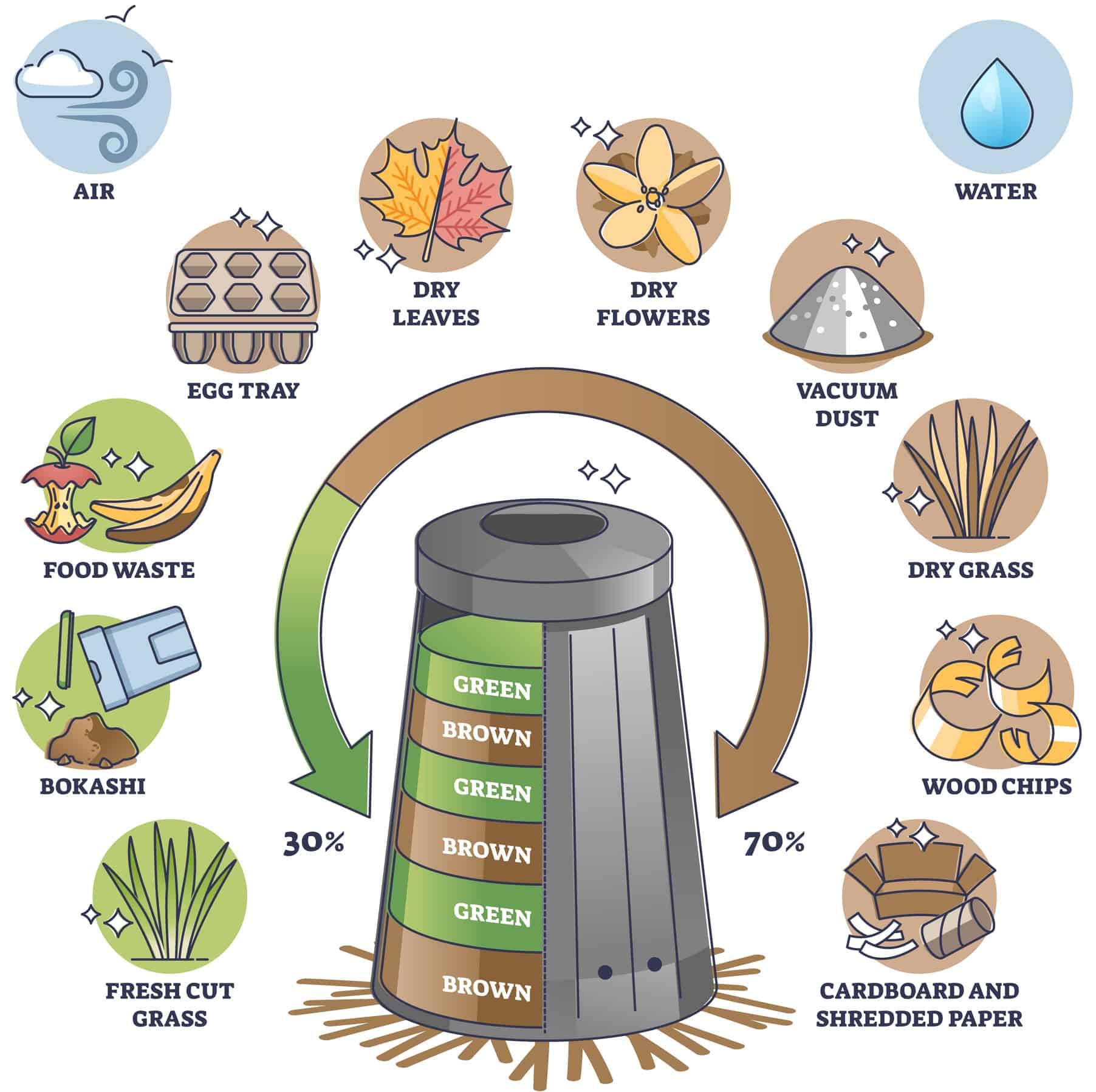
Vegetable and fruit scraps, fresh grass clippings, and the softer and greener parts of plants (free of disease) can be added to the green layer of your compost. Brown Material Layer: We put the brown layer on top of the green layer. The brown materials are rich in carbon, which helps provide energy for the
Layers of a Compost Pile
It is important to turn the compost pile weekly to keep it healthy and free of bad bacteria like salmonella and odors. We opted for a compost bin on a stand with a handle we could easily turn. To turn a pile in your yard, use a pitchfork or shovel.
Check to make sure you don’t have an invasion of rodents. If they appear, it could be materials making their way into the compost bin that shouldn’t be there.

The moisture level should also be checked. If it’s too dry, add a little water. If there is a bad odor, it could be a sign that the pile is too wet.
Once your compost pile has broken down and you have healthy, nutrient-rich soil material, you can add worms to it.
Composting helps reduce waste in our landfills, especially yard waste and food scraps that can create harmful gases. The added nutrients composting returns to the soil help us grow healthier and more beautiful flowers, vegetables, and fruits. These healthy plants provide food for wildlife, including pollinators.
However, the best benefits of a composting project are the knowledge gained and the time spent together on a family project. Whether you have just enough room for a tumbler-type composting bin or space for a larger pile, just get started!
Composting Experiment Activity for Kids
Before starting this composting activity, request the activity packet that goes with this. It does include the instructions for the activity, along with some composting worksheets.
Composting Experiment and Activity for Kids
Materials
- 2 Large jars
- Soil
- Vegetable and fruit scraps that can be composted
- Yard waste – leaves, twigs, grass, pinecones, etc.
- Water
- Gardening gloves and a trowel
- Non-compostable items (plastic bottle cap, a piece Styrofoam egg carton, a plastic lid, etc.
Instructions
- In both clear containers, place a few pieces of small twigs into the bottom of each jar. Add some on top of the twigs if you have a few dead leaves.

- Add a few blades of grass, if available.

- Add soil from your garden. You can also use bagged potting soil.
- Add a large piece or two of fruit or vegetables in one jar.
- Add a piece of plastic or Styrofoam in the other jar.
- Top with more soil and grass clippings.
- Pour a little water on top. Start with ¼ cup of water. Add more if needed.
- Place in a safe place and observe for several days or weeks. You may want to place the jars outside in an area protected from rain. Pictured here are our two mini-compost bins. The one on the right has a plastic bottlecap. This photo was after 6 months outside.


Request the Composting Experiment Worksheets
Input your email address below, and we’ll send you the free printable that accompanies this activity. You’ll be added to our email community but can unsubscribe at any time.

I hold a master’s degree in child development and early education and am working on a post-baccalaureate in biology. I spent 15 years working for a biotechnology company developing IT systems in DNA testing laboratories across the US. I taught K4 in a private school, homeschooled my children, and have taught on the mission field in southern Asia. For 4 years, I served on our state’s FIRST Lego League tournament Board and served as the Judging Director. I own thehomeschoolscientist and also write a regular science column for Homeschooling Today Magazine. You’ll also find my writings on the CTCMath blog. Through this site, I have authored over 50 math and science resources.