


Hands-on Fall and Thanksgiving Math Activities & Worksheets
Fall is the perfect time to add a festive twist to your math lessons. With pumpkins, turkeys, leaves, and pies everywhere, you can sneak in math practice that feels more like play than schoolwork. Thanksgiving math worksheets and free printables give kids the chance to explore important math concepts in fun, seasonal ways—while you get the benefit of stress-free lesson planning.
As someone with a master’s degree in child development and early childhood education, and with years of experience teaching preschool and K-4, I’ve seen firsthand how powerful holiday-themed activities can be. I loved setting up centers where the same math concepts are explored in new ways, depending on the season—pumpkins in October, snowflakes in January, and shamrocks in March. It kept kids excited, engaged, and eager to see what was coming next.
Key Math Concepts by Age Group
Preschool
At this age, math is all about building number sense through play and visuals. Worksheets and hands-on activities can focus on:
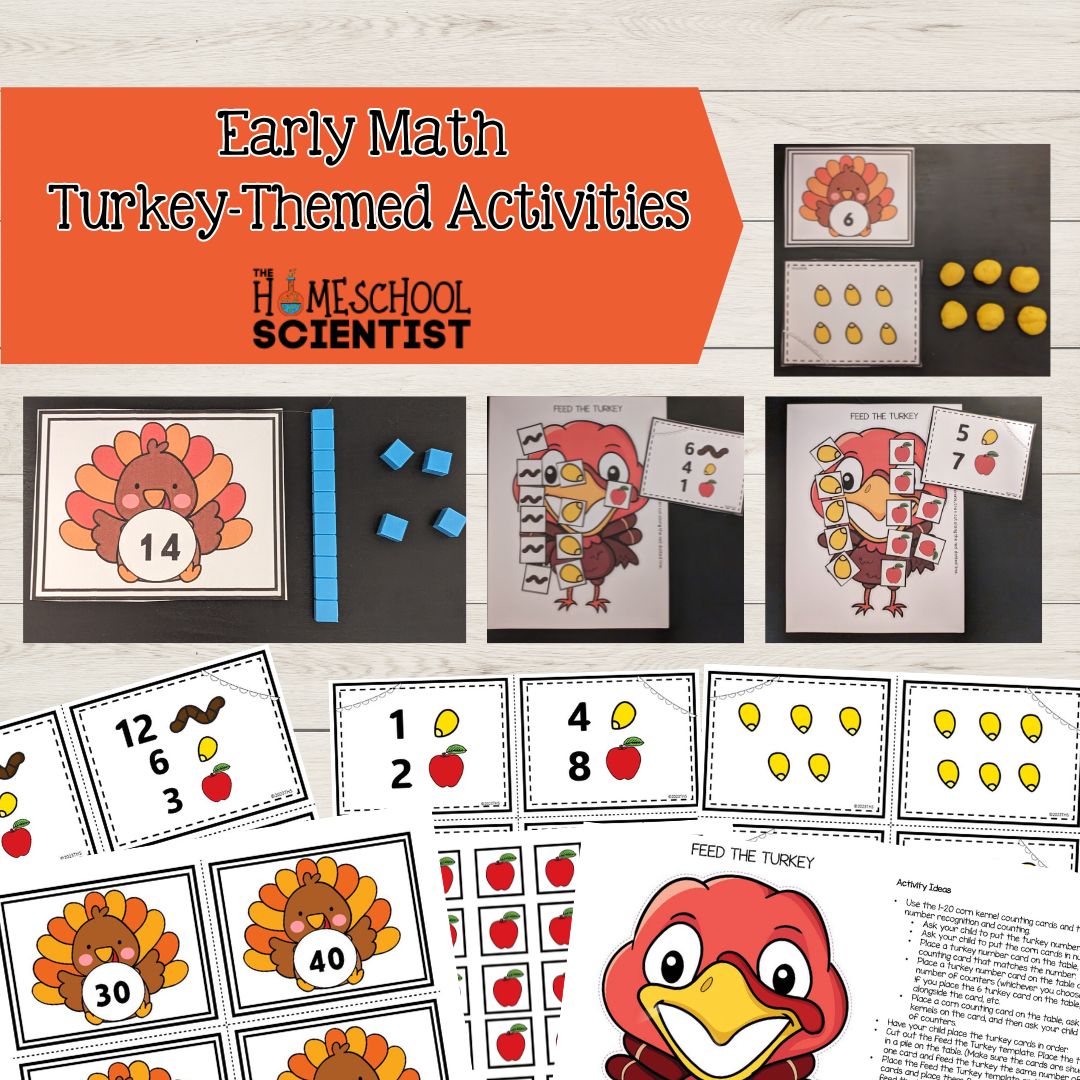
- Counting and One-to-One Correspondence – Activities could include counting turkeys, pumpkins, or pie slices. Check out our turkey counting printable below.
- Sorting and Classifying by size, shape, or color of leaves or gourds
- Patterns – AB, ABB, ABC with corn, feathers, or cranberries
- Shape Recognition – Look for circles, triangles, and rectangles found in pies, hats, and tables. We have linked some art activities below, too, using either one or more shapes.
Kindergarten
Kindergartners are ready to connect numbers to simple operations and real-world ideas. The number equation cards in our turkey printable below have simple addition and subtraction equations. Concepts to weave into Thanksgiving printables include:
- Number Recognition and Writing – tracing numbers on pilgrim hats or pumpkins.
- Simple Addition and Subtraction – How many pies are left after one is eaten?
- Comparing Quantities: Which basket has more apples?
- Sequencing and Ordering – Have your child arrange pumpkins from smallest to largest. Or have them help prepare one of your Thanksgiving recipes and discuss the first step, the last step, and all the steps in between.
Early Elementary (Grades 1–3)
By now, students can tackle bigger math challenges that still feel enjoyable with a Thanksgiving theme. Worksheets and activities could focus on:
- Addition and Subtraction Facts (with festive word problems)
- Basic Multiplication and Division (arrays of corn, sharing pies equally among family members)
- Place Value (tens and ones with acorns or turkey feathers)
- Measurement and Data (graphing favorite Thanksgiving foods, measuring the length of a table for the feast)
- Fractions (what fraction of the pie is gone, shaded turkey feathers)
Benefits of Hands-On Math Activities
While worksheets and printables provide structure, hands-on activities make math stick. For us, this was especially true when one of our children was diagnosed with dyscalculia. We had to get creative and focus on tactile learning—using beans, buttons, craft sticks, and pom poms as counters. These simple tools made abstract concepts concrete, and they provided her with the repetition she needed to build confidence and recall math rules that initially felt impossible to memorize.
Hands-on activities benefit all learners, but especially those who need math to be as concrete as possible:
- Concrete Understanding: Manipulating real or themed objects—like cranberries for counters or pumpkin seeds for grouping—helps abstract concepts click.
- Engagement: Kids stay focused when they’re cutting, gluing, sorting, or moving pieces around.
- Multi-Sensory Learning: Activities tap into visual, auditory, and kinesthetic learning styles, making math more accessible for all learners.
- Problem-Solving Skills: Games, puzzles, and challenges encourage kids to think critically rather than memorize.
- Seasonal Fun: Tying lessons to Thanksgiving traditions makes learning feel relevant and festive, boosting motivation.
With an artsy daughter, mixing art with science, math, history, and literature is something I’ve always done. Even when planning preschool and K4 activities in graduate school and while teaching, I found that integrating art appealed to all of the children and was an engaging way to provide a concrete representation to a concept or topic we were studying.
Here are a few Fall and Thanksgiving themed art activities to teach shapes, and other math concepts:
This is a no-prep scarecrow shape tracing resource. They work perfectly for reinforcing shape recognition and tracing in a seasonal, engaging way.

Image credit: 3dinosaurs.com
- Paper Roll Turkey Craft – Little ones can learn to identify circles while creating an eco-friendly holiday decoration that will look adorable with several placed on the Thanksgiving table!
- Indian Corn Math and Art – This is a creative way to make Indian corn that doubles as a math activity. Children practice counting and creating patterns while decorating their corn cobs with bright, festive colors.
- Practice fractions with this pumpkin pie paper plate fractions craft and math activity.
Below are our free Fall and Thanksgiving math worksheets and activities. These math resources are brought to our site visitors free of charge thanks to our math sponsor, CTCMath. When you request one of these your email address is added to the email community for The Homeschool Scientist and CTCMath. Thank you!

I hold a master’s degree in child development and early education and am working on a post-baccalaureate in biology. I spent 15 years working for a biotechnology company developing IT systems in DNA testing laboratories across the US. I taught K4 in a private school, homeschooled my children, and have taught on the mission field in southern Asia. For 4 years, I served on our state’s FIRST Lego League tournament Board and served as the Judging Director. I own thehomeschoolscientist and also write a regular science column for Homeschooling Today Magazine. You’ll also find my writings on the CTCMath blog. Through this site, I have authored over 50 math and science resources.