


Glow Stick Experiment: How Does Temperature Affect Glow Sticks?


In this glow stick experiment, we will learn how glow sticks work because of a fascinating process called chemiluminescence. This word means it’s a chemical reaction producing light.
We use some big words in this lesson, but even preschoolers will enjoy watching the glow sticks glow in cups of water—in the dark! So, grab several packets and enjoy the glow stick experiment with the whole family!
Glow Stick Experiment: Does Temperature Affect a Glow Stick?
Hypothesis:
Talk with your students about a hypothesis for this experiment. Ask them, “Which glow stick do you think will glow the brightest, the one in cold water, the one in room-temperature water, or the one in warm water?
A possible hypothesis is: I think the glow stick in warm water will glow the brightest because heat makes the chemical reaction happen faster. Have students write down their hypothesis before beginning the experiment. After they conduct the experiment, they will use their observations to see if their prediction is correct.
What You’ll Need
Here are the materials you’ll need for the glow stick experiment:
- 2 packages of glow sticks
- 1 cup each of hot, cold, and room-temperature water
- 1/2 cup ice
- Printout
Directions for the glow stick experiment:
This works best when observing the glow sticks in a darkened room.
Before getting started, remember we are going to use a scale of 1 to 10 to rate the brightness. 1 is no light at all, and 10 is used if it’s an extremely bright glow.
Label the three containers as “Ice”, “Ice Water”, “Room Temp,” and “Warm Water.“
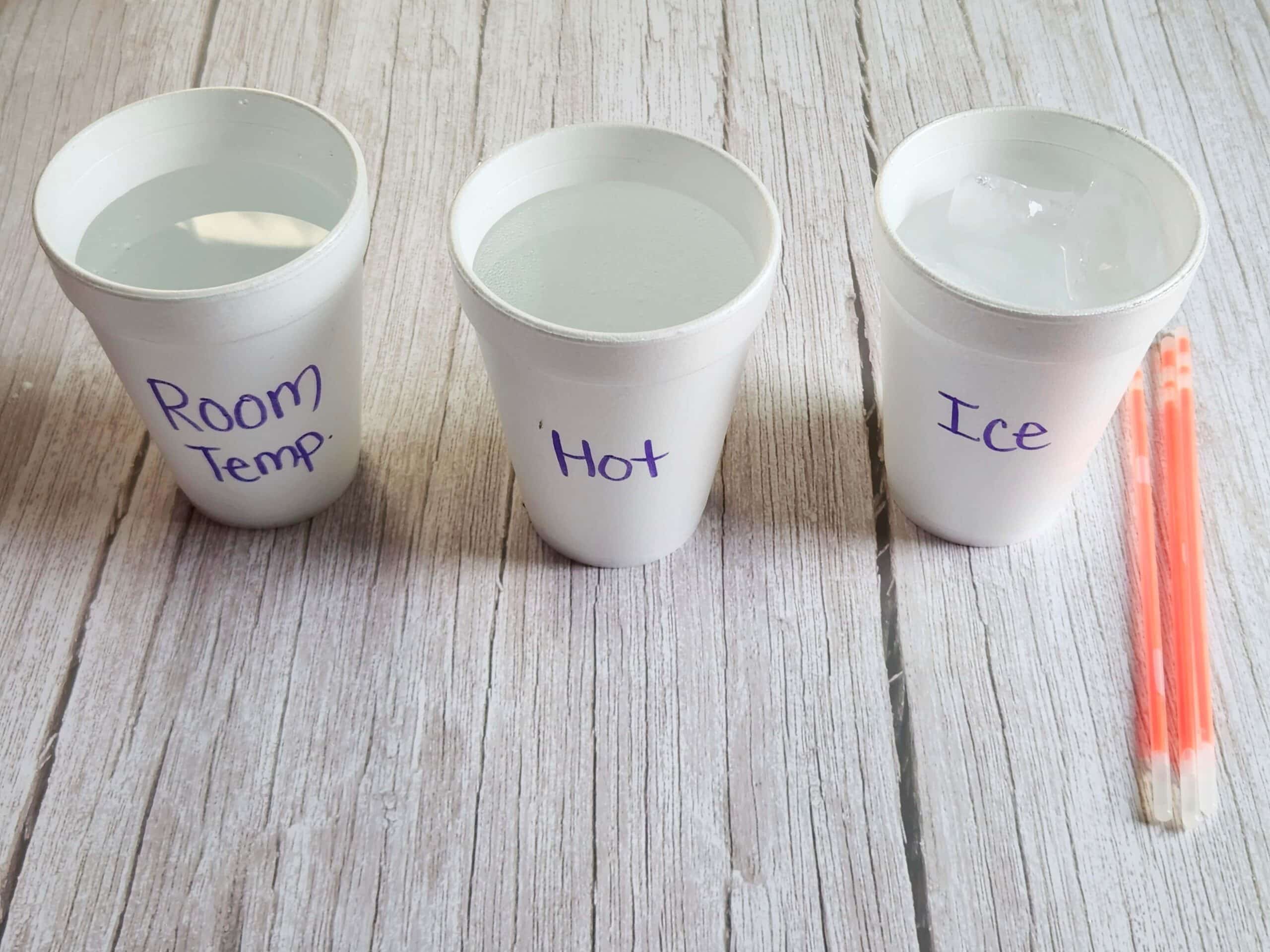
Pour cold water with ice into the “Ice” cup, pour room temperature water into the “Room Temp” cup, and pour hot water into the “Hot Water” cup.
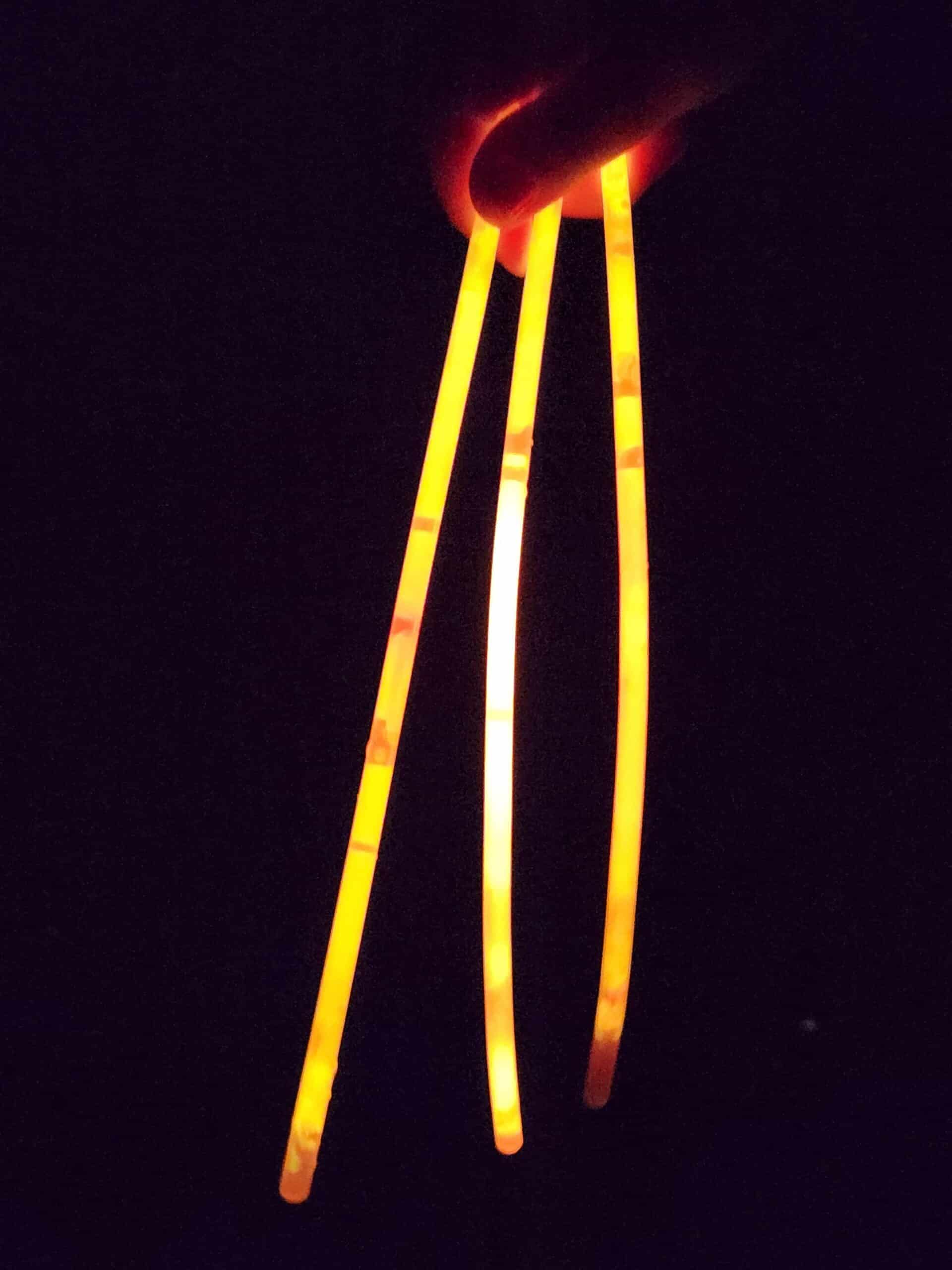
Bend three glow sticks so they begin their chemical reaction and glow.
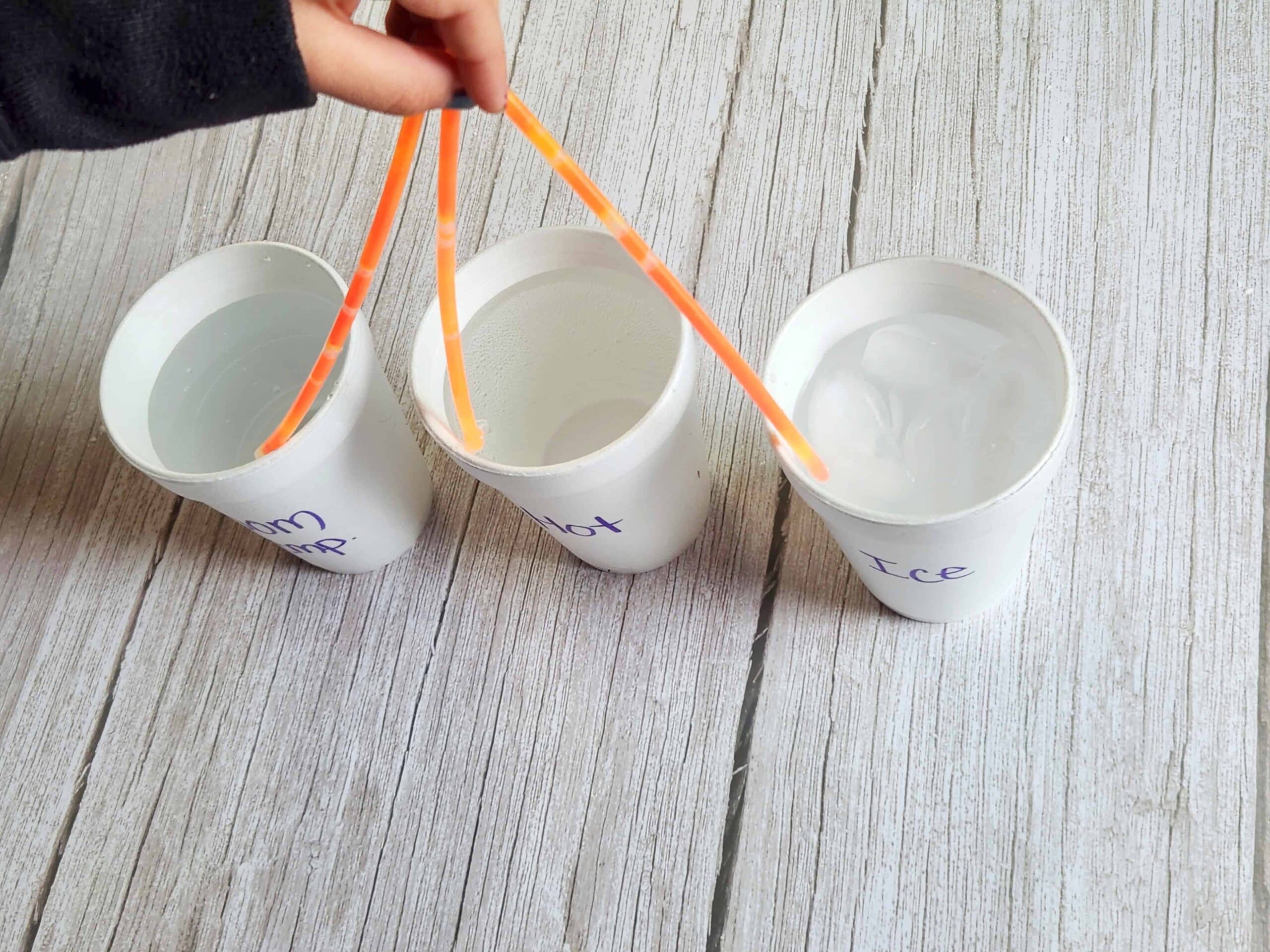
Place a glow stick in each of the three labeled cups.
Fill in the “Start Time” on the Observation Sheet.
Quickly take the temperature of each cup of water and write it on the observation sheet.
Observe the glow of each stick. What do you notice? Write your observations on the sheet.
Take your fourth glow stick and put it in the hot water for a minute or two. Then, move it to the cold water. Did you notice anything?
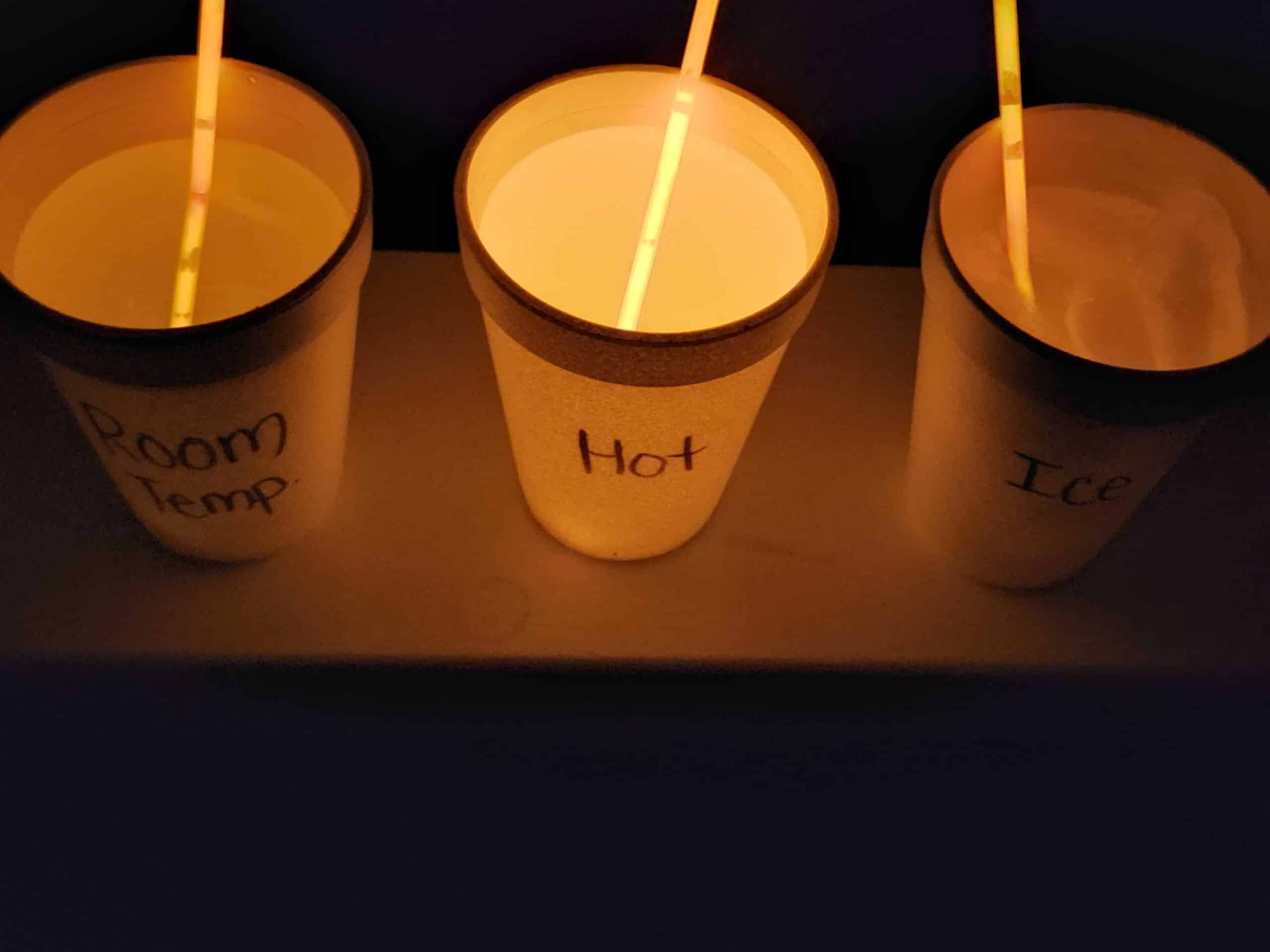
Observe the first three glow sticks; what do you notice as time passes? When do you start to see a change in brightness in any of the glow sticks? Record your observations on the Observation Sheets.
Keep watching the glow sticks and filling out the chart on the Observation Sheet. Answer the discussion questions.
Inside a glow stick are two solutions that are kept separate until you’re ready to use it. One solution contains hydrogen peroxide, while the other contains chemicals including a fluorescent dye, which helps determine the color of the glow.

When you bend and snap the glow stick, you break a small glass container inside. This allows the two solutions to mix and starts a chemical reaction. Energy from the reaction is transferred to the fluorescent dye, exciting its electrons.
As the electrons return to their normal energy state, they release energy as visible light. This production of light through a chemical reaction is called chemiluminescence.

Why Does Hot Water Make a Glow Stick Brighter?
Temperature affects the rate of the chemical reaction inside a glow stick. In warmer conditions, the reacting particles move faster and collide more often, so the reaction happens more quickly. The glow stick shines brighter, but its chemicals are also used up faster.
In cold water, the reaction slows down. The glow stick isn’t as bright, but it can glow for a longer time.
So which glow stick is “better”? Neither! The warm glow stick trades a brighter glow for a shorter reaction, while the cold glow stick trades brightness for a slower, longer-lasting reaction.
Kinetic Energy and Glow Sticks – What’s the Connection in this Glow Stick Experiment
Kinetic energy is the energy of motion. The tiny particles that make up everything around us are always moving, and temperature affects how quickly they move.
When the temperature increases, the particles have more average kinetic energy and move faster. This leads to more frequent collisions between the reacting particles inside the glow stick, so the chemical reaction happens faster. That’s why the glow stick placed in warm water glows brighter.
In cold water, the particles have less average kinetic energy and move more slowly. The chemical reaction slows down, so the glow stick isn’t as bright, but it can glow for a longer time.
When you bend and snap a glow stick, you aren’t giving it the energy it needs to glow. Instead, you’re breaking a small inner container so that two chemicals can mix and begin the light-producing chemical reaction.
Chemiluminescence & Bioluminescence in Nature
Chemiluminescence isn’t limited to glow sticks. It also occurs in nature! When a living organism produces light through a chemical reaction, it is called bioluminescence, a type of chemiluminescence.
Fireflies are a familiar example. A chemical reaction inside their bodies produces the light we see flashing on summer nights. Some jellyfish, fungi, and many organisms that live in the ocean can also produce light through bioluminescence.
Inside a firefly’s body are special chemicals that help produce light. One of these is luciferin, along with an enzyme called luciferase.
When a firefly produces light, luciferin reacts with oxygen with the help of luciferase, ATP, and other substances. During this chemical reaction, luciferin changes into a different molecule and energy is released as visible light.
Because this light is produced by a chemical reaction inside a living organism, it is called bioluminescence.

Fireflies and glow sticks both produce light through chemical reactions, but they don’t use the same chemicals or exactly the same reaction.
During the chemical reaction, energy excites electrons, causing them to move to a higher energy state. As the electrons return to their normal energy state, the extra energy is released as light. That’s the beautiful glow you see when a firefly lights up!
Fireflies use their light to communicate. Many species flash in specific patterns to signal other fireflies, especially when looking for a mate. Different species can even have their own distinctive flash patterns, almost like a light-based language.
Glow Stick Experiment – How-To and Video
Get the Glow Stick Experiment with Worksheets
Use our free printable pack to record observations and answer the discussion questions.
Need other ideas for Glow Day? Check out these glow day activities from LuckyLittleLearners.com. There are activity ideas, snack ideas, planning sheets. Plan a glow day for your class, homeschool, or co-op! Everything you need is here.
Additional Activities to Complement the Glow Stick Experiment

I hold a master’s degree in child development and early education and am working on a post-baccalaureate in biology. I spent 15 years working for a biotechnology company developing IT systems in DNA testing laboratories across the US. I taught K4 in a private school, homeschooled my children, and have taught on the mission field in southern Asia. For 4 years, I served on our state’s FIRST Lego League tournament Board and served as the Judging Director. I own thehomeschoolscientist and also write a regular science column for Homeschooling Today Magazine. You’ll also find my writings on the CTCMath blog. Through this site, I have authored over 50 math and science resources.