


Periodic Table Activities for Kids

These Periodic Table activities for kids help our students learn the basics of chemistry and understand the elements while having fun. One of our favorites are the models we made with grapes and blueberries because it was a concrete representation of a protons, neutrons, and electrons–concepts that can be hard for younger kids to understand without “seeing” them.
Mention chemistry and the Periodic Table, and most people think of a complicated science far too advanced for the non-PhD to grasp. On very advanced levels, it is. However, if the basics of Chemistry are presented in a way that allows students to apply it to their world, Chemistry becomes a much simpler, less scary study.

Chemistry isn’t relegated to a laboratory filled with test tubes and smoking beakers. Chemistry is everywhere. Everything in the universe is made of the same 118 elements found on the periodic table. Learning these elements and becoming familiar with them via some low-prep, visual Periodic Table activities for kids can make learning chemistry less daunting for them.
The Periodic Table
Think of the Periodic Table of Elements as a method to organize the 118 elements. It is set up in a grid of rows and columns. Each horizontal row contains elements that have the same number of atomic orbitals. These are called “periods”, thus the name Periodic Table.
The vertical columns are, also, organized. Each column is called a group. The elements in each group have the same number of electrons in the outer orbital, or valence electrons.
As I mentioned before, sometimes the details of chemistry can be overwhelming. It’s best to start out basic. Once you learn what the purpose of the periodic table is, you can learn the elements that fit in the table. You can actually memorize the elements of the periodic table.
Our favorite online and interactive (and online) Periodic Table of Elements
The periodic table from Ptable® is hands-down our favorite. Here are some of the features:
- Click on any element and you’ll get information such as melting point, boiling point, hardness, density, and conductivity.
- Click the temperature slider at the top of the table and corresponding elements are highlighted.
- Quickly view the solid, liquids, and gases by clicking the categories. Each group will highlight as you hover over each category.
- Hover over specific a specific metal or non-metal category and those elements belonging to that group will highlight.
Periodic Table Activities for Kids
Make Candy Models of Elements
Most of us are visual learners, so this periodic table activity is a simple way to introduce the key concepts and keep engaging and memorable. Use everyday objects, like paper plates and either grapes (if you don’t want to use candy), blueberries, M & Ms, or even pony beads (more affordable if doing this in a large group) to represent protons, neutrons, and electrons. This makes is so easy for our students to see how the atomic number determines an element’s identity and how electrons orbit the nucleus in shells.
There is a free printable included that is an introductory lesson to atoms and molecules.
Everyday Elements Scavenger Hunt
In this periodic table activity, kids see elements in real-world exploration. It can be hard to “visualize” atoms and molecules by reading about the concepts and move beyond just learning the symbols. Students are given clues and have to find the items around them that contain an element from the Periodic Table. This helps reinforce their understanding of what elements are and how they show up in everyday life.
Includes our free Everyday Elements printable.
Make a Periodic Table Model – The Inexpensive and Very Low Prep Method
Making a periodic table model can range from baking 118 cookies and decorating each one to using Lego blocks. However, there are times when you want to go hands-on, but you don’t have the time or space. Or, you may be working with a group of students at home, co-op, in a classroom, or at a community center/library.
Our Periodic Table printable cards (request them below) provide for some creativity (they get to color the cards) with learning. There are 118 cards that can be divvied up in a group, completed and colored, then placed on a wall. Have students complete the research portion of the activity…or not. We have included helpful charts, along with several versions of the Periodic Table of Elements.
Request our Periodic Table of Elements cards below and have fun!
Study the History of the Periodic Table and Enjoy a Beginner’s Lesson
If you are just starting a unit on teaching the Periodic Table and need a printable lesson to use with your kids, then check out our Beginner’s Guide to Teaching Atoms and Molecules. This lesson starts with the scientists behind the Periodic Table and moves through introducing key concepts. Pair this free lesson with the other activities – the Periodic Table of Elements cards (see below) and the modeling activity.
Read Some Entertaining and Quality Books on the Periodic Table
There are two books I highly recommend, that I still own and used in our homeschool. One is more fun and entertaining and the other is a high-quality reference book.
Both of these are linked to my Amazon, and I do collect a very small fee if someone purchases. (Which is one of the ways I can keep all of our resources free or very low cost)
The Mystery of the Periodic Table by Benjamin D. Wilker. I used this book with upper elementary through high school. It takes what would seem like (to a student) dry information and makes it accessible and fun to read. Your student will be introduced to the early scientists and the road to discovery of many of the elements.

The Elements: A Visual Exploration of Every Known Atom in the Universe
While this looks like an advanced book from the cover, the photos make this a fascinating resource for all ages. Older students and adults will enjoy the text, but the photos tell a story on their own. Younger learners will see how Hafnium is used by the clear photos. If you’re building a library of quality chemistry resources for your homeschool or classroom, I recommend this book.
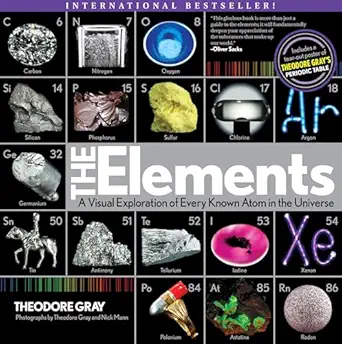
First, I used this book with all grade levels.
Studying Molecules
If you are taking your study of the Periodic Table to the point of studying molecules, we have some posts and activities you’ll want to check out:
- Our science of snow printable lesson has a hands-on molecule building activity
- Studying the properties of water is a nice follow-up too!
- This lesson on hurricanes demonstrates warm and cold molecules and how they interact.
Request the Free Periodic Table Activity Cards
Reinforcing The Periodic Table Lesson
Now that your child has learned and is beginning to be comfortable with the Periodic Table of Elements, it’s time to reinforce what they have learned and build on that. Below are some resources to help your children learn more about the Periodic Table.

To learn more about the elements themselves, check out this site that has short video lessons
