


Animal Tracks Printable with Capturing Animal Tracks Activity


Animal tracks are evidence for the presence of animals in an area. Even if the animal is elusive and sneaky, or active mostly at night, they all leave behind tracks. With our animal tracks printable, your children can enjoy a hands-on study and make an animal tracks trap and an animal track identifier!

We created this viewer off of the idea from our cloud viewer project. Also pair the animal tracks viewer with our free Nature Journal pages.
Animal tracks not only tell us which animals live in an area, but scientists use animal tracks to learn about animal populations, migration patterns, and conservation efforts.
Table of Contents
Animal Tracks: Exploring the Clues of the Wild
Have you ever wondered how we can learn about animals without actually seeing them? Well, one way is by studying their tracks! Animal tracks are like tiny clues left behind that can tell us a lot about the animals that made them. In this lesson, we will dive into the fascinating world of animal tracks and discover how we can use them to learn more about the creatures that roam our planet.
What Are Animal Tracks?
Animal tracks are marks left behind by animals when they walk, run, or even hop. Just like each of us has a unique fingerprint, animals have unique tracks that can be identified. These tracks serve as evidence that an animal has passed by a certain area. By carefully observing the tracks, we can gather information about the animal’s size, the way it moves, and even its behavior.
How Can We Identify Animal Tracks?
To identify animal tracks, we field guides, books, or resources that provide pictures and descriptions of different animal tracks. They help us match the tracks we find in the wild to the animals that made them.
You can make our animal track viewer here.
Some common features we look for when identifying tracks include:
- Size: The size of the track can give us an idea of how big the animal is. For example, a large track might indicate a bear or a deer, while a small track could belong to a squirrel or a rabbit.
- Shape: The shape of the track can reveal whether the animal has paws, hooves, or paws with claws. Hoof prints are usually round-shaped, while tracks with claws might have sharper edges.
- Pattern: The pattern of tracks can provide clues about the animal’s walking or running style. For instance, some animals walk with a waddle, while others have a direct, straight pattern.
- Number of Toes: Counting the number of toes in a track can help us narrow down the possibilities. For example, a track with three toes might belong to a bird, while a track with four toes could be from a mammal.

Coyote or bobcat (?) tracks on the banks of a stream. Photo taken at Porcupine State Park in the U.P. of Michigan.
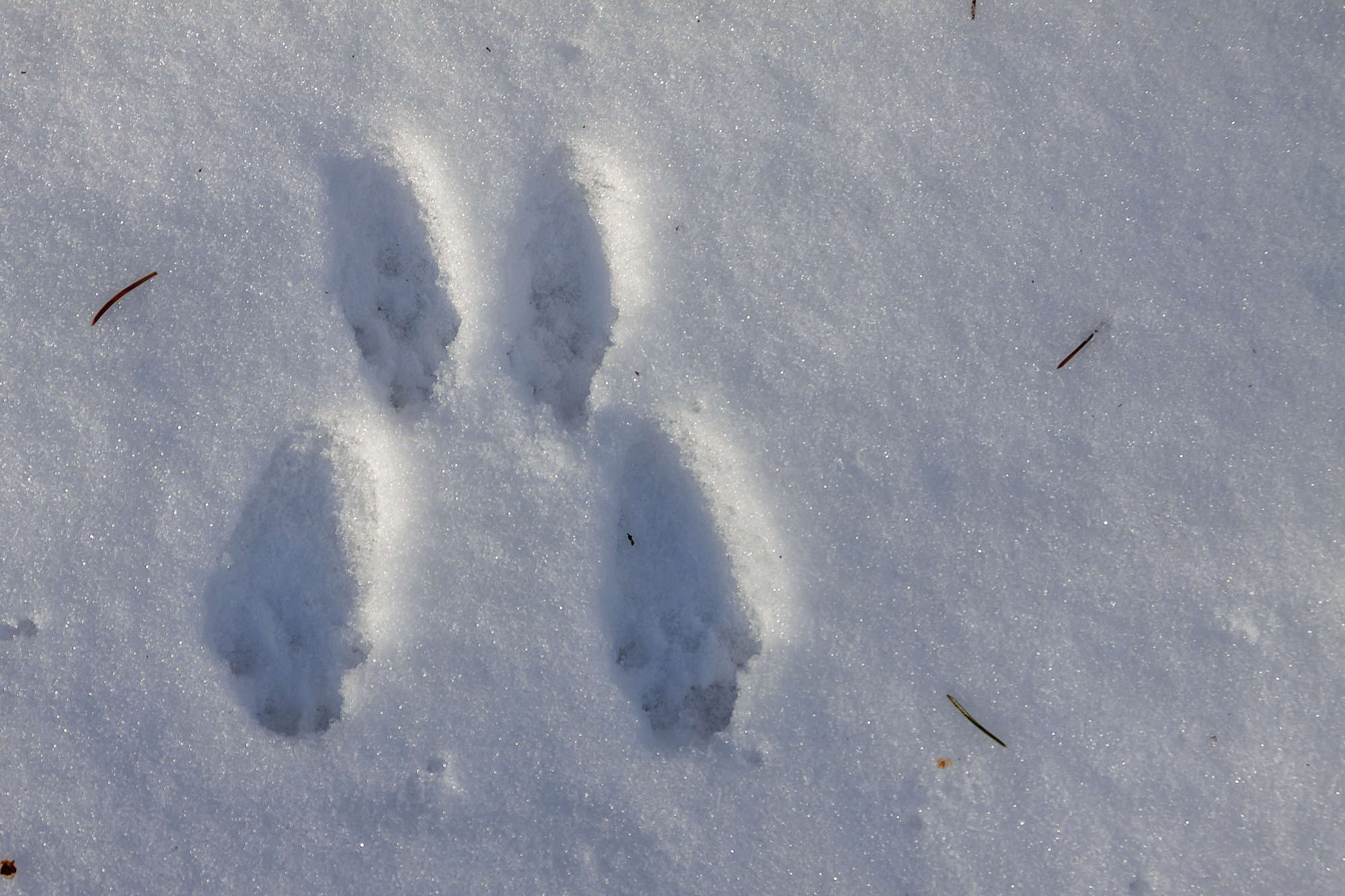
Hare tracks
- Size: The size of the track can give us an idea of how big the animal is. For example, a large track might indicate a bear or a deer, while a small track could belong to a squirrel or a rabbit.
- Shape: The shape of the track can reveal whether the animal has paws, hooves, or paws with claws. Hoof prints are usually round-shaped, while tracks with claws might have sharper edges.
- Pattern: The pattern of tracks can provide clues about the animal’s walking or running style. For instance, some animals walk with a waddle, while others have a direct, straight pattern.
- Number of Toes: Counting the number of toes in a track can help us narrow down the possibilities. For example, a track with three toes might belong to a bird, while a track with four toes could be from a mammal.
Animal Track Detective
Now that we know how to identify animal tracks, let’s put our skills to the test! It’s time to become an animal track detective. Imagine you are in the forest, and you come across a set of tracks. Use the information we’ve learned to try and identify the animal that made them. Here are the details of the tracks:
- Size: The tracks are approximately 4 inches long and 3 inches wide.
- Shape: The tracks are oval-shaped.
- Pattern: The tracks have a direct pattern, with one track in front of the other in a straight line.
- Number of Toes: There are four toes in each track.
What animal do you think made these tracks? Take a moment to think about it, and when you’re ready, let’s reveal the answer together.
The tracks you encountered in the forest belong to a fox! Foxes have oval-shaped tracks with four toes, and their tracks often have a direct pattern. Congratulations, detective!
The Stories Animal Tracks Can Tell Us
Below we have posted photos we have taken on the panhandle of Florida, at Porcupine Mountains State Park in the UP of Michigan, in Everglade City, Florida, and in North Carolina.

These images are from Everglade City, FL, on the Gulf side of Florida. These are tracks from either bobcats and/or Florida panthers. The tracks were very fresh, so we didn’t linger long in this area.

The tracks pictured here are from a bird landing and hopping through the snow. The tracks with the straight lines are the wings.
At first we thought a bird of prey had swooped down to grab a small mammal. But after watching the birds in the snow for two days, we changed our minds about what this track was telling us.
However, if you happen to find wing tracks, look carefully in the surrounding area, so you see wing tracks and small mammal tracks? Or does it look like a bird landed and hopped around?

Why Are Animal Tracks Important?
Animal tracks are not only intriguing, but they also serve important purposes in the natural world. Here are a few reasons why animal tracks are significant:
- Survival: Understanding animal tracks can help humans and other animals avoid potentially dangerous encounters. For example, by recognizing the tracks of a predator, other animals can steer clear of their territory.
- Conservation: By studying animal tracks, scientists can gather information about an animal’s habitat, its population, and even its migration patterns. This knowledge is crucial for conserving endangered species and protecting their habitats.
- Education: Animal tracks provide an opportunity for us to learn more about wildlife and the environment. By observing and identifying tracks, we become more connected to the natural world around us.
Three Engaging Animal Tracks Printables and Activities
We have created three animal tracks activities and several printables.
- First, is our Animal Tracks Viewer and Identifier. This is similar to our cloud viewer, but with animal tracks. The instructions are below. You will receive this printable and our Animal Tracks Printable identification cards in one email.
- Next, make an animal track trap in your backyard. It’s super-easy and fascinating! It’s so fun to see what creatures are out and about, active in our backyard when we’re not watching or are asleep at night. It’s truly an engaging way to study animals right from your back door. We have also put up game cameras at the same time and during heavy snow.
- The third activity includes our 3-part animal track cards.
These three activities pair well with:
- Our free Nature Journal pages here
- Our free cloud viewer printable and using clouds to predict the weather. Study how the weather affects the animal behavior in your backyard. Tracks can give us a lot of clues into the habits of animals during season weather events – extreme temps, drought, heavy snows, hurricanes, etc.
- A warm-weather nature study
- A cold-weather nature study
- Snowy weather
- A backyard animals study
- A wildlife study
- A nature hike or family trip where you’ll be camping, hiking, or visiting a natural area. (We love getting information before our trips about the wildlife preserves in the areas in which we’ll be traveling. We have found some small but interesting visitor centers at some of these, staffed by volunteers who have so much information to share about the wildlife and vegetation in the area.
So, let’s get started on these activities
Animal Tracks Printable – Make an Animal Tracks Viewer
We designed our Animal Tracks Viewer to work the same way as our cloud viewer. (Why not study clouds and tracks together!)
How to Make an Animal Tracks Viewer & Identifier:
Materials:
- The two pages of tracks from the animal track printable
- Glue
- Scissors
- Cardboard (We cut out the side of a shipping box. You can also use a cereal box, cracker box, etc.)
- 2 craft sticks. We used the wide sticks like these, or you can use regular sized craft sticks. The no-longer-a-dollar store carries them. 🙂
While you are waiting for the glue to dry on your animal track viewer, check out some of the tracking tips below and in the printable. A lot of discussion and learning happens when looking for and finding tracks. It’s an excellent way to help students slow down and observe some of the smallest things out in nature.
Directions:
Photo instructions are below the written instructions.
- Print the 2 animal tracks pages on cardstock or paper.
- Cut out the center of each.
- Trace the outline and center cut-out of one of the pages onto the cardboard and cut out the cardboard.
- Tape the two craft sticks to the bottom of the cardboard so it is sturdy when your child holds it and moves it around.
- Glue one page of tracks to one side of the cardboard (with the tracks facing out).
- Glue the other page of tracks to the other side of the cardboard (with the tracks facing out.) The craft sticks and cardboard should be between the two pages of tracks.
- Let the glue set for an hour or so.
- Take your viewer, a ruler, pencil, clipboard, and Track Trek Observation sheets with you.


Download the Animal Track Printables
Use the form below to request the free printables. Everything is included in one PDF. When you request the goodies, you will be added to our email community so you can be the first to be notified of our future free resources.
Let’s Get Tracking!
Now that you know the basics of animal tracks, it’s time to embark on your own tracking adventure. Grab a field guide, head outdoors, and see if you can find any tracks in your own neighborhood. Remember to take notes, sketch the tracks, and try to identify the animal that made them. Enjoy your journey into the exciting world of animal tracking!
Remember, each track is like a hidden message from an animal, waiting to be deciphered. Happy tracking, nature detectives!
Many of us have bird feeders in our backyard so birds will come close enough for us to see them well. We observe them through our windows, and some birds will even stick around the feeders while we are outside.
What other animals do you observe in your backyard? Right now, I see a couple rabbits and a squirrel. Here in the Midwest, those are the most common visitors to our backyards besides the birds. I happen to know that other animals visit our yard when we can’t see them. Some visit when the yard is quiet and they are very sneaky. Others visit under cover of night.
We have some free animal report forms you can easily print and have your children research an animal that is found in your area.
How can you tell what animals visit your yard? Look for evidence. Look for animal tracks!
But, wait! Our backyard is all grass. How can I find track in the grass?
We have to make a track trap!
Making A Trap For Animal Tracks
This is an easy, backyard project for all ages that uses supplies you probably already have at home. You can do this project over and over and keep a journal of your results (or use something like these nature observation printables.)
Animal Track Trap Supplies
- baking tray
- sand
- water
- garden trowel or large spoon
- 2 small plates or bowls
- fruits, veggies, nuts, bread, etc.
How to Make an Animal Tracks Trap
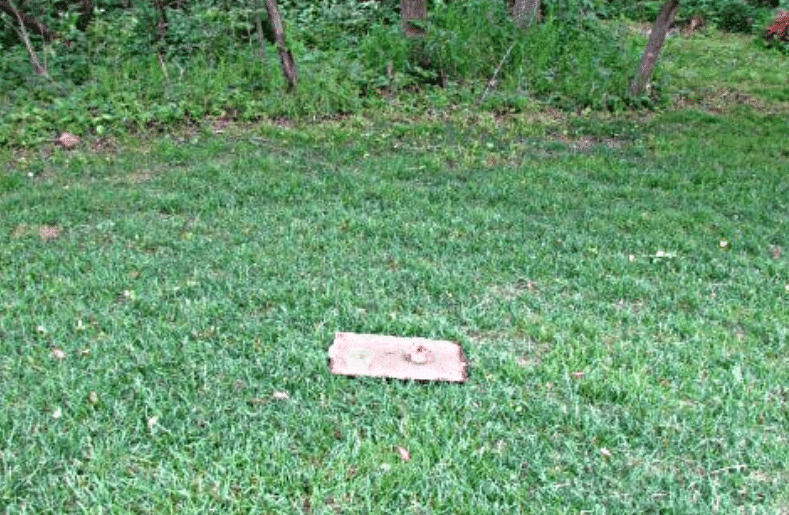
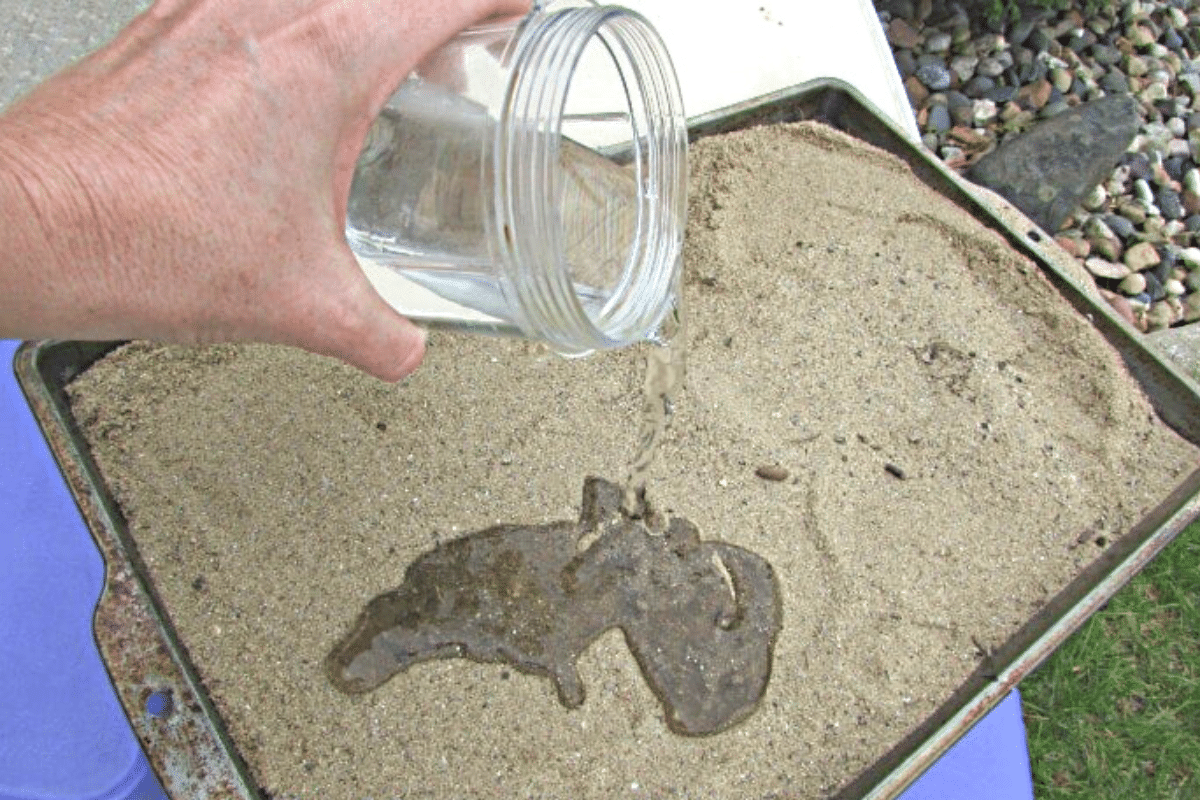
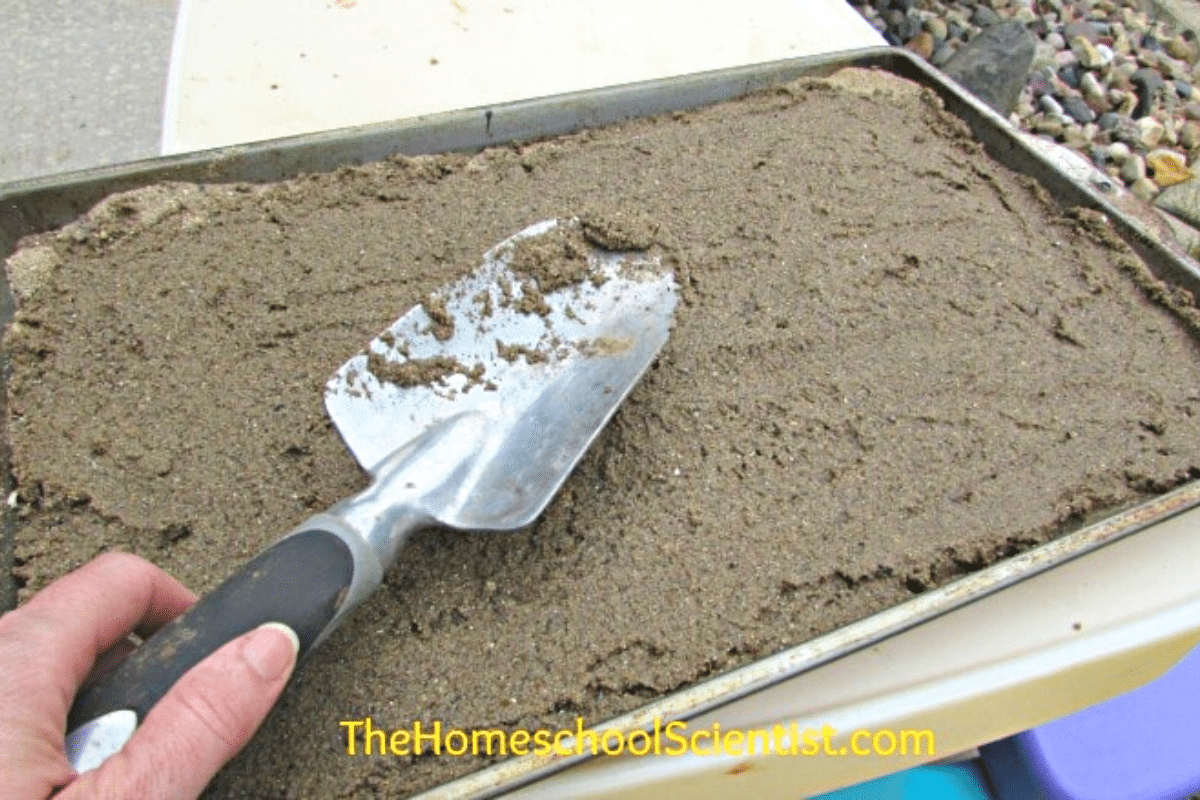
Using the garden trowel, scoop enough sand into the baking tray to cover the bottom. Add a small amount of water to dampen the sand. Smooth the sand with the garden trowel.
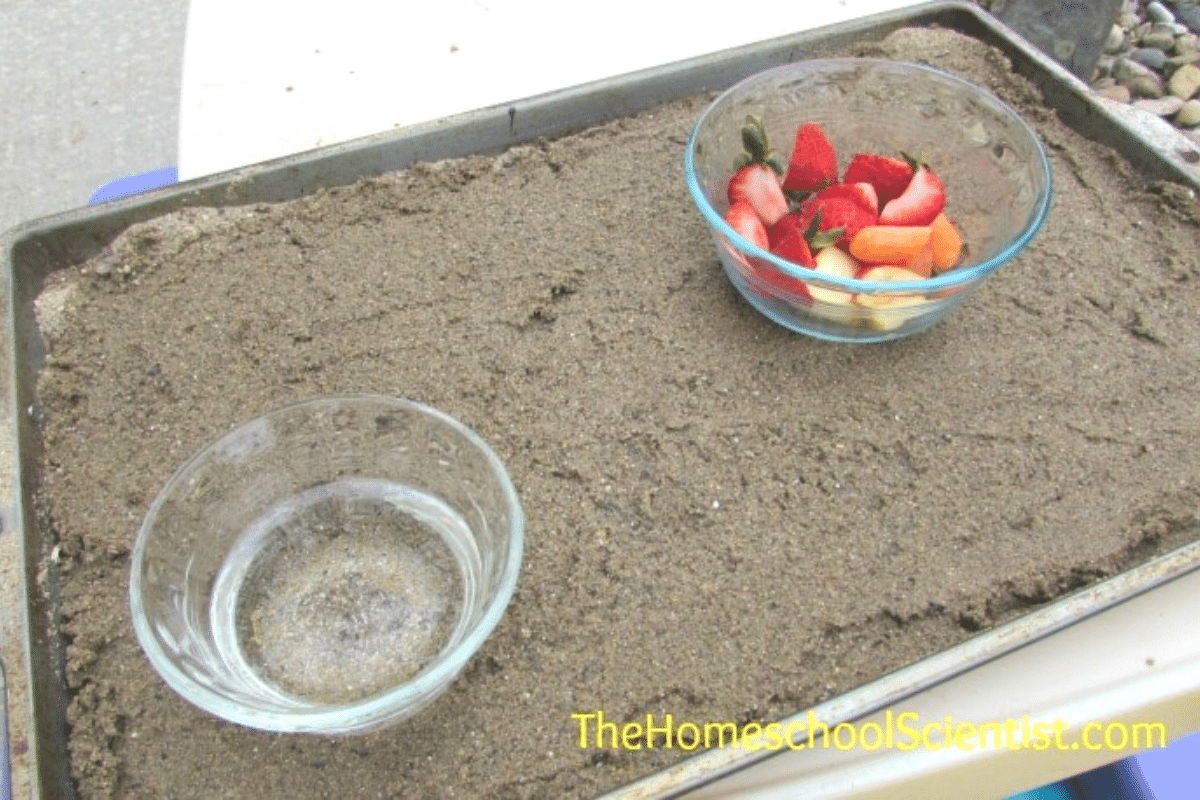
Add fruit, veggies, nuts, and bread to one plate or bowl. Add water to the other. Place the containers on the tray. This is the bait.
You have now created your animal track trap. Place the trap in a quiet spot in your yard. Leave the trap overnight. Check the trap for tracks in the morning. Sketch or take a photo of the tracks that are left by the animal visitors. Smooth the sand over the tracks and refill the containers, if necessary. Check the trap again in the afternoon and once again sketch or photograph the tracks. Sometimes animals will leave another bit of evidence in the trap – scat! Don’t be grossed out. It’s a clue!!
Use an animal track guidebook to determine who left each of the tracks (or scat). I bet you’ll be surprised! For even more fun, leave the trap our over a longer period of time checking each morning and late afternoon or evening. Vary the food left for bait and see if that makes a difference in who visits your trap.
Animal Track Guides
- Tracks, Scat, and Signs – This is a simple guide for all ages. It includes both tracks and scat of common North American wildlife.
- Folding Pocket Guide To Tracks & Signs of Familiar North American Species (Pocket Naturalist Guide Series) – I love all the guides in the Pocket Naturalist Guide Series. These are laminated, foldable and made to go outside with you!
- Peterson Field Guide To Animal Tracks – You just can’t go wrong with a Peterson Field Guide! This is going to more comprehensive that the above guides. This is the one to have for the long haul and if you plan on traveling to different parts of the country.


Other Animal Related Resources You Might Enjoy
- Great Backyard Bird Count official website
- Easy to Make Birdfeeders (We’re talking very inexpensive!)
- Our favorite birding apps
- Does your child love studying animals? Check out our printables for bats, elephants, sea turtles, red pandas, and more!

I hold a master’s degree in child development and early education and am working on a post-baccalaureate in biology. I spent 15 years working for a biotechnology company developing IT systems in DNA testing laboratories across the US. I taught K4 in a private school, homeschooled my children, and have taught on the mission field in southern Asia. For 4 years, I served on our state’s FIRST Lego League tournament Board and served as the Judging Director. I own thehomeschoolscientist and also write a regular science column for Homeschooling Today Magazine. You’ll also find my writings on the CTCMath blog. Through this site, I have authored over 50 math and science resources.