


Shrinky Dink Science Lesson with Worksheets


In this activity, we will enjoy a Shrinky Dink science lesson and cover atoms, molecules, monomers, polymers, and copolymers.
We’ll use a polymer called polystyrene to make our Shrinky Dinks. To help our kids understand the science behind Shrinky Dinks, we need to answer the question, “What is a polymer?” and explain a few chemistry terms like atoms, molecules, and monomers.
This Shrinky Dinks science lesson has been created to cover a range of grades. There are worksheets in the free printable that are appropriate for elementary students, and other activities and pages work well for grades 6-10.
NOTE: We have created a free printable Shrinky Dink science lessson that explains what a polymer is, different types of polymers, plastics, the numbers assigned to plastics, and much more. There are 5 activities, including the Shrinky Dink instructions. We also have a vocabulary list, along with vocabulary cards and activities. See the request box further down in this post.

To understand the science behind how Shrinky Dinks work, we need to talk about atoms, molecules, monomers, and polymers.
Shrinky Dink Science – Monomer and Polymer Basics
- Atoms are all around us. We cannot see atoms. Look around where you are now. What’s around you? Chairs, tables, light bulbs, pencils, windows, door handles, everything is made of atoms.
- A molecule is a tiny group of atoms that are stuck together. You may have heard someone refer to water by its chemical name, H2O. That is because a water molecule is made up of two hydrogen atoms (H2) and one oxygen atom (O). Can you find the two hydrogen atoms and one oxygen atom in the molecule model here?
- A monomer is a small molecule that can bond (or stick) to other similar molecules to form a larger molecule called a polymer. Mono- is Greek for the word one and -mer in Greek means part or segment. Monomer means single part. Monomers are the building blocks of polymers.
- A polymer is a chain made up of many small parts called monomers. Poly- in Greek means many. Remember, -mer in Greek means part of segment. So, polymer means many segments or parts.
Providing a concrete representation will help kids understand what a polymer is and how it is formed by multiple monomers. Grab a few colored paper clips and do this quick demonstration. Select several paper clips of one color and lay them out next to each other. These represent individual monomers.

Next, select multiple paper clips and connect them together by linking them. Each time you add a paper clip, you are building a polymer. Create different lengths of chains. Remember, each paper clip represents a monomer. The chain of paper clips represents a polymer.

If monomers and polymers were beaded necklaces, the single beads would represent the monomers, and the beads strung together to make the necklace would represent the polymers.

Natural and Synthetic Polymers
Polymers can naturally occur, or they can be synthetic or man-made. Synthetic things are created in factories or labs using machines and chemicals.
Natural polymers are polymers found in plants, animals, and humans. These include:
- The DNA in our bodies
- Amino acids in our bodies that help build proteins, which help build and repair tissues and support our immune system. Arginine is a type of amino acid that helps our blood vessels open up and allows blood to flow, aids in healing cuts by helping the body grow new cells and helps fight off germs that make us sick.

- Monosaccharides in our bodies. These are simple sugars that are the basic unit of carbohydrates. Glucose is a common monosaccharide that our body uses for energy.
- Casein, a protein in cow’s milk.

- Cellulose found in plants. Cellulose helps plants grow strong and tall.

Request the Free Printable Shrinky Dink Science Lesson
Request the free printable that covers monomers, polymers, copolymers, and more. This resource is designed to be used with multiple ages. Several activities are appropriate for grades 6-10. Plus, includes the Shrinky Dink instructions and explanation. You will be added to our email community and can unsubscribe at any time.
Shrinky Dink Science – What is the Polystyrene?
The science behind Shrinky Dinks lies in a special plastic called polystyrene. It is a man-made polymer material that is lightweight plastic and can easily be molded into shapes.
Some takeout containers or the tops to foil take-out containers are polystyrene. Look for the plastic #6 stamped into the plastic. Pictured below are other items that contain the polymer polystyrene.
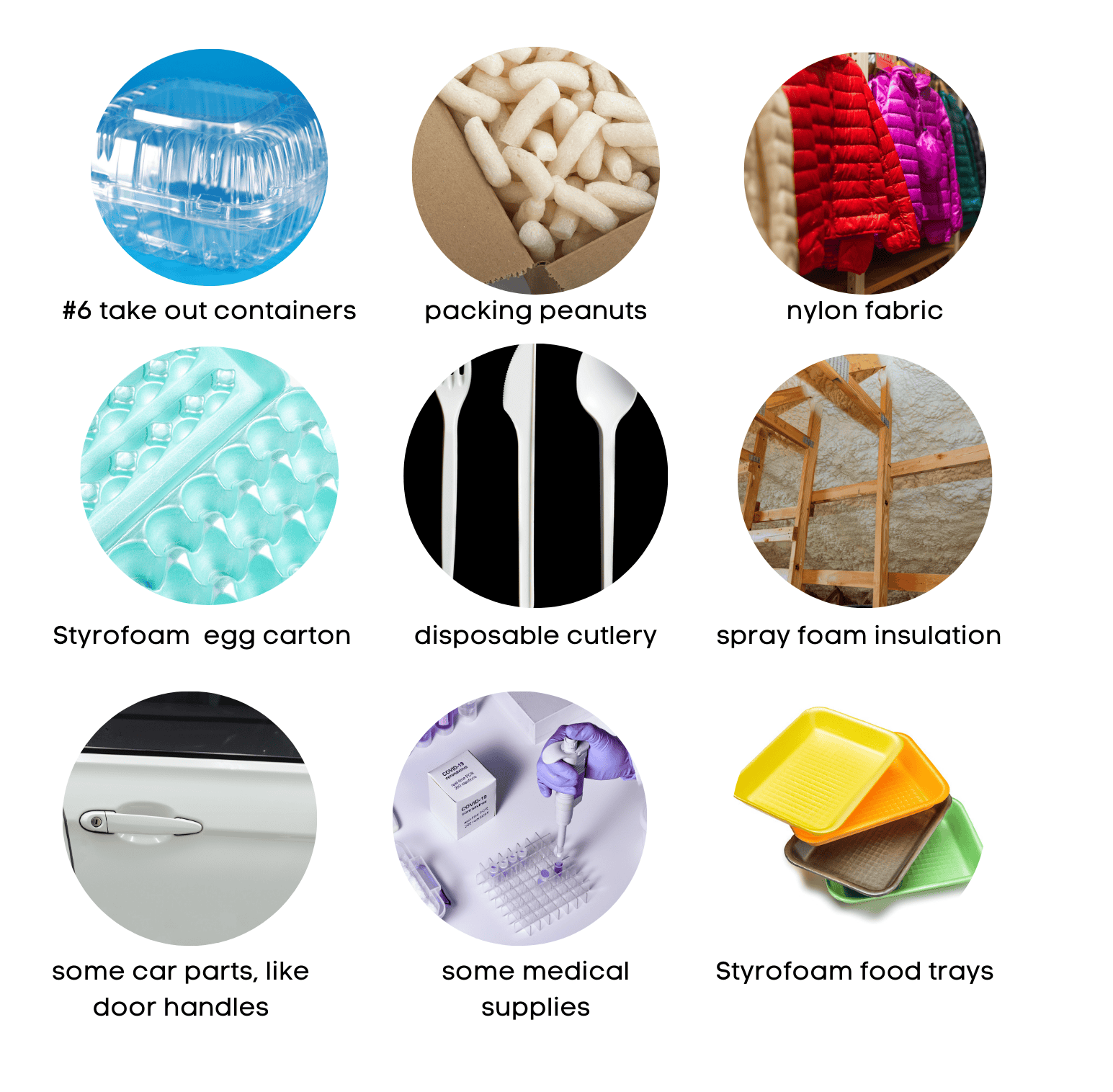
Polystyrene becomes more rigid and shrinks down when it is heated. We will talk more about that after we make Shrinky Dinks.
Polystyrene is made up of tiny building blocks called styrene, linked together in long chains. Remember, poly- means many. So, there are many styrene monomers linked together.
How these chains are arranged can change how the plastic feels—like how flexible, hard, or clear it is. Some Shrinky Dink sheets are clear, and others are more opaque (or white in color.)
Let’s see what happens to polystyrene by making some Shrinky Dink Christmas decorations.
We have included other templates that can be used year-round. You can also make your own designs!
Have fun making ornaments, keychains, or charms for a bracelet or necklace. You can even use your Shrinky Dink creation as a suncatcher!
The templates in the printout include a dog, rocket, race car, butterfly, penguin, cupcake, dolphin, octopus, sea turtle, frog, cat, Christmas ornament designs, and more!
How to Make Shrinky Dinks
Gather the following materials
- Shrinky Dink sheets like these on Amazon (aff link)
- Sharpies or colored pencils. If you purchase the opaque sheets, you can use colored pencils. Clear sheets work best with permanent marker.
- Scissors
- Hole punch
- Baking sheet
- An oven – an adult should be responsible for using the oven, watching the Shrinky Dinks while in the over, and removing them from the oven.
Shrinky Dink Directions:
Start by drawing or coloring your design on the rough side of the Shrinky Dink sheet using permanent markers or colored pencils. Colored pencils work best on the more opaque sheets.
Remember, your design will shrink down, so make it a bit bigger than you want the finished size to be.

Cut Out Your Design: Use scissors to carefully cut out your design. If you want to make charms or ornaments, use a hole punch to create a hole at the top before baking.
Prepare for Baking: Line a baking tray with parchment paper or place a baking sheet on it. This will help prevent your Shrinky Dinks from sticking.

Bake the Shrinky Dinks: Preheat your oven to 325°F (163°C). Once all is ready, place your cut-out designs on the baking tray. Make sure they are lying flat and not touching each other. Bake them for about 2-3 minutes. You will see them curl up and then flatten out again.

Watch Them Shrink: Keep an eye on your Shrinky Dinks as they bake. They will start to curl and then flatten out. When they are flat, they are done!
Cool Down: Carefully take the baking tray out of the oven (ask an adult for help if needed). Let the Shrinky Dinks cool for a few minutes. They will harden as they cool.

Once they are cool, you can use your Shrinky Dinks as keychains, jewelry, or decorations. Enjoy your unique creations!


Shrinky Dink Science – What Happened?
Chemical Change or Physical Change?
The change we see in the sheets of polystyrene is a physical change NOT a chemical change. The chemical makeup of the polystyrene remains the same, but the arrangement of the molecules has changed.
Explanation for younger students:
As the Shrinky dinks heat up in the oven, the heat gives energy to the molecules, making them move faster and faster.
The same thing happens to water molecules when we heat water in a pan. The heat makes the molecules move faster, and eventually, the water boils.
As the molecules in the Shrinky Dink sheets get more energy, they start to pull away from each other and spread out. This is why the Shrinky Dinks begin to curl and bend.
As the Polystyrene chains cool, the chains reattach in a smaller, more compact form, resulting in the shrinking effect.
Explanation for Older Students
When Shrinky Dinks are placed in the oven, the heat causes the polystyrene chains to absorb energy. This energy makes the molecules move faster and more, allowing them to move more freely. As a result, the material stays flexible and can be shaped.
As the temperature rises, the polystyrene reaches its glass transition temperature (about 220°F or 104°C). The glass transition is the temperature range where the polystyrene changes from being hard and brittle (like glass) to soft and flexible (like rubber). The polystyrene molecules move more, allowing the chains to move closer together.
As the softening occurs, the material begins to shrink. The dimensions of the Shrinky Dinks can be reduced to about one-third of their original width and height, while the thickness may increase slightly.
Once the Shrinky Dinks have fully shrunk and flattened out, they are removed from the oven and allowed to cool. As they cool, the polymer chains lose energy and settle into a more stable configuration. The new, smaller shape is “fixed” in place as the chains become less able to move.
Request the Free Printable Shrinky Dink Lesson on Polymers
Request the free printable that covers monomers, polymers, copolymers, and more. This resource is designed to be used with multiple ages. Several activities are appropriate for grades 6-10. Plus, includes the Shrinky Dink instructions and explanation. You will be added to our email community and can unsubscribe at any time.
Learn More About Polymers
Make Glue Putty from Carnegie-Mellon University
Polymer information for advanced high school students from The Essential Chemical Industry

I hold a master’s degree in child development and early education and am working on a post-baccalaureate in biology. I spent 15 years working for a biotechnology company developing IT systems in DNA testing laboratories across the US. I taught K4 in a private school, homeschooled my children, and have taught on the mission field in southern Asia. For 4 years, I served on our state’s FIRST Lego League tournament Board and served as the Judging Director. I own thehomeschoolscientist and also write a regular science column for Homeschooling Today Magazine. You’ll also find my writings on the CTCMath blog. Through this site, I have authored over 50 math and science resources.