


Walking Water Experiment with Worksheets

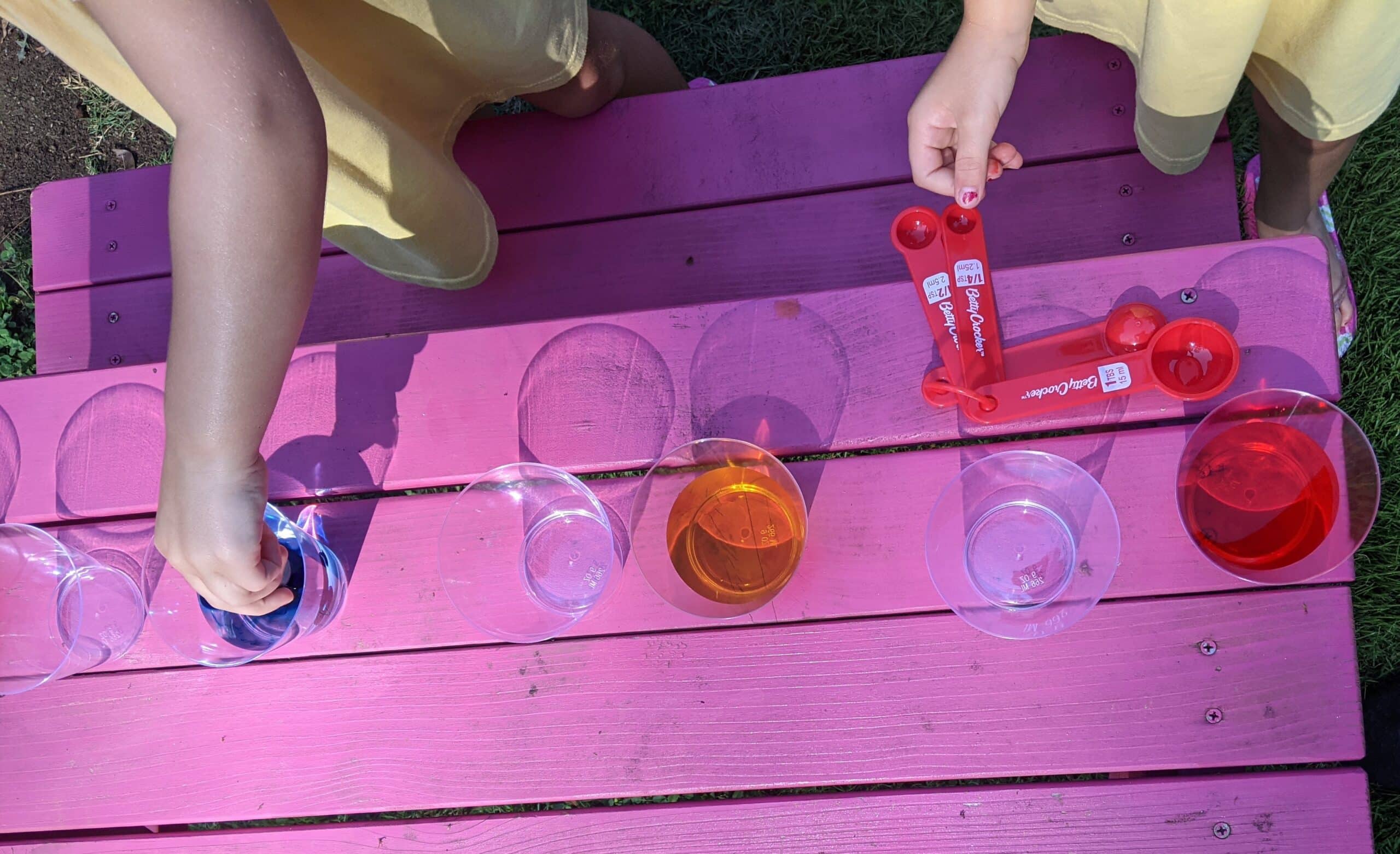
The classic walking water experiment is one of those science activities with a visual WOW! factor. Kids love to see the colorful changes that happen. We have set this experiment up with the colors in different orders, so the kids could do their own coloring mixing.
I recommend having lots of water, paper towels, and food coloring on hand and allowing extra time so your children can experiment with putting the colors in different order. This is an inexpensive activity, but one that will allow your children to try their ideas and enjoy science.
Plus, this activity is a very concrete way of showing students how plants soak up water and nutrients through capillary action. Capillary action sounds like such a difficult concept, but by setting up and observing the walking water experiment, students can get a better understanding of what’s happening when plants take in water and nutrients from the soil.
So, the walking water experiment can be used with a wide range of ages from preschool to high school.
We enjoyed the walking water experiment with our preschool twins. It was easy for them to set up, and they enjoyed watching the water “walk”. Our recording sheets in the free printable work well for this age, too. Hint: If they get food coloring on their fingers, the coloring comes off with some baking soda and vinegar. (Which is another fun experiment!) You can opt to have them wear gloves when handling the food coloring.

If you need ideas on how to add something like this walking water experiment and worksheets to your preschool curriculum or how to even design your own preschool curriculum, check out this at home preschool curriculum kit with a guide for creating your own curriculum and activity ideas from Jaimi at the Stay-at-HomeMom Survival Guide.
For even more color exploration before or after your experiment, try this simple color sorting activity for toddlers, which uses everyday objects to help young learners name, match, and categorize colors in a tactile, playful way. Pairing the two activities gives kids a chance to see colors move and blend and then practice identifying and organizing them — deepening both their observational and thinking skills in a fun, hands-on way.
For middle and high school students, I recommend pairing this with a study of the properties of water.
In our co-op, we paired the walking water experiment with this color changing experiment with carnations. Our Get Growing printable pack is another good companion to this experiment.
Walking Water Experiment and Worksheets
Here’s a video of the experiment. Also, you can request the walking water experiment worksheet pack at the end of this post. The packet includes worksheets for different age levels.

Supplies you’ll need:
- Water
- Clear plastic cups
- Paper towels – use the half-sheet papr towels and fold them lengthwise
- Food coloring
- Spoon
- Explain to your child what they will be doing. Then, ask them what they think will happen when the paper towel is put in the cups. (The colors will mix.) Then talk about the colors they think they will see? Will there be new colors?
- Optional, have them record what they think will happen in the empty cups and cups with water.
- Fill 4 of the plastic cups 2/3 full with water.
- Add one color of food coloring to each of four cups – red, yellow, green blue – and stir well. Make sure you have added enough food coloring to make dark, rich colors.
- Fold 8 paper towels lengthwise so they resemble long strips
- Place the four cups on your work surface, then place an empty cup in between each color.
- Place the paper towels into the cups as shown below.
- Wait and watch!
- Use the recording sheets in our free printable to record what happened.
- Try it again, but move the order of the cups around.
- You can also try it by using the colors in the once-empty cups. There are many different possibilities for setting up subsequent experiments. Allow extra time for your children to test their ideas. We want our children to take ownership of these types of activities or projects. It’s what gets them excited to learn!


Questions to Discuss with Your Kids
Have your child color in the cups on the worksheet to show what happened after the colors had time to “walk” and be absorbed by the paper towels.
Then, enjoy a guided discussion. Some of these questions are geared more towards older students who have studied the properties of water or have studied plants.
Here are a few questions to ask, depending on the age of your child.
- What do you observe happening to the water in the paper towels?
- How did the colors mix in the empty cups?
- Why do you think the water was able to move from cup to cup?
- If you have studied how plants use their roots to absorb water and nutrients in soil, talk about how this walking water experiment helps demonstrate this process in plants.
- If you have studied the properties of water (see this post), talk about cohesion and adhesion. Can your child explain cohesion and adhesion and how it applies here.
What’s Happening
In the Walking Water experiment, capillary action occurs when the water is drawn up the paper towel strips due to adhesion and cohesion forces. The water molecules stick to the paper towel fibers (adhesion) and to each other (cohesion), allowing the water to move against gravity and travel from cup to cup. As the water is absorbed by the paper towels, it spreads out and climbs up the fibers, creating a colorful display of capillary action in action.
If your child is old enough to grasp the concepts in this properties of water post, consider following up the walking water experiment with these six activities.
One fun follow-up if you are using this as a color mixing activity, check out the TryColor color mixing tool.
Request the Walking Water Experiment Worksheets
Use the form below to request the printable pack for this activity.

I hold a master’s degree in child development and early education and am working on a post-baccalaureate in biology. I spent 15 years working for a biotechnology company developing IT systems in DNA testing laboratories across the US. I taught K4 in a private school, homeschooled my children, and have taught on the mission field in southern Asia. For 4 years, I served on our state’s FIRST Lego League tournament Board and served as the Judging Director. I own thehomeschoolscientist and also write a regular science column for Homeschooling Today Magazine. You’ll also find my writings on the CTCMath blog. Through this site, I have authored over 50 math and science resources.