


How to Make Candy Cane Slime (Floam)


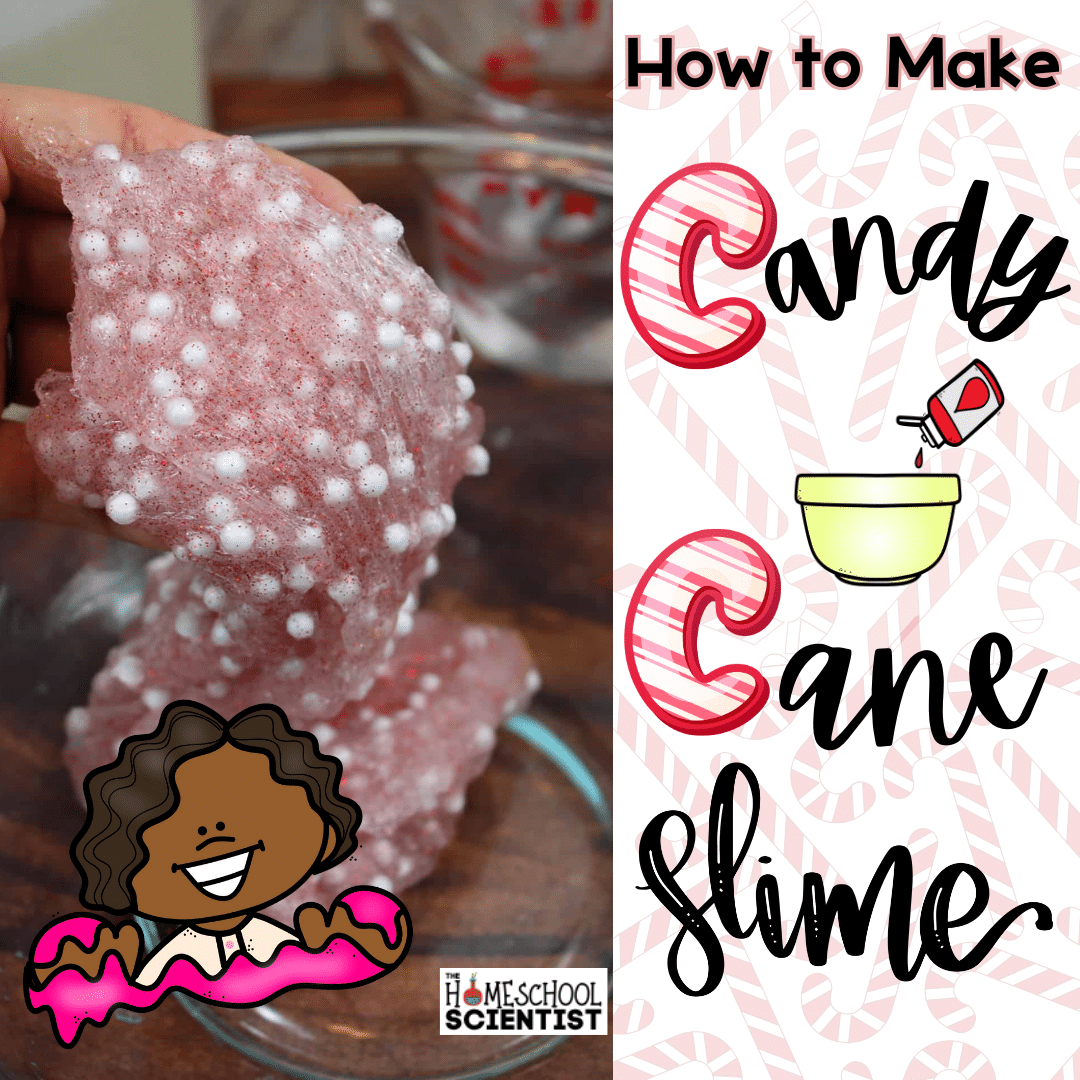
Looking for a holiday-themed science activity that’s as fun as it is educational? Candy cane slime is the perfect hands-on project! This slime recipe combines chemistry with creativity, resulting in a stretchy, squishy material filled with tiny foam balls that mimic the texture of floam. Also note, we don’t use actual candy canes in this recipe. 🙂
Learning how to make our candy cane slime is another fun way to help our kids understand monomers, polymers, and chemical reactions. We also have a Shrinky Dinks activity that covers information about monomers, polymers, and copolymers. We have created a printable that I highly recommend you print and use with this activity. It covers some definitions and concepts that apply here. There is also an activity about other polymers we use every day in our homes and how some polymers are recycled. The activities in the polymer printable would be a fun way to add to this candy cane slime activity.
Plus, this floam is a fun sensory activity for your kids! Hot Cocoa Play Dough is more sensory bliss for your children! There’s even a gluten-free version of the recipe. Fill some cozy winter afternoons with the scent of hot cocoa and play dough fun!
If you want to add some chemistry to this activity, definitely check out our Dissolving candy canes activity and printable.
Candy Cane Slime Recipe and Instructions
Here are the ingredients and steps for making candy cane slime or floam. The foam balls added to this slime recipe give it the floam name. Whatever you call it, this is a fun way to teach our children about polymers and chemical reactions.
Candy Cane Slime Ingredients and Equipment:
- 1 cup of warm water
- ½ teaspoon of borax
- Clear school glue
- Red glitter for a festive touch
- ⅛–¼ cup of foam balls
- A bowl, fork, and tablespoon measuring spoon
- Gather all the supplies needed.
- Add borax to warm water and stir until it is dissolved.
- Pour clear glue into a bowl. Add foam balls and glitter. Stir with the fork.
- Add 1 tablespoon of water/borax mixture to the glue. Stir to incorporate.
- Add 1 tablespoon of water/borax water and stir until slime is formed.


The Chemistry Behind Candy Cane Slime (Floam)
Here is some background information that you can also find on our Shrinky Dink post. (Request the polymer printable on the that post so you can do the build-a-polymer activity too. It’s quick and only requires some beads and string or paper clips.)
- Atoms are all around us. We cannot see atoms. Look around where you are now. What’s around you? Chairs, tables, light bulbs, pencils, windows, door handles, everything is made of atoms.
- A molecule is a tiny group of atoms that are stuck together. You may have heard someone refer to water by its chemical name, H2O. That is because a water molecule is made up of two hydrogen atoms (H2) and one oxygen atom (O). Can you find the two hydrogen atoms and one oxygen atom in the molecule model here?
- A monomer is a small molecule that can bond (or stick) to other similar molecules to form a larger molecule called a polymer. Mono- is Greek for the word one and -mer in Greek means part or segment. Monomer means single part. Monomers are the building blocks of polymers.
- A polymer is a chain made up of many small parts called monomers. Poly- in Greek means many. Remember, -mer in Greek means part of segment. So, polymer means many segments or parts.
The specific polymer in the glue is called polyvinyl acetate, or PVA for short.
PVA contains polymers with long, stringy molecules that can slide past each other. When you mix the glue with water, the polymers spread out and become a thick liquid.
The borax molecules connect the different polymer chains together, forming bridges between them. This thickens the mixture and gives it its slime-like consistency. This action of linking the polymer chains is called cross-linking.
More detailed information: When the borax is dissolved in water, this process creates a solution where the borax breaks into ions, forming borate ions in the water. These ions are essential for the chemical reaction that turns glue into slime. Borax acts as a “cross-linker,” meaning it connects long chains of molecules called polymers, which are found in the glue, creating a flexible but solid structure of polymers.
Cross-linked materials in real life
Cross-linking is used to create different materials, including rubber and plastics, to make them stronger and more durable.
Here are some ways cross-linked materials are used in things we use in our daily lives:
- In tires to make them more durable, heat resistance, and elastic
- In rubber bands to give them more strength and flexibility, allowing the rubber bands to stretch without breaking
- In mattresses and pillows. Memory foam is cross-linked to create a material that conforms to body shape while returning to its original form.
- In stain-resistant fabrics used on couches, chairs, and carpets
- In athletic wear like shorts, shirts, leggings. The fabric made with cross-linked materials is more flexible, easy to move in, and keeps its shape better.
- To protect metal and wood outdoor furniture. These cross-linked coatings help keep moisture (like rain, snow, and dew) and UV rays from fading and wearing out the furniture materials.


Learn more about monomers and polymers on our Shrinky Dink post here.
The American Chemical Society has a PDF lesson on polymers geared for older students. It’s a great resource! It does open a PDF.
Try some other chemistry activities with a holiday theme:
- Dissolving candy canes
- Making borax crystal snowflakes
- Christmas Chemistry activities
- 110+ chemistry activities, listed by grade level

I hold a master’s degree in child development and early education and am working on a post-baccalaureate in biology. I spent 15 years working for a biotechnology company developing IT systems in DNA testing laboratories across the US. I taught K4 in a private school, homeschooled my children, and have taught on the mission field in southern Asia. For 4 years, I served on our state’s FIRST Lego League tournament Board and served as the Judging Director. I own thehomeschoolscientist and also write a regular science column for Homeschooling Today Magazine. You’ll also find my writings on the CTCMath blog. Through this site, I have authored over 50 math and science resources.