


Famous Scientists for Kids: Meet 12 Curious Thinkers Who Asked Questions


When teaching STEM classes and camps, I love relating our topic to famous scientists for kids. We’ll look at contemporary or past scientists, in addition to current events.
This helps our children get to know the people behind scientific development, research, and discoveries, and see that they are normal people. One of the battles we face as educators (whether parents, teachers, or community leaders) is that as our children get older, they are more likely to say they are “not a science person” or “not a math person.”
Getting to know curious thinkers, scientists, mathematicians, and inventors gives our kids a chance to explore how these scientists or mathematicians think, ask questions, pursue interests, and handle challenges they worked through. Their stories can spark conversations and send us looking for answers to our own questions. That’s why I’m excited to share the Curiosity Case Files with you!
Some of my favorites are the YWAM Heroes of History books and their Christian Heroes: Then & Now missionary biographies. I especially enjoyed the stories of George Washington Carver, Milton Hershey, and Clara Barton. And I wish I had listened to several of those missionary biographies before my first mission trip! You can read my review off the YWAM Heroes of History here.
Another series we have on our bookshelf is the World of series by Masterbooks.
I do have many biographies listed on my Amazon storefront here. (aff link)
Biographies often leave our children wanting to learn more. How did someone come up with that idea? What made them keep trying? What would I have done in the same situation?
This is why I’m excited we have this resource to share with you. I wanted children to meet people whose questions led them to investigate, observe, invent, and solve problems, then have an opportunity to follow their own questions.
What Do These Curious Thinkers Have in Common?
The 12 people in this collection had different interests and backgrounds. Some studied plants or animals. Others worked with mathematics, medicine, electricity, or machines. Some earned advanced science degrees, while others pursued their interests without a science degree.
When teaching STEM classes and camps, the one thing I do emphasize is asking questions, testing ideas, and just being curious. That is what STEM careers are about. When I worked in DNA labs and did IT development and programming, we had to try and test ideas, troubleshoot when an idea didn’t work, and have the confidence to step back into the situation and keep brainstorming and testing. That takes confidence and a willingness to step outside the norm, follow through, and find solutions when an idea didn’t quite work as intended in the situation.
These 12 curious scientists didn’t follow a single path, but they share a vivid imagination, creative thinking, confidence, and determination.
Our children need to realize they don’t need to “be a math person” or “a science person” to do STEM or even pursue a STEM career. They need other qualities, like confidence, to try ideas and voice them.
Meet the 12 Famous Scientists in the Curiosity Case Files
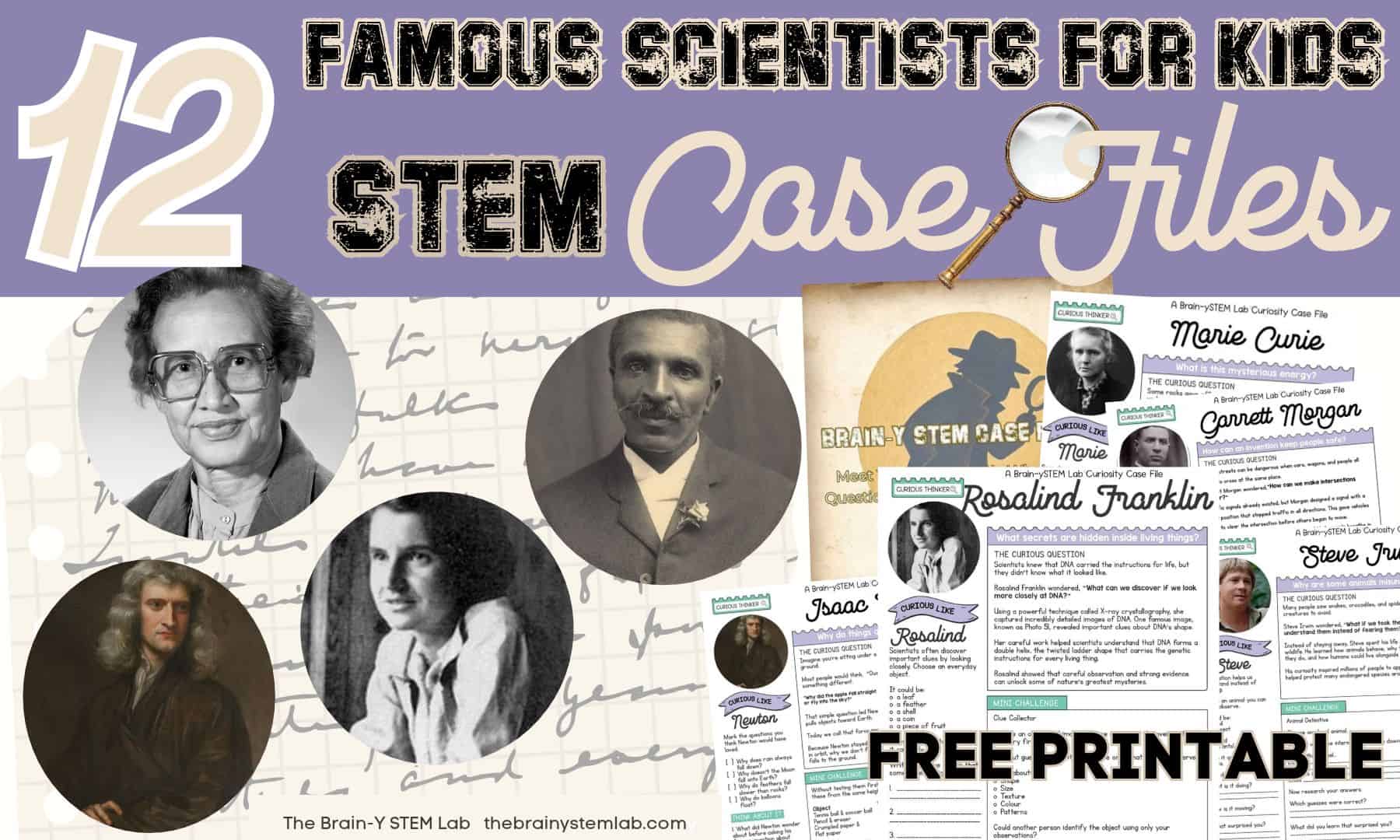
This collection introduces famous scientists for kids alongside mathematicians, inventors, and other STEM thinkers. Below this list are links to hands-on STEM activities that align with the work of each famous scientist.
- Leonardo da Vinci
- Isaac Newton
- George Washington Carver
- Marie Curie
- Garrett Morgan
- Hedy Lamarr
- Katherine Johnson
- Rosalind Franklin
- Jane Goodall
- Temple Grandin
- Mae Jemison
- Steve Irwin
Pair the Famous Scientists for Kids with Hands-On STEM Projects
Here is the list of people included in the resource and activities we have to go with each:
Here are some hands-on STEM activities to go with some of the biographies in this resource and listed on our Amazon storefront:
- Isaac Newton:
- George Washington Carver:
- Peanut life cycle
- Nature Journal (George Washington Carver spent a lot of time in his childhood observing nature.)
- Marie Curie:
- Garret Morgan
- Katherine Johnson
- Rosalind Franklin
- Jane Goodall, Temple Grandin, Steve Irwin
What’s Inside Each Curiosity Case File?
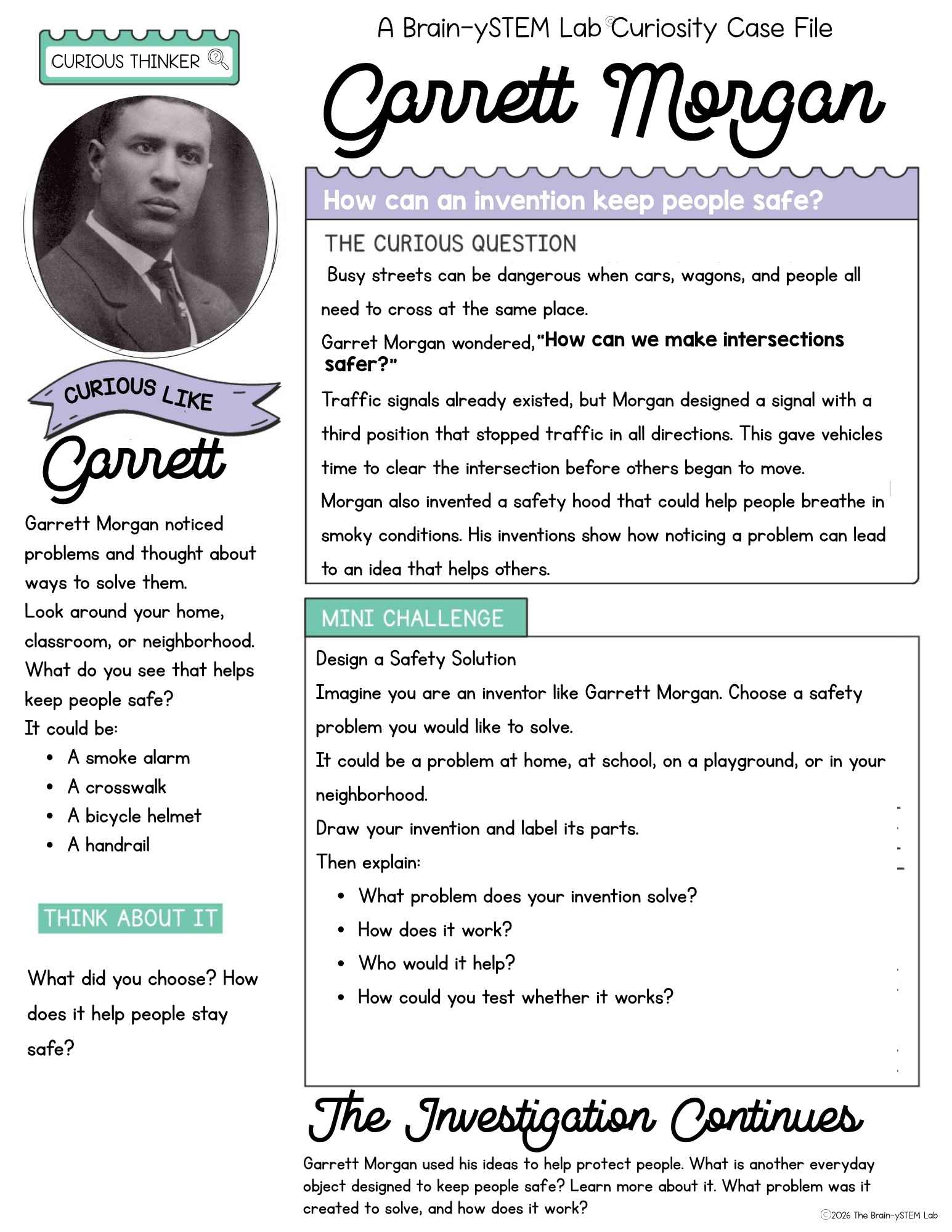
Each case file introduces a curious thinker and gives your children a chance to try their own questioning, observing, and problem-solving. Here’s what you’ll find:
The Curious Question: This is a short introduction to the person and lists the bigger question they were asking. These questions are inspired by their interests and discoveries; the questions aren’t direct quotations.
Curious Like…: This is where your child thinks about how the person approached their work and other questions that they have.
Each case file introduces a curious thinker and gives your children a chance to try their own questioning, observing, and problem-solving. Here’s what you’ll find:
The Curious Question: This is a short introduction to the person and lists the bigger question they were asking. These questions are inspired by their interests and discoveries; the questions aren’t direct quotations.
Curious Like…: This is where your child thinks about how the person approached their work and other questions that they have.
Think About It: The purpose behind this section is to help you and your children start a conversation about this person’s work and findings.
The Mini Challenge: This section is designed to help children put their ideas to work, whether by writing, drawing, or building. You may then want to use one of our STEM activities we have linked below.
The Investigation Continues: This section is a prompt to help students take the ideas further. The purpose is to get them diving deeper.
Remember, our goal is to help our children gain confidence in their ability to do science, technology, engineering, and math!
How to Use the Curiosity Case Files
There are several ways to fit these into your studies. You could explore one person each week, choose someone who connects with your current science or history topic, or let your children pick the person they want to learn about first.
Start by reading the introduction together and see what catches their interest. Some children will want to talk through every question. Others may prefer to draw or write. Younger children can tell you their ideas while you jot them down.
Keep a few books, paper, and drawing supplies handy. You might find yourselves looking for a biography at the library, trying a simple experiment, or heading outside to watch the insects in your yard.
And you don’t need to finish a whole page in one sitting. If one question gets your children talking and investigating, give them time to follow it!
What Skills Will Children Practice?
As children learn about these famous scientists and STEM thinkers, they’ll practice skills they can use in many areas of learning:
Observation: Slowing down, looking closely, and noticing details.
Questioning: Asking questions like, “Why did that happen?” “What if we try try or change this part?
Research: Looking for answers in books and other resources.
Critical thinking: Comparing ideas and considering what the evidence tells them.
Problem-solving: Noticing a problem and thinking of ways to solve it.
Communication: Sharing what they discover through conversation, writing, or drawing. Speaking in this way helps them build confidence to speak in from of groups.
They’ll also practice sticking with a question when the answer isn’t immediately clear. Sometimes they’ll discover something they didn’t expect, and sometimes they’ll end up with more questions. Both give them a reason to keep learning.
Download the Famous Scientists Printable

I hold a master’s degree in child development and early education and am working on a post-baccalaureate in biology. I spent 15 years working for a biotechnology company developing IT systems in DNA testing laboratories across the US. I taught K4 in a private school, homeschooled my children, and have taught on the mission field in southern Asia. For 4 years, I served on our state’s FIRST Lego League tournament Board and served as the Judging Director. I own thehomeschoolscientist and also write a regular science column for Homeschooling Today Magazine. You’ll also find my writings on the CTCMath blog. Through this site, I have authored over 50 math and science resources.